
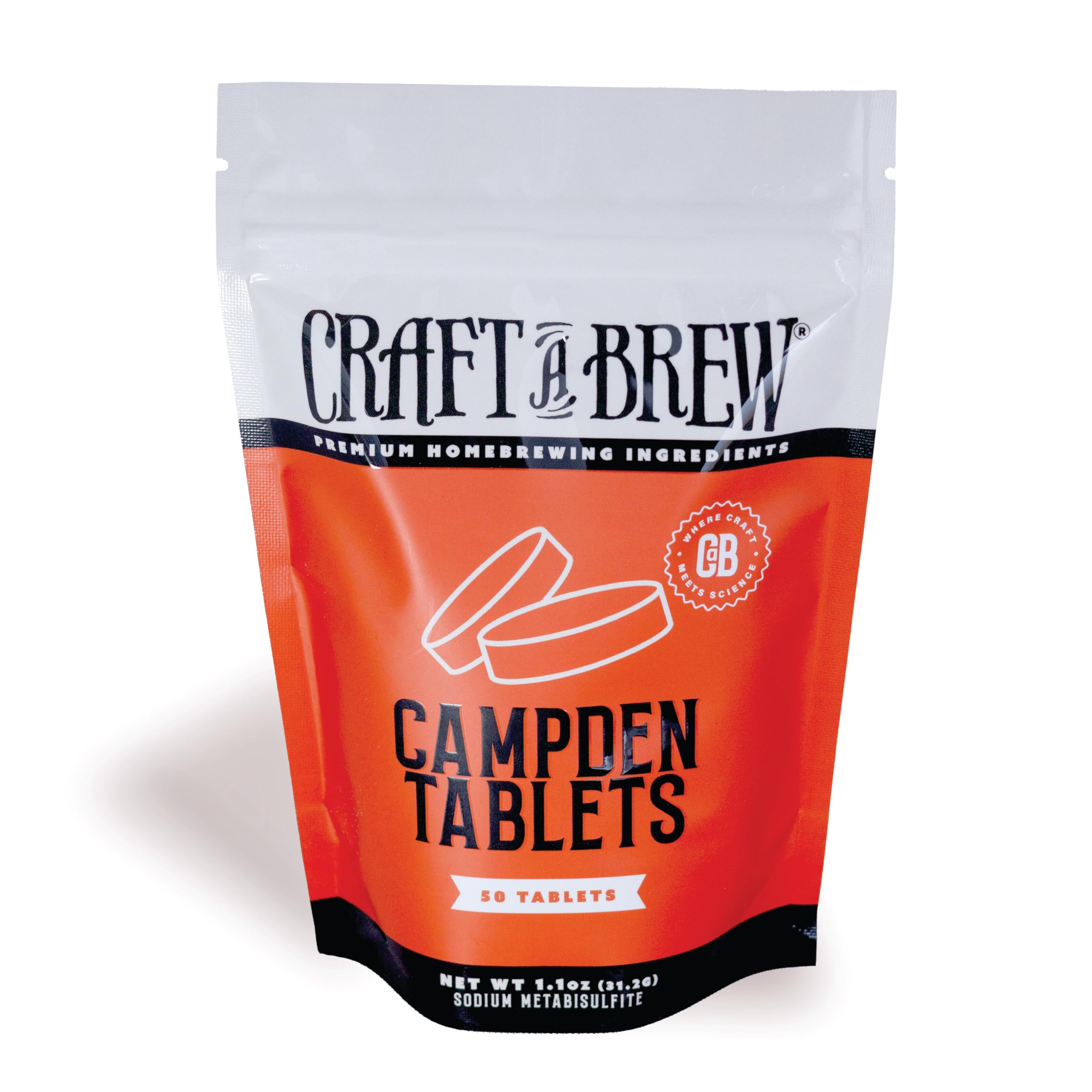
When you start making wine or cider at home, the list of consumables grows quickly. Beyond the obvious ingredients like juice, yeast, and sugar, there are the less glamorous but essential additives. Campden tablets fall squarely into that category. They are one of those products that don’t get much attention until you realize your batch tastes a bit off or, worse, has started to turn. Craft A Brew’s version of these tablets—sodium metabisulfite in 50-count packaging—is a straightforward option for anyone looking to stabilize or sanitize without a lot of fuss.
In practice, these tablets are used in two main ways. The first is as a sterilant for equipment. Crush a tablet, dissolve it in water, and you have a sulfur-based solution that can wipe down fermenters, bottles, and tools. The second, and arguably more common use, is in the wine or cider itself. A single tablet per gallon is the typical dosage for stopping fermentation or protecting a finished batch from oxidation and microbial spoilage. That’s the kind of specificity that makes this product useful—it removes the guesswork of measuring out a powder by weight.
The tablets themselves are small and white, with a faint sulfur smell that’s hard to miss once you open the bottle. That odor is a good reminder that you’re dealing with a chemical, not a flavoring. The instructions on the label are decent, but they assume a basic level of familiarity with winemaking. If you’re brand new, you’ll likely need to look up the exact timing for when to add these relative to other additives like potassium sorbate. That’s not a knock on Craft A Brew specifically—it’s just the nature of this product category.
One thing I appreciated is the packaging. The tablets come in a small, resealable bottle that fits easily in a pantry or fridge. The 50-count size is practical for someone making a few batches a year, though if you’re doing larger volumes or continuous production, you’ll probably go through this faster than expected. The tablets also have a decent shelf life if stored properly, but they do degrade over time if exposed to air and moisture. So, while the bottle is convenient, don’t expect to keep it forever.
Compared to using a liquid sulfite solution or a powdered metabisulfite, the tablets offer a clear trade-off. They’re more convenient and safer to handle—no dusty powder to accidentally inhale—but they’re less flexible. With powder, you can measure out exactly the amount you need for a specific volume. With tablets, you’re locked into the pre-measured dose, which can be a bit awkward if you’re making a 3-gallon batch and the standard dose is one tablet per gallon. You end up crushing partial tablets, which is doable but adds a step. For most home winemakers, this is a minor annoyance rather than a dealbreaker.
Another limitation is that these tablets are not a substitute for proper cleaning. They’re a sanitizer, not a detergent. If you have visible residue or buildup on your equipment, you’ll need to wash it first. Also, the sulfur dioxide they release can be a concern for people with sulfite sensitivities. That’s worth keeping in mind if you’re making wine for friends or family who might be affected. The product itself is fine, but it’s not something you want to use carelessly.
In terms of performance, these tablets work as intended. They dissolve reasonably well in warm water, though crushing them first helps speed things along. I’ve used them in a few batches of apple cider and a standard grape wine kit. In both cases, the fermentation stopped when I wanted it to, and the finished products didn’t have any noticeable sulfur off-flavors—provided I followed the recommended dosage. That last part is key. Overdosing can lead to a rubbery or burnt-match aroma, which is hard to fix once it’s in the wine. So, measure carefully.
Who is this for? Honestly, it’s a good fit for beginners who want a simple, reliable way to stabilize their first few batches. It’s also fine for more experienced makers who prefer the convenience of tablets over powders. On the flip side, if you’re making wine on a larger scale or you’re particularly sensitive to sulfites, you might want to look into alternatives like potassium metabisulfite powder or even a no-sulfite approach, though the latter carries more risk of spoilage.
There are other brands out there, and most of them are functionally similar—sodium metabisulfite is sodium metabisulfite, after all. What you’re paying for with Craft A Brew is the packaging and the brand reliability. The tablets are consistent in size and potency, which is more than I can say for some generic options I’ve tried. But don’t expect any magic. This is a workhorse product, not a showpiece.
At the end of the day, Campden tablets are one of those things that you don’t think about until you need them. And when you do, you’ll be glad you have a bottle on hand. Craft A Brew’s version does the job without any unnecessary frills. Just remember to store them properly, dose carefully, and treat them with the respect any chemical deserves.