
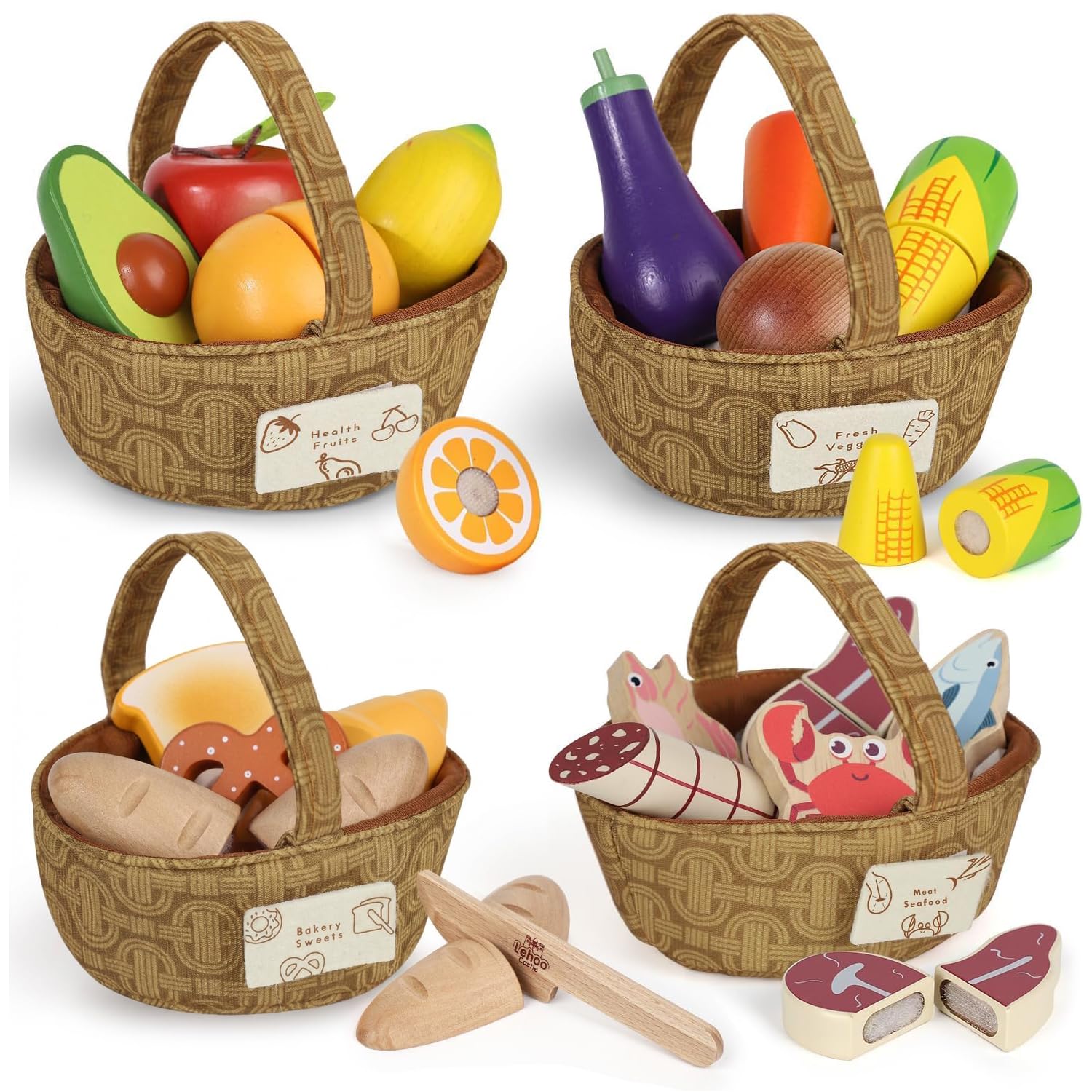
The Lehoo Castle Wooden Play Food Set is one of those play kitchen accessories that looks straightforward in photos but raises a few practical questions once you start thinking about how a toddler will actually use it. It is aimed at the two-to-four age range and is built around the familiar pretend-cooking routine: cutting, serving, and arranging food on a plate. Whether it earns a place in the toy rotation depends less on the novelty of the pieces and more on how the construction holds up and how the set fits alongside whatever play kitchen a family already owns.
Most households use a set like this in a fairly predictable way. A child stands at a play kitchen, takes pieces out of a drawer or basket, pretends to chop vegetables, and serves them to a parent or a stuffed animal. The appeal is partly tactile: wooden pieces have a different weight and feel than molded plastic, and the cutting action, where a wooden knife passes through a split piece held together by Velcro, tends to hold attention longer than simply stacking plates. Parents often report that the food pieces get used more than the pots and pans, because they are easy to grab, carry around, and incorporate into other games.
Functionally, the set covers the basics well. The pieces are painted wood, and the cut-apart items use hook-and-loop fastening so a child can slice through and reattach them repeatedly. That reattachment is the part that matters most over time, since the fastening is what makes the cutting feel real rather than symbolic. The paint is generally described as water-based and the edges are rounded, which is the minimum expected for a toy aimed at children who still put things in their mouths. The pieces are sized for small hands, though some of the smaller items warrant a closer look depending on the age of the child.
The main trade-off is the fastening itself. Velcro-style tabs on wooden play food are a wear item; with heavy daily use they collect lint, lose grip, and eventually need replacing or the cut pieces stop holding together. That is not unique to this set, but it is the failure point to expect. A second consideration is piece count versus storage: more pieces means more to lose under the sofa, and sets like this rarely include a container, so a small basket or bin is worth budgeting for. Paint chipping at the cut edges is also a realistic possibility after months of vigorous play, particularly where the knife contacts the wood.
Compared with molded plastic play food, the wooden approach trades lightness and low cost for weight, durability, and a more natural feel. Plastic sets often include more pieces for the same money and survive drops without visible damage, but they can feel flimsy and the cutting mechanism is usually less satisfying. Compared with fabric or felt food, wood is easier to wipe clean and holds its shape, though felt is quieter and softer if a child is prone to throwing. Families with a plastic play kitchen will find the wood visually mismatched but functionally compatible; the pieces do not need to match the kitchen’s material to be used with it.
Suitability is fairly clear. This set fits well for families who already have a play kitchen or a dedicated pretend-play corner and want durable, open-ended food pieces that encourage slicing and serving. It suits children in the two-to-four range who are developing pretend-play routines and fine motor control. It is less suitable for households that want a complete play kitchen setup in one purchase, since this is an accessory rather than a standalone toy, and for families who prefer plastic because of cost or because they have hard floors and worry about dropped wooden pieces. Children under two should be supervised closely given the small components, and anyone expecting the cutting pieces to stay firmly attached indefinitely should temper that expectation.
The realistic verdict is that this is a solid, ordinary wooden food set that does what it claims without standing out dramatically from similar sets. Its value comes from consistent use rather than from any single feature. Buyers should expect the fastening to degrade with heavy play and plan for storage, but for the core job of giving a toddler something satisfying to chop and serve, it is a reasonable addition to an existing play kitchen.