
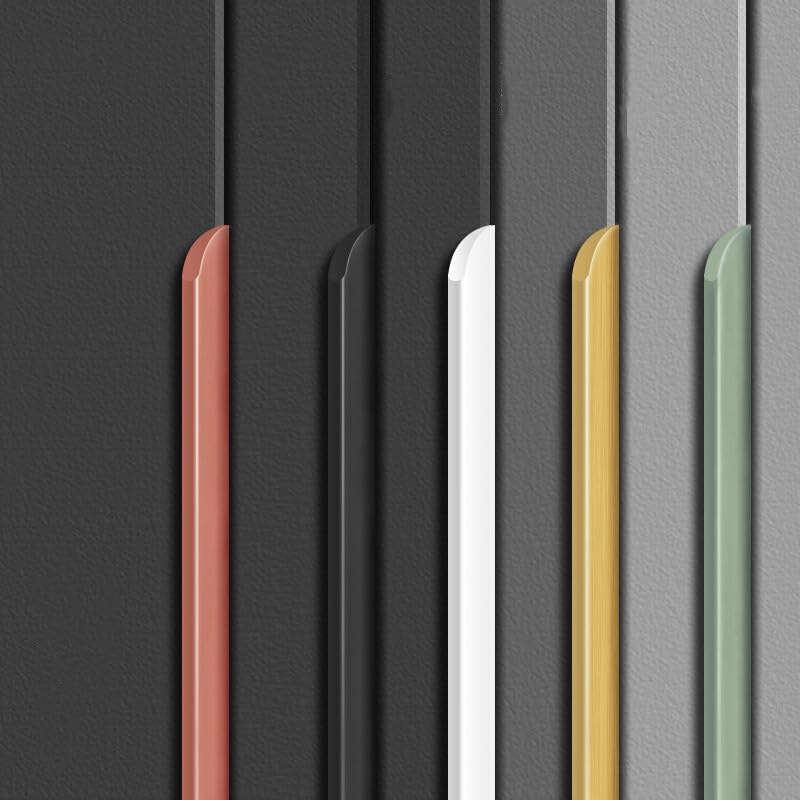
Finger pulls occupy a strange spot in cabinet hardware. They are not decorative handles in the traditional sense, and they are not quite push-to-open latches either. The Shozafia 4-pack of 47.24-inch (1200mm) concealed edge tab pulls sits firmly in that middle ground: long, slim profiles that mount along the top or bottom edge of a door or drawer front, letting you hook a finger underneath rather than grab a protruding knob. This is hardware that disappears into the cabinetry rather than announcing itself, and that design intent shapes almost everything about how it performs.
The most obvious thing to understand before buying is the scale. At 1200mm, each pull is just under four feet long. That is not a drawer pull in the conventional sense; it is closer to a continuous edge rail intended for wide cabinet doors, integrated appliance panels, or long drawer banks. A four-pack therefore covers a substantial amount of cabinetry, which is why the format tends to appeal to anyone doing a full kitchen or wardrobe run rather than someone replacing a single handle.
In practice, these are installed along the hinge-side edge or the top edge of a door, depending on how the cabinet is built. The finger recesses into the gap between door and frame, and the pull provides a smooth, finished surface where your hand meets the cabinet. On a flush or handleless kitchen, this is the detail that makes the whole system feel intentional rather than unfinished. The concealed profile also means there is nothing to snag clothing or catch a hip as you move through a tight galley layout, which is a genuine practical advantage over bar pulls and knobs in narrow spaces.
Functionally, the design is straightforward. The pull is a slim aluminum profile, and the four-pack ships with mounting hardware intended for face-frame or frameless cabinets. The black finish is a matte or satin type rather than a glossy lacquer, which tends to hold up better against fingerprints in a kitchen environment. Because the profile is low and continuous, it distributes the pulling force along the edge of the door rather than concentrating it at two screw points, which is a meaningful difference on wide or heavy doors where a single central knob can cause the panel to flex.
That said, the trade-offs are real and worth weighing. The first is installation tolerance. A 1200mm profile leaves very little room for error; if your cabinet edges are not straight, or if the door gap varies along its length, the pull will make that inconsistency visible rather than hide it. Long linear hardware is unforgiving in a way that a small knob is not. The second is ergonomics. Finger pulls require you to reach into a recess, and for anyone with limited hand strength, arthritis, or long fingernails, this motion can be awkward compared with grasping a conventional handle. It is a design that prioritizes clean sightlines over accessibility.
It is also worth comparing these to the alternatives. Standard bar pulls and knobs are cheaper per unit, easier to retrofit, and far more forgiving of imperfect cabinet construction. Push-to-open latches eliminate the pull entirely but introduce their own issues with door alignment and accidental opening. Integrated routed finger pulls, common in higher-end handleless kitchens, look the most seamless but require the door itself to be machined, which is not something most people can do after the fact. The Shozafia pulls sit between these options: less invasive than routing, cleaner than a bar pull, but dependent on careful measuring and a cabinet that is already reasonably square.
Who is this for? Primarily anyone pursuing a handleless or minimalist look on a budget, especially on wide doors and drawer fronts where a continuous edge pull reads as a deliberate design choice. It suits DIY installers who are comfortable measuring precisely and drilling accurately, and it works well in modern kitchens, wardrobes, and media units where visual clutter is the enemy. It is less suitable for renters or anyone who needs reversible changes, since installation means drilling into the cabinet face. It is also a poor fit for households where accessibility matters, for cabinets with significant door-gap variation, or for anyone who wants the tactile feedback of a substantial handle in hand.
Expectations should stay grounded. This is functional, affordable hardware, not a precision-machined luxury component. The finish is consistent enough for the price, the profiles are straight, and the four-pack represents reasonable value for the coverage it provides. What it will not do is compensate for a poorly built cabinet or an imprecise installation. Measured carefully and mounted on sound cabinetry, it does its job quietly and looks the way it is supposed to look. Mounted hastily on a door with a wandering gap, it will show every flaw. The hardware is only as good as the surface it goes onto.