
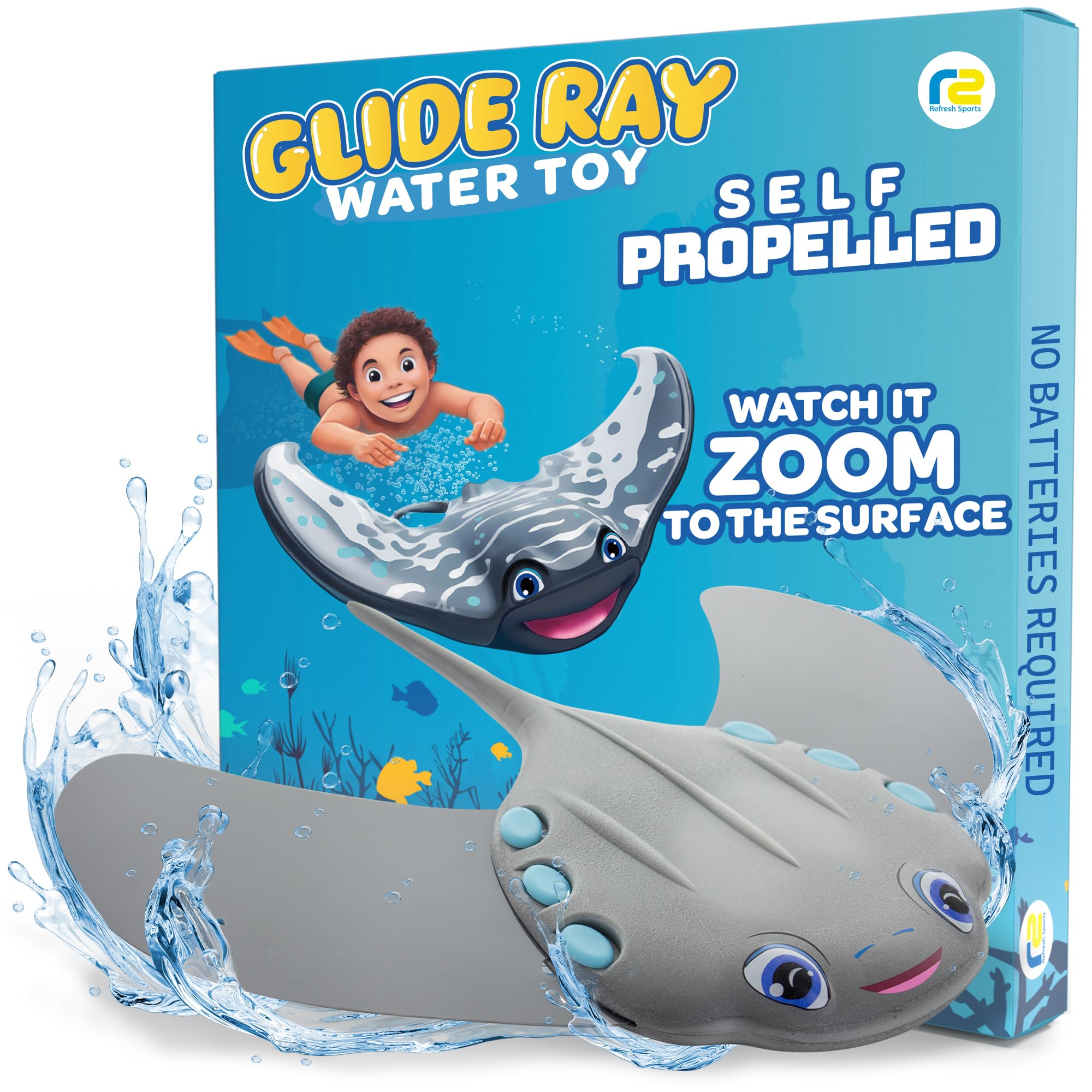
Pool toys tend to fall into two camps: the cheap inflatables that last a week and the gimmicky gadgets that promise more than they deliver. The Stingray Pool Torpedo sits somewhere in between, a self-propelled underwater glider aimed at kids roughly five to ten years old. It is a simple idea — a torpedo-shaped body that a child launches through the water — and whether it earns a place in the pool bag depends on what you expect from it.
The basic play pattern is straightforward. A kid grips the toy, winds up, and throws it forward under the surface. The stingray shape and weighted nose let it track in a relatively straight line rather than tumbling, and the glide carries it a few body lengths before it slows. Younger swimmers treat it as a chase object, diving after it and racing siblings to grab it first. Older kids tend to turn it into a target game, tossing it toward a floating ring or trying to land it in a specific spot. It works for solo play too, since the toy can be launched and retrieved repeatedly without needing a second person.
What separates it from a plain diving stick is the self-propelled feel. The torpedo design gives the throw some momentum, so even a modest toss produces a satisfying underwater run. That matters for kids who are still building confidence in the water, because they get a payoff without needing a strong arm. The construction is molded plastic rather than inflatable vinyl, which is the right call for something that gets thrown and stepped on. It does not require inflation, batteries, or assembly, and it survives the usual pool-deck abuse better than soft toys do.
Performance expectations should stay realistic. This is not a motorized toy and it does not steer itself; the glide is entirely a function of how it is thrown. A hard, flat throw gets the longest run, while a weak or angled toss produces a short, wobbly path. In shallow water the toy tends to hit the bottom quickly, which limits the glide but makes retrieval easy for small kids. In deeper water it performs better, though a child who cannot yet swim down a few feet will need an adult to fetch it. Chlorine and salt water have not shown obvious wear in the molded body, but the paint or finish on some units can scuff with heavy use on rough concrete.
The main trade-off is versatility. A torpedo does one thing well — it glides and it is chased — but it does not float, so it sinks to the bottom when it stops. That is fine for confident swimmers and frustrating for kids who are not yet comfortable putting their faces underwater. Compared with a set of diving rings or sticks, the torpedo offers more satisfying motion but less variety; rings can be stacked, sorted, and used for games, while the torpedo is essentially a single-activity object. Compared with an inflatable ride-on or a floating basketball hoop, it takes up almost no space and travels easily, which makes it a better fit for families who pack light or visit public pools.
Durability is a mixed picture. The body is solid and the nose holds up to repeated impacts, but the fin or tail section is the weak point on some versions, and a hard throw onto the pool deck can crack thinner plastic. It is not a toy that rewards carelessness, and a bit of supervision around the concrete edge is sensible. Sizing is also worth noting: the torpedo is small enough for a five-year-old to handle but heavy enough that a very young child may not throw it far. Parents of kids at the lower end of the age range should expect shorter glides and more adult assistance.
Who is it for? Families with kids around six to ten who already swim and enjoy dive-and-retrieve games will get steady use out of it, especially in a backyard pool where the same toy gets picked up dozens of times in an afternoon. It is also a reasonable travel toy because it is compact and needs no setup. Who is it not for? Families with toddlers or non-swimmers, kids who prefer floating toys they can lounge on, and anyone expecting a battery-powered or self-steering device. It is a manual throw toy, and its appeal depends on a child who likes active underwater play.
Overall, the Stingray Pool Torpedo is a modest, functional addition to a pool toy collection rather than a standout. It does its one job reliably, holds up reasonably well, and encourages the kind of repeated diving that builds water confidence. The lack of flotation and the single-purpose design keep it from being a must-have, but for the right kid in the right pool, it earns its spot in the bag.