
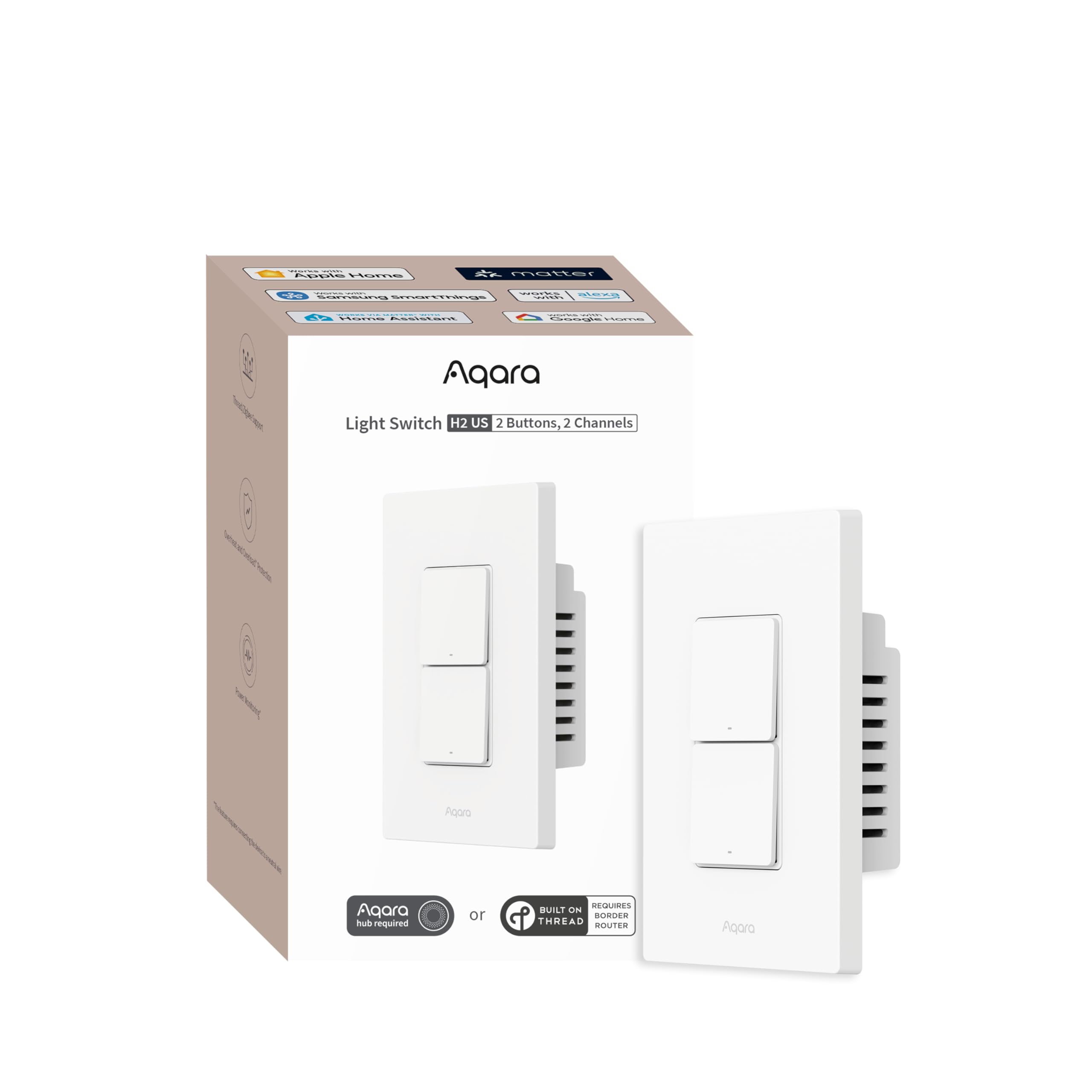
The Aqara Smart Light Switch H2 is aimed at people who want to make their existing wall lighting smart without replacing fixtures or adding smart bulbs to every socket. It is a two-button, two-channel switch designed to fit into a standard wall box, and the version reviewed here is the neutral-wire model. That detail matters more than almost anything else in this review, because it determines whether the switch will work in a given home at all.
In practice, the H2 is used in place of a conventional wall switch, usually in a hallway, bedroom, or living room where two separate lighting circuits need independent control. Each button maps to its own channel, so one switch can handle, for example, a ceiling light and a set of wall sconces. Once connected to an Aqara hub, the switch can be controlled from a phone, included in schedules and automations, and used as a trigger for other devices. It also supports manual operation, which is important: guests and family members who never open the app still need a physical button that behaves predictably.
The functional feature set is fairly standard for this category. The H2 offers two channels, two buttons, and a neutral-wire connection, which is what allows it to power its radio without drawing a trickle through the load. That design generally produces more stable behavior with LED and low-wattage bulbs than no-neutral switches, which sometimes flicker or fail to fully turn off. Aqara’s ecosystem support is the other major selling point: the switch can participate in routines alongside sensors, curtains, and other Aqara devices, and it works with the major smart-home platforms through the hub rather than on its own.
Installation is where expectations need to be managed. This is not a plug-in module or a battery-powered remote; it requires opening the wall box, identifying the neutral line, and wiring the switch in line with mains voltage. Homes built or rewired in regions where switch boxes lack a neutral conductor will not be able to use this model, and that is a large share of older housing stock in many countries. Even where a neutral is present, the box needs enough depth to accommodate the switch body and its wiring. For anyone unsure about their wiring, the honest advice is to budget for an electrician rather than treat this as a weekend DIY project.
Performance in daily use is generally undramatic, which is the right outcome for a light switch. Physical presses register reliably, and the two-button layout is easy to learn. Remote control depends on the hub and the local network, so response times are typically fast on a good connection but can lag when the hub is busy or the network is weak. Automations that depend on the cloud will be slower and less reliable than those running locally on the hub, and that distinction is worth understanding before building routines around the switch. As with most smart switches, the device is only as dependable as the hub and network behind it.
There are real trade-offs. The neutral-wire requirement is the biggest one, and it limits the addressable market considerably. The switch is also tied to the Aqara ecosystem through a hub, so buyers who want a standalone Wi-Fi switch with no bridge will find this an awkward fit. The two-button, two-channel format is useful but inflexible: there is no dimming, and the button count is fixed. Compared with smart bulbs, the H2 keeps conventional switch behavior and controls the whole circuit, but it loses the color and dimming flexibility that bulbs offer. Compared with no-neutral smart switches, it is generally more stable with modern LED loads, at the cost of excluding homes without a neutral line. Compared with a simple relay module hidden behind an existing switch, it offers a cleaner finished look and dedicated buttons but requires replacing the switch faceplate entirely.
The H2 suits homeowners with neutral wiring who already use or plan to use an Aqara hub and want wall-level control that stays usable for everyone in the house. It also fits well in renovations where wiring is being updated and the extra effort of running a neutral is already part of the job. It is a poor match for renters, for older homes without neutrals, for anyone hoping to avoid a hub, and for users who want dimming or color control from the wall. Buyers should also confirm regional compatibility and the specific wiring standard in their country before ordering, since switch formats and box dimensions vary.
Overall, the Aqara Smart Light Switch H2 is a competent, purpose-built device that does one job well when the wiring cooperates. Its strengths are stability, ecosystem integration, and a familiar physical interface. Its weaknesses are the neutral-wire dependency, the hub requirement, and the lack of dimming. It is less a product for everyone and more a product for the right installation, and that is the fairest way to judge it.