
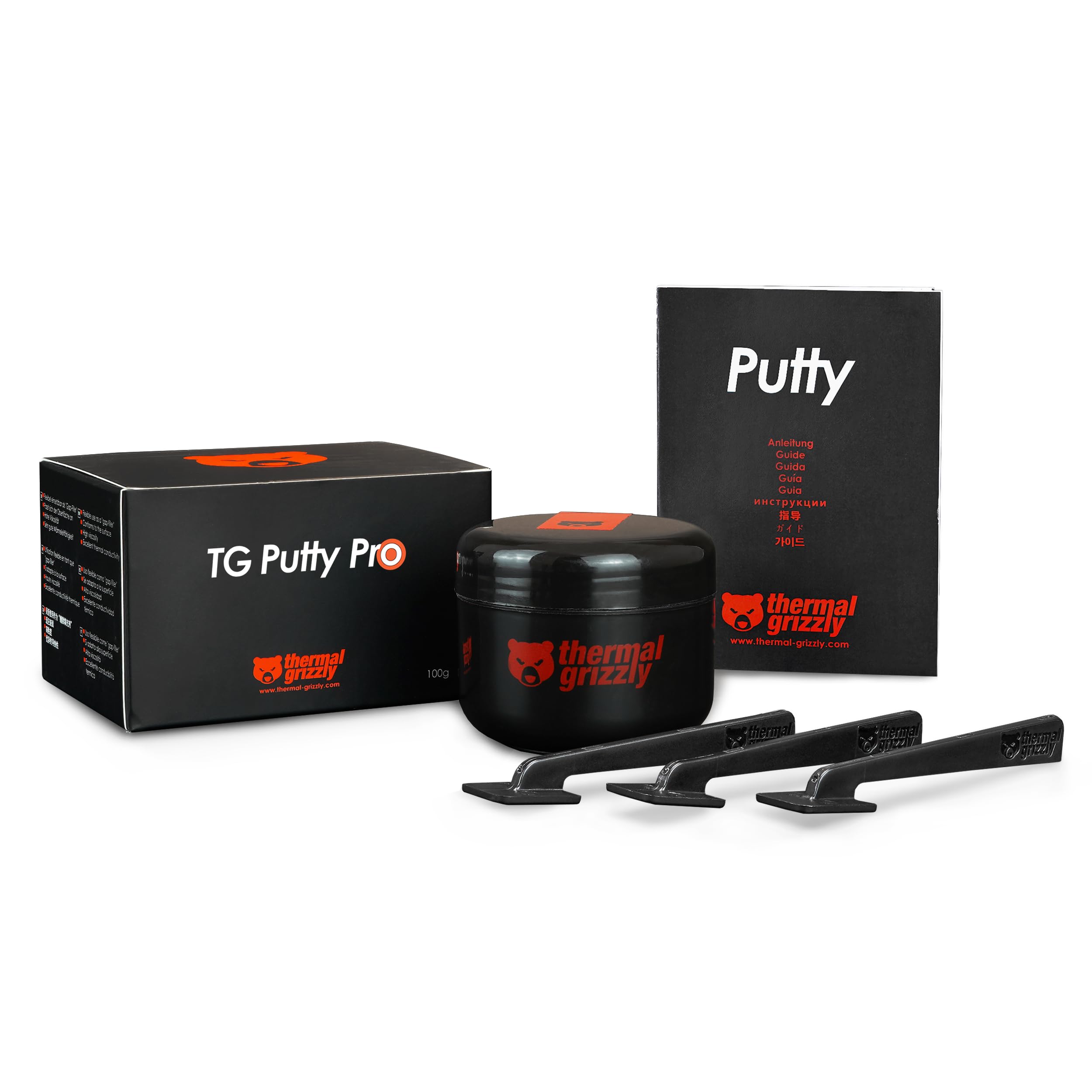
Thermal putty occupies an odd middle ground in the thermal interface materials market. It is not a paste, and it is not a pad, though it often gets used in places where one of those two would traditionally go. Thermal Grizzly’s Thermal Putty Pro, sold here in a 100-gram tub, is aimed squarely at the people who have figured out that neither paste nor pads quite solve their problem: VRAM chips on a graphics card, power delivery components on a PCB, cramped laptop heatsink assemblies, and the PlayStation 5, whose liquid metal and memory cooling setup has become a recurring topic in repair circles.
The case for putty is straightforward once you have dealt with a card that uses thermal pads of several different thicknesses. Putty is applied as a dollop or a spread and compresses to fill whatever gap exists between a component and the heatsink. It conforms to uneven surfaces, tolerates slightly inconsistent mounting pressure, and does not require you to order a specific thickness. For VRAM and VRM cooling in particular, that flexibility is the appeal. The 100-gram tub is a generous amount for this kind of work; a single GPU typically consumes a small fraction of it, so the container is really aimed at people doing multiple builds or repeated repairs.
In practice, Thermal Putty Pro behaves like a thick, slightly tacky clay. It can be rolled into small balls, pressed into place with a plastic spreader or gloved finger, or applied in a thin layer across a row of memory chips. It does not cure, which means it stays compliant over time and can be reworked if you need to remove a heatsink again. That non-curing behavior is a genuine advantage over pads, which tend to tear or deform after a disassembly, and over paste, which can pump out under thermal cycling in wide-gap applications. Thermal Grizzly rates the material for a broad operating temperature range and describes it as electrically insulating, which matters when you are pressing it against exposed PCB traces and small surface-mount components.
Performance expectations deserve some grounding. Putty is generally not going to match a well-applied paste in a very thin bond line on a bare CPU die, and it is not intended to. Its thermal conductivity figures look competitive on paper, but the real-world result depends heavily on how much you apply and how much it compresses. Use too little and you leave gaps; use too much and you add unnecessary thermal resistance and make a mess. The practical approach is to apply slightly more than you think you need and let mounting pressure do the rest. On VRAM, users typically see memory temperatures drop relative to worn or mismatched stock pads, but the improvement is not dramatic in every case, and results vary by card and by how bad the original interface was.
There are trade-offs worth naming. Putty is messier than pads. It sticks to gloves, tools, and fingers, and a heavy application can squeeze out around the edges of a heatsink, requiring cleanup. Removing it later takes patience, especially from the fine gaps around memory packages. It is also more expensive per application than a set of generic pads, though the 100-gram tub offsets that somewhat if you are doing several jobs. And unlike a pre-cut pad, there is a small learning curve: getting consistent thickness across a row of chips takes a little practice, and uneven application can lead to uneven contact pressure.
Compared with conventional thermal pads, putty wins on conformity and reworkability but loses on convenience and cleanliness. Compared with standard thermal paste, it handles larger gaps far better and resists pump-out, but it is not the right choice for a direct-die CPU application where a thin, high-performance paste is preferable. It is best understood as a gap-filling material for components that were never designed for a paste-thin bond line.
As for who should buy it: this is a sensible product for people who regularly service GPUs, replace memory cooling on laptops, or work on consoles and want a reusable, conformal interface material on hand. It suits repair technicians and experienced hobbyists who are comfortable disassembling hardware and cleaning up afterward. It is not a good first purchase for someone who just wants to repaste a CPU once, and it is overkill for a single pad replacement where a pre-cut pad would be simpler and cleaner. Buyers expecting a dramatic, universal temperature drop should temper those expectations; the gains are real in the right application but depend on the hardware and the quality of what was there before.