
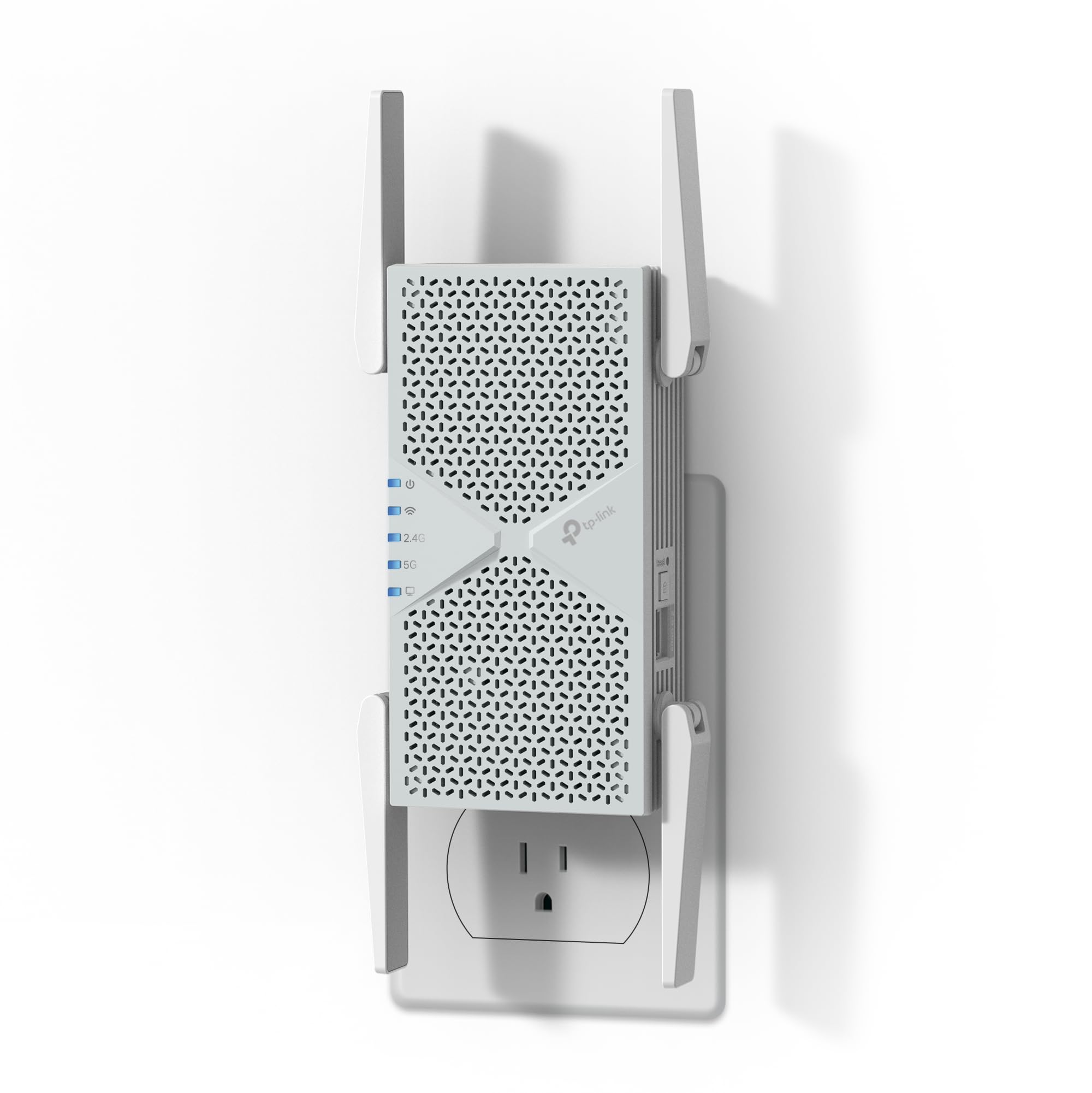
The TP-Link RE403BE is a dual-band Wi-Fi 7 range extender aimed at people who need to push a usable signal into a dead zone without replacing their main router. It sits in a somewhat unusual spot in the market: most Wi-Fi 7 extenders are tri-band, and most budget extenders still top out at Wi-Fi 6. The RE403BE splits the difference, offering Wi-Fi 7 features and a 2.5G Ethernet port at a price that undercuts the tri-band options. Whether that trade-off makes sense depends heavily on how your home network is laid out.
In practice, an extender like this is used in one of two ways. The first is the classic scenario: the router lives in a front room or closet, the far bedroom or home office gets a weak signal, and the extender is placed roughly halfway between them to relay traffic. The second is a wired backhaul setup, where an Ethernet cable runs from the router to the extender, and the extender broadcasts its own Wi-Fi from there. The RE403BE supports both, and the 2.5G port is what makes the wired option more interesting than usual.
The hardware itself is a wall-plug unit, so placement is limited to wherever an outlet happens to be. That is a real constraint. Extenders work best when they sit in open space at mid-distance from the router, and a wall outlet near the floor or behind a couch is rarely ideal. TP-Link includes a signal indicator LED to help find a decent spot, but the outlet placement still dictates the ceiling on performance. If the only free outlet is in a hallway corner, expect the relayed signal to reflect that.
On the wireless side, the RE403BE is dual-band, meaning it uses 2.4GHz and 5GHz radios. Wi-Fi 7 features like multi-link operation and 4K-QAM are present, but with only two bands, some of the more ambitious Wi-Fi 7 benefits are muted compared with tri-band extenders. In a typical home, the extender will dedicate part of its 5GHz capacity to talking back to the router, which means the throughput clients see is roughly half of what the extender receives. That is normal for wireless extenders and not a flaw specific to this model, but it is worth setting expectations: a 1Gbps fiber connection will not deliver 1Gbps at the far end of a wirelessly extended network.
The 2.5G port is the standout feature. Used as a wired backhaul, it lets the extender receive a full multi-gig feed from a router that supports it, and the extender’s Wi-Fi 7 radios can then distribute that capacity. For someone with a 2.5G-capable router and a wired run to a distant room, this is a genuinely useful combination at this price point. Used as a LAN port for a desktop or NAS, it also makes sense, though buyers should note that the port’s speed is only as good as the backhaul feeding it.
Setup follows TP-Link’s usual pattern: the Tether app walks through pairing with the main router, and WPS is available for a quicker, less granular configuration. The app exposes the usual controls, including a dedicated backhaul option and the ability to keep the extender’s SSID separate if you prefer to manage connections manually. One SSID with roaming is the default and generally the better choice, though some devices cling to the weaker router signal longer than they should. That is a client behavior issue more than an extender one, but it shows up in real use.
Compared with a mesh system, the RE403BE is a narrower tool. A two-node mesh kit from the same brand or a competitor typically costs more but handles roaming and backhaul more gracefully across the whole home. The extender’s advantage is that it slots into an existing network without replacing the router, and it can be added one room at a time. Compared with older Wi-Fi 6 extenders, the Wi-Fi 7 radios and 2.5G port are the reasons to pay more, but only if the rest of the network can take advantage of them. On a Wi-Fi 5 or entry-level Wi-Fi 6 router with a 1Gbps WAN link, much of the RE403BE’s headroom goes unused.
Thermals and stability are unremarkable in a good way; the unit runs warm under load but not alarmingly so. Throughput at mid-distance through one interior wall lands in the range you would expect from a dual-band extender with a strong 5GHz backhaul, and latency increases modestly for clients connected through the extender rather than the router. Gaming and video calls are workable but not ideal on a wireless backhaul; a wired run fixes most of that.
This extender suits households with a Wi-Fi 7 or high-end Wi-Fi 6 router, at least one hard-to-reach room, and either a willingness to run a cable or acceptance of halved wireless throughput. It is a poor fit for large multi-story homes that need seamless coverage everywhere, for anyone on an older router who will not benefit from the 2.5G port, or for users who cannot place the unit in a sensible location. Buyers in those situations are better served by a mesh kit or by repositioning the main router. The RE403BE is a competent, narrowly focused piece of hardware, and it makes the most sense when its specific strengths line up with the network it is joining.