
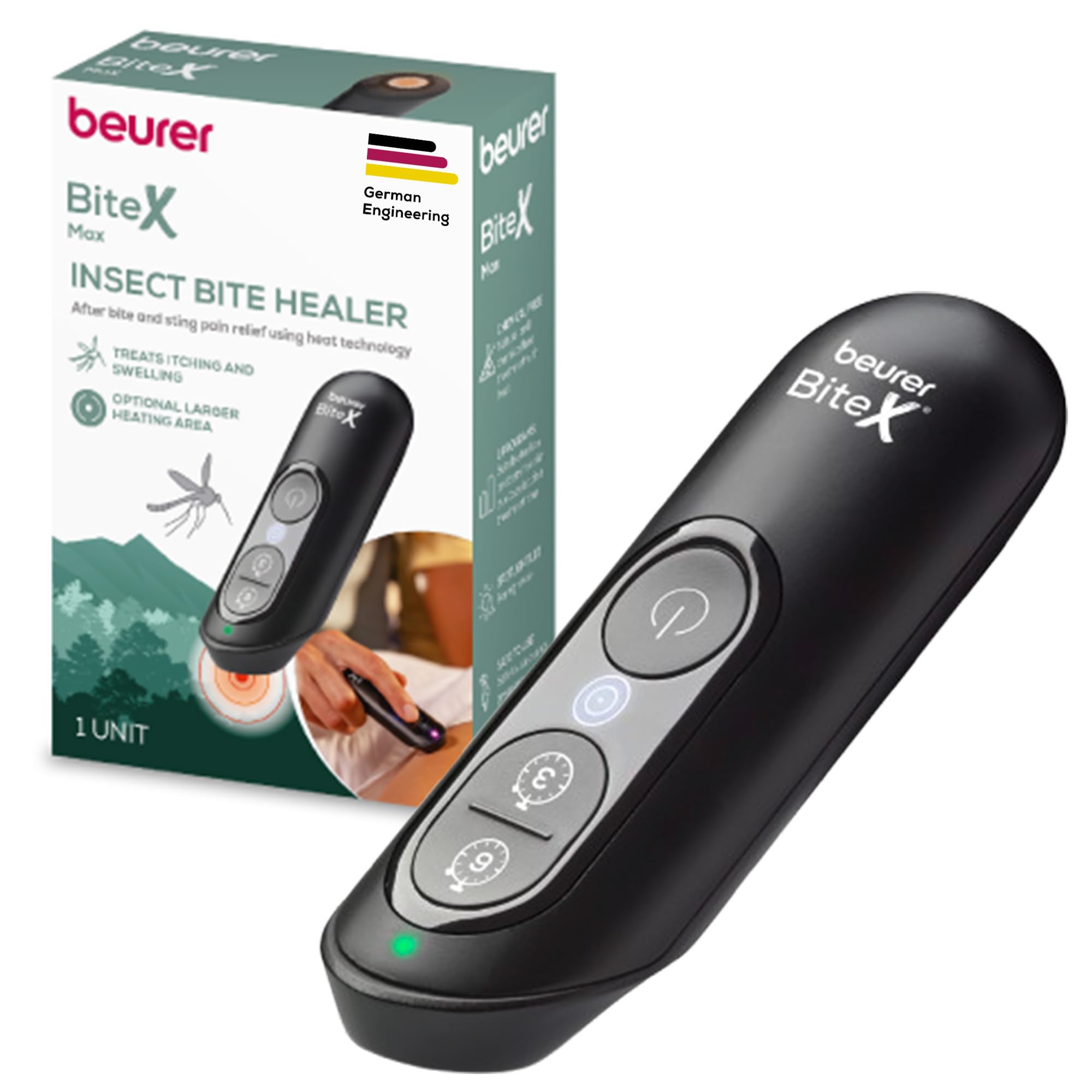
The BiteX Max is one of a small but growing category of devices that treat insect bites by applying concentrated heat to the skin rather than relying on creams, gels, or antihistamines. Beurer, a German company better known for health and wellness electronics, positions this as a pocket-sized tool for mosquito bites and similar minor skin irritations. The premise is straightforward: a small ceramic plate heats to a controlled temperature, you press it against the bite for a few seconds, and the localized heat is meant to break down the proteins in mosquito saliva that trigger the itch response. It is a physical intervention, not a chemical one, and that distinction matters for how you use it and who it makes sense for.
In practice, the device is used immediately after a bite is noticed. You select one of the heat settings, wait for the indicator to show it has reached temperature, and hold the plate against the skin for roughly three to six seconds depending on the setting. The BiteX Max offers several temperature levels, which is useful because sensitivity varies widely between people and body parts. Arms and legs tolerate the higher settings; thinner skin on the neck or near the face does not. The device runs on a rechargeable battery and is small enough to sit in a jacket pocket or a daypack, which is the main reason people carry it rather than a tube of hydrocortisone. It also includes a small light for locating bites in low light, a detail that sounds gimmicky until you are swatting at your ankles on a camping trip after dark.
The mechanism is worth being clear about, because expectations often run ahead of the evidence. Heat treatment for bites has some clinical backing, but it is not a cure and it does not work the same way for everyone. Some users report that the itch fades within minutes; others find the relief partial or short-lived, and a few notice no meaningful difference. The effect seems to depend on how quickly you treat the bite after it happens. Waiting a day and then applying heat is unlikely to do much. This is a tool for the first hour, not a rescue for a bite that has already been scratched into a welt.
There are practical trade-offs. The heat itself is uncomfortable, and on the higher settings it is genuinely sharp for a second or two. That is the point, but it is not a pleasant sensation, and children in particular may resist it. The device also should not be used on broken skin, over moles, or on people with reduced skin sensation, and the instructions are explicit about not using it near the eyes or on sensitive areas. Anyone with a heat sensitivity, circulation problems, or certain skin conditions should check with a clinician first. It is also not a substitute for medical attention if a bite becomes infected, spreads, or is accompanied by fever, which is a real risk with some insect bites in certain regions.
Compared with the more familiar alternatives, the BiteX Max occupies a specific niche. Antihistamine creams and oral tablets are cheaper, work systemically or over a wider area, and are well understood. They also require carrying something that can leak or expire. The heat pen is reusable, has no consumables, and works in seconds, which makes it appealing for hiking, travel, and households that go through bites regularly. Against other heat-based bite devices, the differences come down to temperature control, build quality, and battery life rather than any fundamental change in approach. Beurer’s version is well made and the multiple heat levels give it an edge over simpler single-setting pens, but it is not a radically different product from the category as a whole.
Battery life is adequate rather than generous. A charge covers a reasonable number of treatments, but if you are using it daily on a long trip, you will want to pack the charging cable. The device is also not waterproof, so it should not be left out in rain or used with wet hands. These are minor points, but they affect how carefree the thing actually is in the field.
Who it suits: people who react badly to mosquito bites and want a fast, chemical-free option they can keep in a bag; campers, hikers, and travelers in bite-prone areas; parents looking for an alternative to topical steroids for older children, with supervision. Who it does not suit: anyone expecting a guaranteed fix, people with sensitive skin or medical conditions that make heat application risky, young children, and those who want a treatment that works on bites that are already days old. It is also a poor fit for anyone who finds the heat sensation intolerable, since that is the entire mechanism.
The BiteX Max is a sensible, well-built device for a narrow but real problem. It will not replace repellent, and it will not help everyone equally, but for the right user it earns its place in a daypack. The honest summary is that it is a useful tool with a modest effect, best deployed early and with realistic expectations.