
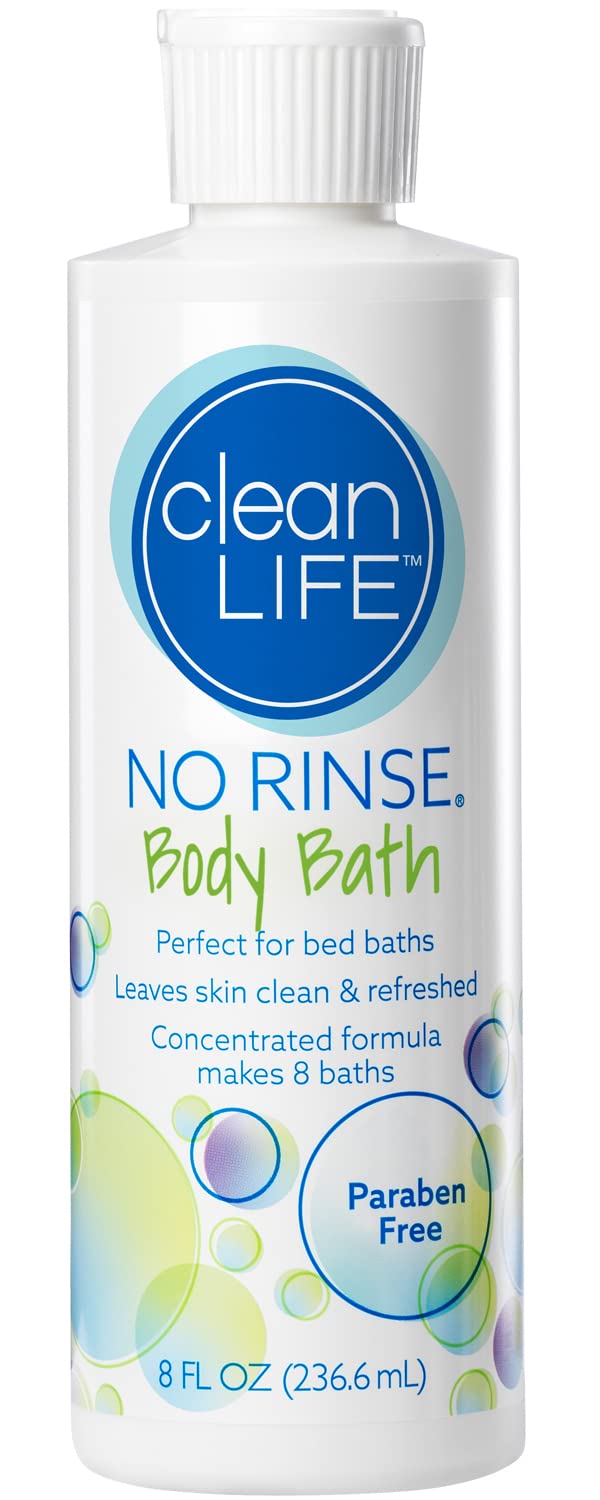
Rinse-free body washes occupy a specific niche: they exist for situations where a shower or bath isn’t practical, safe, or possible. CleanLife’s Body Bath, sold in an 8 fl oz bottle that the label says makes eight complete baths, is one of the more widely distributed options in that category. It’s a concentrated liquid rather than a pre-moistened wipe or a foaming mousse, which changes both how it’s used and what you should expect from it.
The basic mechanic is straightforward. You dilute a small amount of the concentrate in warm water, apply it with a washcloth or sponge, and then towel off rather than rinsing. The product is intended to lift soil and body oils while leaving behind a light, clean scent. Because it’s concentrated, the per-bath cost is low compared with single-use wipes, and the bottle takes up little shelf or suitcase space. CleanLife markets it for post-surgery recovery, elderly care, camping, and travel, and that range is a fair summary of where a product like this actually gets used.
In real-world caregiving settings, the typical scenario is a bedbound or mobility-limited person who needs a sponge bath a few times a week. A caregiver mixes the solution in a basin, wipes down the body in sections, and finishes with a towel. The appeal is that no rinsing step means no maneuvering the person to a sink or shower, and no water left on the skin in skin-fold areas, which matters for people at risk of irritation. For post-surgical patients who can’t get incisions wet, the same logic applies, though anyone with a fresh wound should confirm with a clinician that a particular cleanser is appropriate for the surrounding skin.
Campers and travelers tend to use it differently: a capful in a small basin, a quick wipe-down of the face, underarms, and feet, and a towel dry. It’s not a substitute for a real shower after a long hike, but it does take the edge off, and the concentrate travels better than a full bottle of body wash because you need so little per use.
Functionally, the product is a surfactant-based cleanser, similar in principle to a very dilute liquid soap, formulated to be left on the skin without rinsing. The label directions call for dilution rather than direct application, and following that ratio matters; using it too concentrated can leave a residue that feels tacky until it dries. Performance is reasonable for everyday grime, sweat, and light body odor. It is not a heavy-duty cleanser, and it won’t do much for stubborn substances like sunscreen residue, heavy grease, or the kind of grime that accumulates after days without bathing. Expect it to freshen and clean, not to replicate the result of a full shower.
The main trade-offs are worth naming. First, the towel-off step is non-negotiable, and in practice you go through a fair number of washcloths and towels per bath, which adds laundry to an already labor-intensive caregiving task. Second, some users report that the scent, while light, lingers, and people sensitive to fragrance may want to test it on a small area first. Third, the dilution step introduces room for error; a pre-moistened wipe or a foaming no-rinse product is more foolproof, though both cost more per use and generate more packaging waste. Compared with rinse-free wipes, the concentrate wins on cost and on covering large body areas efficiently; compared with a foaming no-rinse wash, it requires a bit more setup but stretches further. Compared with simply using a mild liquid soap and a damp cloth, the difference is modest, though the dilution ratio is designed to be left on skin, which ordinary soap is not.
The product suits caregivers, post-surgical patients with clinician approval, campers, and travelers who want a compact backup. It’s also reasonable for people in temporary situations, like a hospital stay or a stretch of limited mobility. It is not a good fit for anyone expecting a shower-equivalent clean, for heavy soiling, or for people who want a one-step product with no mixing. Those with fragrance sensitivity or very reactive skin should patch-test, and anyone with open wounds or skin conditions should get medical guidance before routine use.
At 8 ounces for eight baths, the math works out to roughly an ounce per bath, which is a reasonable yield if you measure rather than pour freely. The made-in-USA labeling is a plus for buyers who prioritize domestic manufacturing, though it isn’t a performance claim. Overall, this is a functional, unglamorous product that does what it says within its limits. It’s worth keeping on hand for the situations it was designed for, provided you go in expecting a sponge bath rather than a shower.