
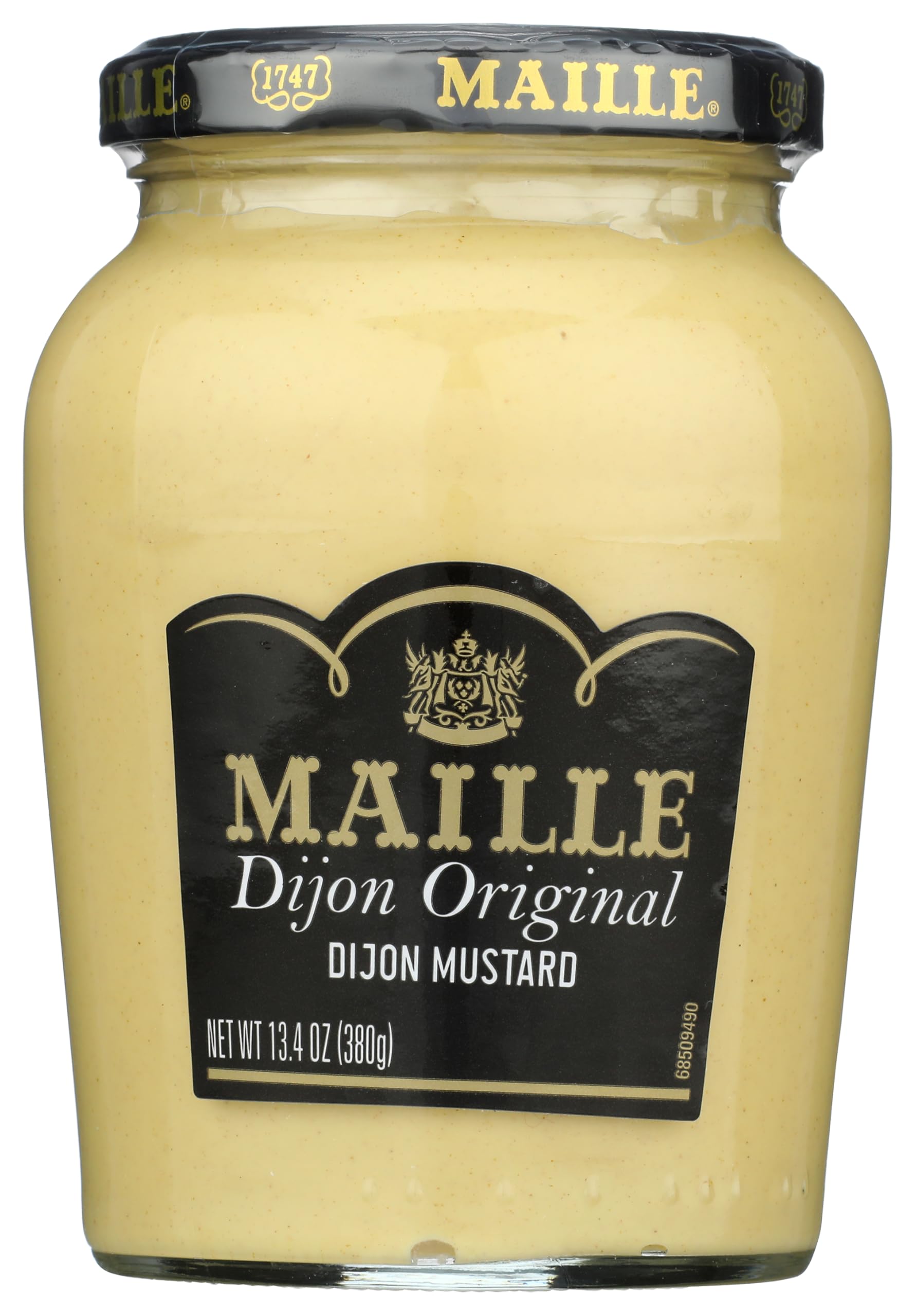
Maille Originale Dijon is one of those pantry items that shows up in a lot of kitchens without much fanfare. It is a straightforward Dijon mustard made in France, sold in a 13.4-ounce jar, and positioned as a “fancy” Dijon rather than a flavored or specialty variant. The question worth asking is whether it earns its place over the store-brand Dijon sitting a shelf below it. The answer is mostly yes, with some caveats about price and how much Dijon you actually go through.
In practice, this is a working mustard rather than a condiment for the table alone. It gets used in vinaigrettes, where a spoonful emulsifies oil and vinegar and adds a sharp background note. It goes into marinades for chicken and pork, into a pan sauce with white wine and cream, and into sandwiches where its heat cuts through fatty meats like ham or roast beef. The texture is smooth and pourable, which matters for dressings and sauces because it disperses evenly instead of clumping. The jar is glass with a metal lid, and the 13.4-ounce size is large enough to last through a few weeks of regular cooking but not so large that it sits forgotten in the door of the fridge.
The flavor is the main reason people come back to this brand. Maille’s Dijon has a clean, sharp acidity followed by a horseradish-like heat that fades fairly quickly. It is not a sweet mustard, and it is not a coarse-ground rustic style. Compared with a generic supermarket Dijon, the difference is noticeable: the store-brand versions tend to taste flatter, with more vinegar bite and less of the mustard seed character. Maille’s version holds up in cooked applications, where cheaper mustards can turn harsh or lose their edge. That said, the heat is moderate. Anyone expecting the sinus-clearing punch of a strong English mustard will find this mild by comparison.
One trade-off is price. Maille typically costs more than the supermarket house brand, sometimes by a wide margin depending on where it is bought. For someone who uses Dijon mostly as a sandwich spread, the difference may not be worth it. For cooking, where the mustard is a structural ingredient in dressings and sauces, the better-balanced flavor is easier to justify. Another consideration is that this is a conventional Dijon, not a specialty mustard. If the goal is a grainy, whole-seed mustard for charcuterie boards or a flavored mustard for specific dishes, this jar will not fill that role. It is a general-purpose product, and it behaves like one.
Compared with brown or yellow American mustard, Dijon is sharper and less sweet, and Maille’s version fits that profile. Compared with a whole-grain mustard, it is smoother and more uniform, which makes it better for emulsified sauces but less interesting as a standalone spread. It also differs from hotter mustards like English or Chinese styles, which are used in much smaller quantities. This is a mustard you can use by the tablespoon without overwhelming a dish.
The ingredient list is short, which is typical for Dijon: water, mustard seed, vinegar, salt, and preservatives. Nothing unusual, and nothing that would raise concerns for most buyers. The jar should be refrigerated after opening, and like most mustards it will keep for months, though the sharpness tends to mellow over time. A jar that has been open for a year will still be usable but will taste less lively.
Who is this for? It suits home cooks who make vinaigrettes, pan sauces, and marinades regularly and want a dependable Dijon that behaves predictably. It also works for anyone who wants a sharper sandwich mustard than the yellow squeeze bottle offers. It is less suitable for people who only occasionally use mustard, since the jar is fairly large for infrequent use, and for anyone on a tight grocery budget who is content with a store-brand Dijon. It is also not the right choice for someone specifically looking for a coarse-ground or flavored mustard.
The realistic expectation is a well-made, consistent Dijon that does its job without drawing attention to itself. It is not a transformative ingredient, and it will not make a bad recipe good. What it offers is reliability: the same sharp, clean flavor every time, in a jar size that fits a normal cooking routine. For kitchens that go through Dijon steadily, that is a reasonable trade for the higher price. For everyone else, it is a fine product that may not be worth the premium over a cheaper alternative.