
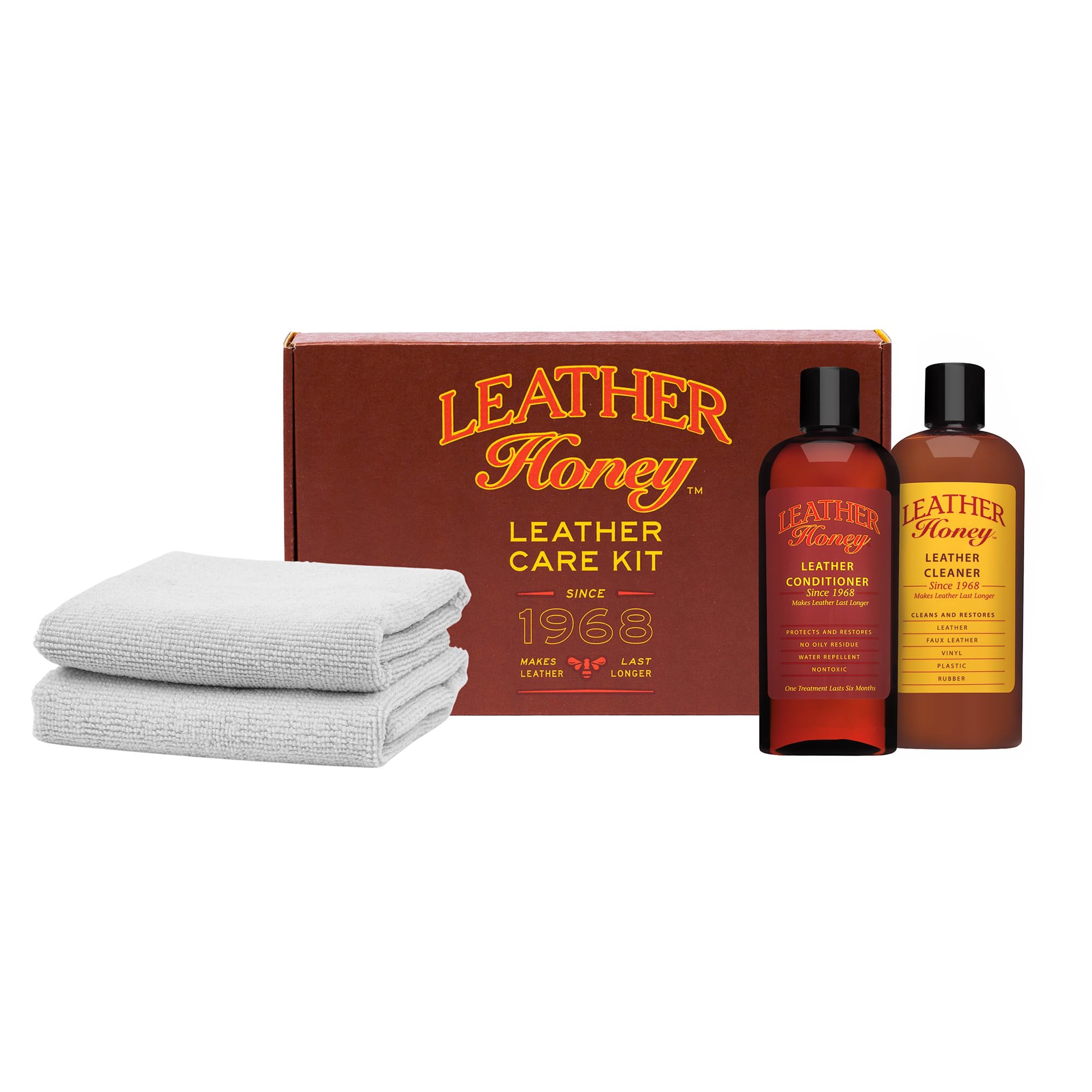
Leather Honey’s Complete Leather Care Kit bundles the brand’s two core products — a leather cleaner and the original Leather Honey conditioner — with a couple of applicator pads and a microfiber cloth. It is a straightforward two-step system rather than a single all-in-one product, which matters more than the packaging suggests. The kit is aimed at people who want to clean and recondition finished leather on furniture, car interiors, boots, jackets, and bags without solvents or silicone.
The most useful way to think about this kit is as a maintenance routine rather than a rescue treatment. In practice, the cleaner goes on first with a dampened pad or cloth, lifts surface grime and body oils, and then the conditioner is worked in thin layers and left to absorb. That two-stage process is the reason the kit exists: the conditioner is a heavy, honey-like liquid, and applying it to dirty leather tends to trap grit and produce an uneven finish. Skipping the cleaner and going straight to conditioning is the most common mistake with this kind of product, and the kit at least nudges users toward doing it in the right order.
On the formulation side, Leather Honey is marketed as non-toxic and made in the USA, and the ingredient list is short and largely free of the solvents found in many mass-market leather treatments. The conditioner is thick and spreads sparingly, which means a small bottle lasts through several sessions on a sofa or a full set of car seats. That slow absorption is also the main practical drawback: it needs time — often several hours, sometimes overnight — before the leather stops feeling tacky, and applying too much leaves a residue that has to be buffed out. This is not a wipe-on, walk-away product, and anyone expecting instant results will be disappointed.
Performance is best understood in terms of what it does and does not do. On finished, pigmented leather — the kind used on most couches, car seats, and work boots — it cleans light soiling and restores some suppleness and color depth. On heavily cracked, dried-out, or neglected leather, it softens things somewhat but will not repair damage, and it should not be expected to. It is also not intended for suede, nubuck, unfinished leather, or exotic skins, where the oils can darken or stain. A patch test on a hidden area is worth the two minutes, particularly on lighter-colored upholstery, since the conditioner can deepen the tone slightly on some finishes.
Compared with all-in-one leather wipes or spray-on cleaners, this kit asks for more time and attention. Wipes are convenient for a quick wipe-down of a steering wheel or a dining chair, but they do little in the way of conditioning. Dedicated saddle-soap-and-oil routines, the traditional alternative, are cheaper per use but messier and slower. The Leather Honey kit sits between those options: more effort than a wipe, less fuss than a full saddle-soap regimen, and with a formulation that many people prefer for indoor use because it lacks the solvent smell of some competitors.
Who is it for? It suits households with a leather sofa or a few leather items that get regular use and need periodic cleaning and conditioning — perhaps twice a year for furniture, more often for car seats and boots that see weather. It is also a reasonable choice for people who are sensitive to harsh chemical odors or who want a shorter ingredient list. It is less suitable for anyone who wants a one-step product, for very large collections where the slow application becomes tedious, or for leather that is already damaged and needs repair rather than maintenance. The included pads and cloth are functional but basic; most users will end up supplementing with their own applicators.
Overall, the Complete Leather Care Kit is a practical, no-frills maintenance set that rewards patience and proper technique. It does not perform miracles, and the conditioner’s slow absorption is a genuine inconvenience, but for routine care of finished leather it covers the essentials without unnecessary extras.