
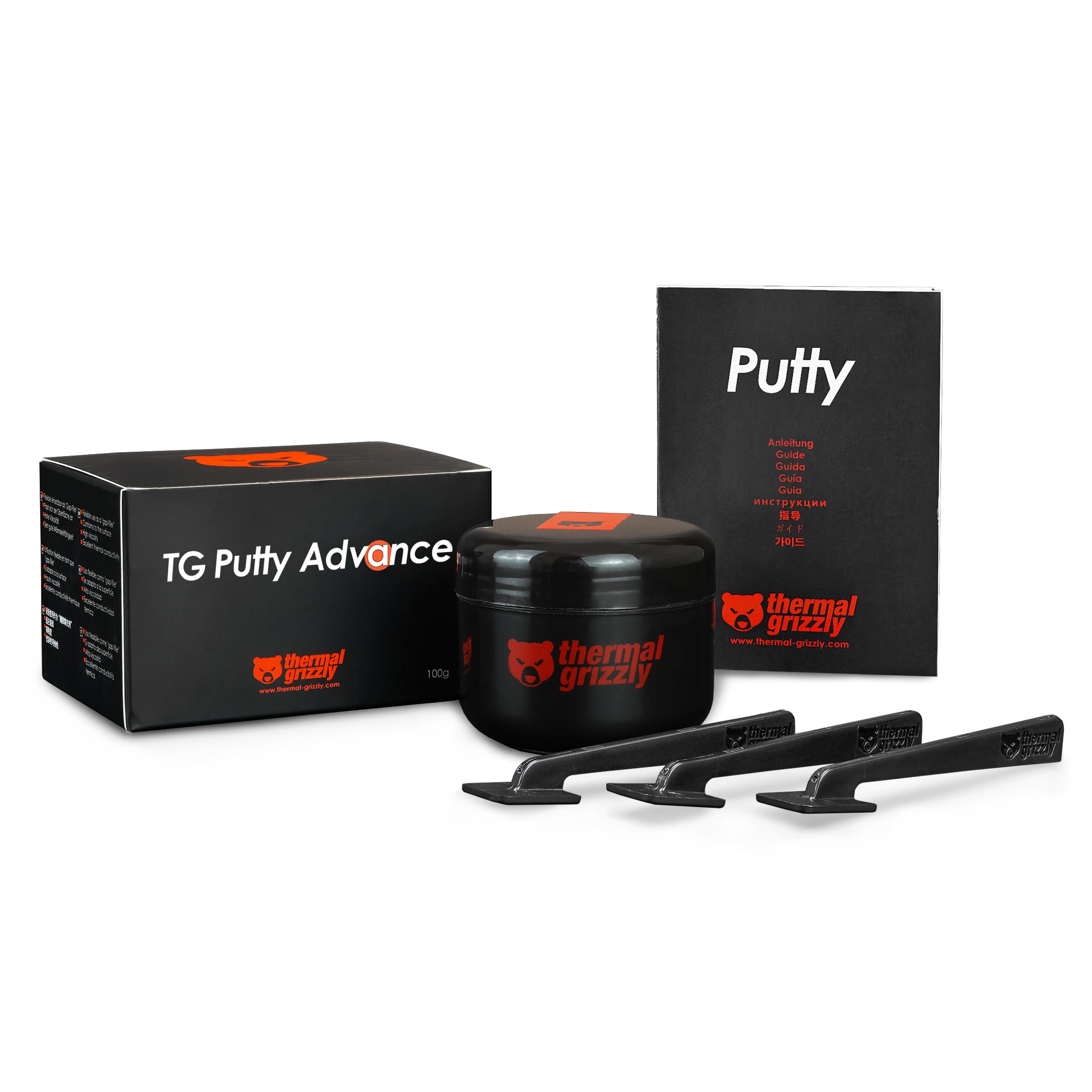
Thermal putty occupies a strange middle ground between thermal paste and thermal pads, and the TG Putty Advance from Thermal Grizzly is a good example of what that category does well and where it falls short. It is a 100 g tub of non-curing, moldable compound intended for uneven surfaces where a pad might not make full contact and paste would simply run or pump out. The most common use case is a graphics card teardown: you remove the stock pads from the VRAM and VRM areas, clean the components, and press putty into the gap before reseating the cooler. Because the material stays soft, it conforms to the actual gap rather than forcing the cooler to sit at a fixed height.
The core appeal is contact. Thermal pads come in fixed thicknesses, and a 1.0 mm pad in a 1.2 mm gap leaves an air layer that hurts heat transfer. Putty fills that space and squeezes out the excess. TG Putty Advance is formulated to be a bit firmer and less oily than some competing putties, which matters during installation because it holds its shape better when you apply it and does not migrate as readily under clamping pressure. It is also electrically non-conductive, which is reassuring when you are working close to exposed PCB traces and small surface-mount components.
In practice, the 100 g tub is generous. A typical GPU refresh uses somewhere in the range of 10–20 g depending on how many memory modules and VRM phases need coverage, so one tub can handle several cards. The putty is easy to spread by hand or with a plastic spatula, and cleanup with isopropyl alcohol is straightforward if you apply too much. Thermal results are realistic rather than dramatic: expect memory and VRM temperatures to improve modestly compared with worn or poorly sized stock pads, and expect the biggest gains on cards where the original pads were clearly too thin or compressed. It will not transform a hot card into a cool one, and it does not replace a repaste of the GPU die itself.
There are trade-offs worth knowing. Putty is messier than pads. It can be fiddly to apply evenly, and over-application can cause it to ooze onto nearby components or make future disassembly a cleaning chore. Unlike a pad, it has no defined thickness, so the installer has to judge the gap and the mounting pressure. The 100 g size is also more than many casual users need, and the material has a shelf life, so buying a large tub for a single card may be wasteful. Compared with pre-cut thermal pads, putty demands more care and patience; compared with liquid metal or standard paste, it is safer for VRAM and VRM use but offers lower peak conductivity than the best pastes on a perfectly flat die.
This product suits people who are comfortable disassembling a GPU or motherboard, who have a card with uneven contact or degraded pads, and who want a reusable, moldable interface material for multiple projects. It is less suitable for first-time builders, for anyone who wants a drop-in replacement with a known thickness, or for applications where a clean, residue-free teardown matters. For those cases, a quality thermal pad in the correct thickness remains the simpler and more predictable choice. TG Putty Advance is a practical tool for a specific job, not a universal upgrade.