
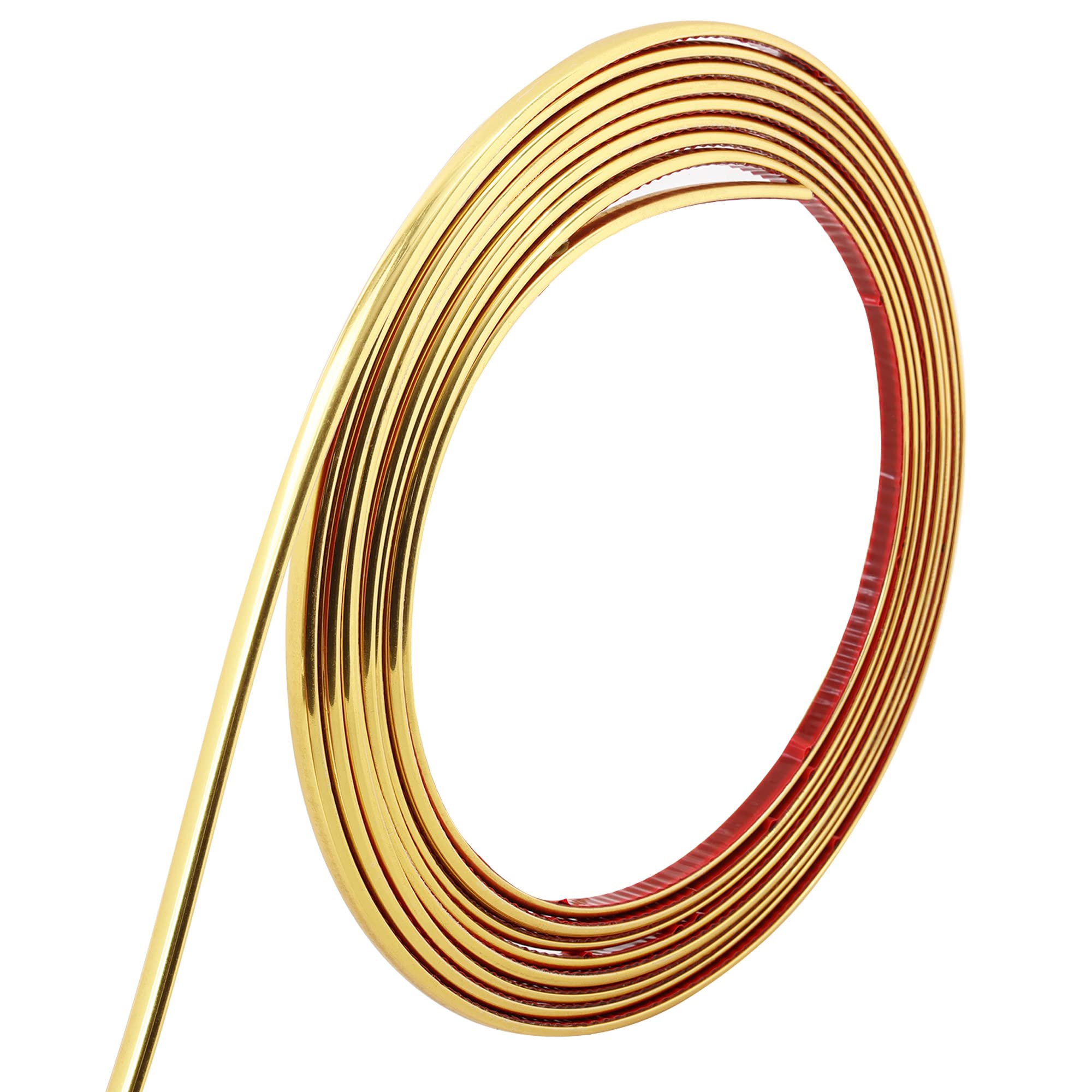
Peel-and-stick molding trim occupies an odd corner of the home improvement market. It promises the look of installed trim without nails, caulk, or a miter saw, and it sells mostly to renters, dorm residents, and homeowners looking for a quick cosmetic fix. The Trimold 16.4ft Shiny Gold molding strip sits squarely in that category, and it is worth understanding what it actually is before deciding whether it fits a project.
The product is a flexible strip with an adhesive backing and a reflective, gold-toned surface. The 16.4-foot length is the headline figure, and it matters because trim projects tend to consume more linear footage than people expect. Wrapping a single interior door frame, for instance, typically eats through most of a roll once you account for both sides and the head. A mirror or accent wall border can use the full length in one pass. The flexibility is the more interesting feature: the strip can follow gentle curves and irregular edges that rigid wood or PVC trim cannot, which is why it shows up in projects like arched alcoves, rounded cabinet fronts, and tile transitions.
In practice, this kind of trim is used in a fairly narrow set of applications. The most common is edge finishing: covering the raw edge of a backsplash tile run, hiding the seam where a cabinet panel meets a wall, or capping the perimeter of a mirror. A second use is decorative framing, where the strip outlines a headboard, a closet opening, or a ceiling medallion. A third, more ambitious use is as a substitute for real metal trim in rental-friendly makeovers, where the goal is visual impact rather than permanence. The reflective gold finish reads as metallic from a distance, though up close it behaves more like a laminated film than actual brushed or polished metal.
Functionally, the strip is straightforward. It cuts with household scissors or a utility knife, which makes fitting around outlets and corners manageable. The adhesive backing is pressure-sensitive, so installation involves cleaning the surface, peeling the liner, pressing firmly, and holding for a bit. Surface preparation is not optional here; dust, grease, or textured drywall will undermine the bond. The material is thin and lightweight, so it conforms to minor surface imperfections rather than bridging them, which cuts both ways: it hides small gaps but also telegraphs bumps underneath.
The main trade-off is durability. Peel-and-stick trim of this type is not a permanent building material. Adhesion on painted drywall tends to hold well in climate-controlled rooms but can loosen in bathrooms, above stoves, or anywhere with repeated moisture and temperature swings. The reflective surface is also prone to showing fingerprints and smudges, and it can scratch if cleaned aggressively. On curved surfaces, the strip may lift at the edges over time unless the curve is gentle. None of this is unusual for the category, but it means the product is better understood as a cosmetic upgrade with a finite lifespan than as a substitute for installed trim.
Compared with rigid metal or wood molding, the Trimold strip is cheaper, faster to install, and far more forgiving of uneven walls, but it lacks the weight, crisp edges, and paintability of traditional trim. Compared with plain PVC peel-and-stick trim, the gold finish is more decorative and less neutral, which limits where it looks appropriate. Compared with adhesive-backed metal foil tape, it is wider and more trim-like, but the finish is less convincing at close range.
Suitability breaks down fairly cleanly. It works for renters who want a reversible accent, for craft and furniture projects where the strip outlines a mirror or panel, and for quick visual fixes in low-moisture rooms. It is less suitable for bathrooms and kitchens near water, for exterior use, for anyone expecting a seamless metal look, and for projects where the trim will take physical contact, such as door edges in busy households. Buyers should also measure carefully and expect some waste at corners.
Overall, the Trimold strip is a reasonable tool for a specific job: fast, flexible, decorative edge finishing where permanence is not the priority. It performs about as well as the category allows, with the usual caveats around adhesion and finish quality.