
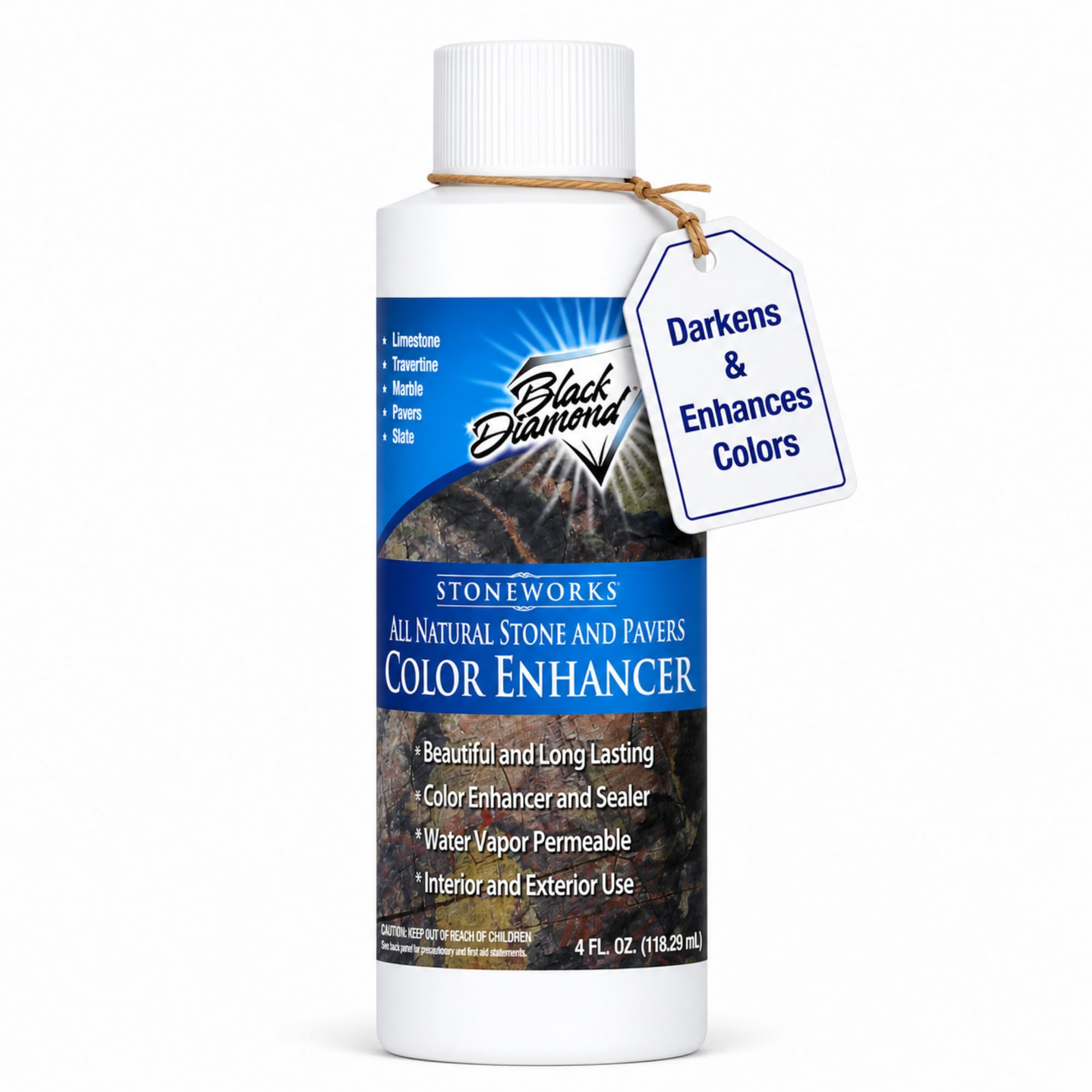
Color-enhancing sealers occupy a specific niche in stone care. They are not simply protective coatings; they also alter the appearance of the surface by deepening color and increasing contrast. This trial-size product is intended for marble, travertine, limestone, granite, slate, concrete, grout, brick, and block, which covers a broad range of porous and semi-porous materials. The appeal is obvious for anyone dealing with faded pavers or stone that looks chalky after cleaning, but the category also comes with trade-offs that are worth understanding before committing to a full application.
In practice, a color enhancer is applied after the surface has been cleaned and fully dried. It is typically rolled, brushed, or sprayed on and then worked in with a pad or cloth to avoid puddling, especially on textured stone like travertine or slate where excess product can collect in pits and leave dark spots. On smooth surfaces such as honed limestone or polished marble, application is faster but less forgiving of streaks. The trial size makes sense for testing on an inconspicuous area first, which is the correct approach with any enhancer, since the final color shift depends on the stone’s porosity and mineral content. A small bottle is enough to coat a sample paver or a few square feet, letting you judge whether the deepened tone is what you actually want.
Functionally, the product does two jobs at once. The enhancing component darkens and saturates the color, mimicking the look of stone when wet. The sealing component slows water absorption, which helps resist staining from spills, rain, and general grime. On concrete and grout, the effect tends to be more dramatic because these materials are more uniformly porous and often lighter in color to begin with. On dense granite, the change is subtler, and on polished surfaces the enhancer may not penetrate well at all. That variability is not a defect so much as a characteristic of the category, but it does mean results are inconsistent from one material to the next.
- Enhances color while providing a degree of water repellency
- Suited to a wide range of masonry and stone surfaces
- Trial size supports patch testing before full coverage
- Can be applied by roller, brush, or spray depending on texture
The main limitation is reversibility and uniformity. Most enhancers of this type are penetrating products, and once cured they are difficult to remove completely. If the color shift is stronger than expected, or if overlapping passes create darker bands, correcting it usually means stripping and redoing the surface, which is labor-intensive on large paver areas. On very porous or uneven stone, achieving an even tone requires careful technique and consistent coverage, and even then some blotchiness is common. There is also the matter of finish: these products generally leave a matte to low-sheen look rather than a glossy film, which is fine for patios and driveways but may not satisfy someone expecting a polished appearance. Curing time and odor are typical of solvent- or water-based sealers, so ventilation matters during application.
Compared with a straightforward penetrating sealer that offers protection without changing appearance, this product trades neutrality for visual impact. A standard sealer is the safer choice for interior stone where color consistency is critical, or for anyone who likes the existing tone. A film-forming topical sealer, by contrast, adds gloss and a visible layer but can peel and requires more maintenance. The enhancer sits between those options: more visual change than a penetrator, less surface build than a topical coating. For exterior pavers that look washed out, that middle ground is often the practical choice.
This product is suitable for homeowners and contractors working with outdoor pavers, concrete, brick, and grout who want to restore depth of color and add modest stain resistance. It is less suitable for polished interior marble, for anyone unwilling to test first, or for those expecting a uniform result across mixed materials. The trial size is a sensible way to evaluate whether the enhancement effect matches expectations before buying a larger quantity, and it is probably the most useful format for this kind of product given how much results vary by substrate.