
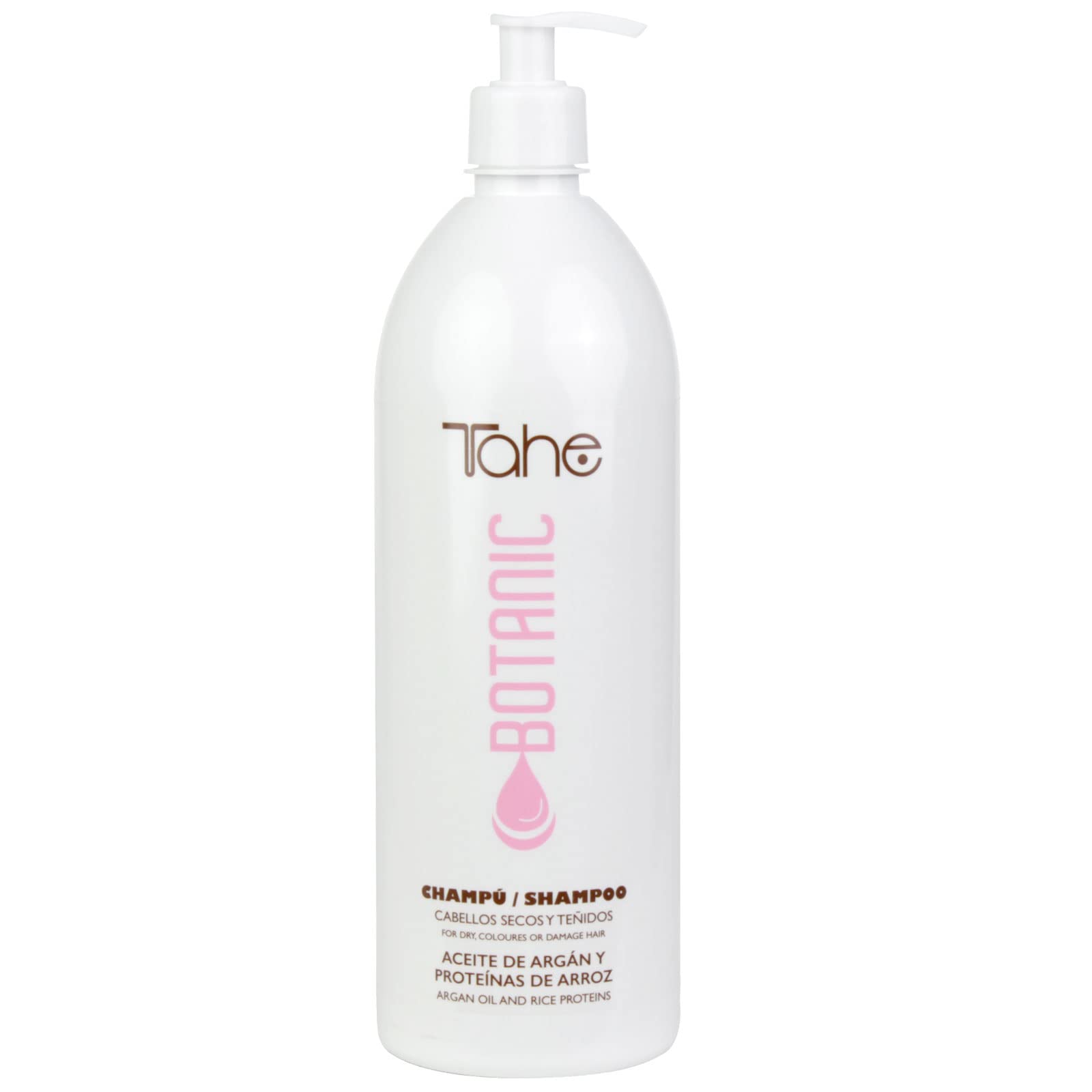
Tahe is a Spanish salon brand that has built a steady following among professional stylists, and the Botanic Color-Protecting line sits in the more accessible part of its range. This 1000 ml bottle is the kind of size you see behind the basin in a salon or on the shelf of someone who has decided to stop buying 250 ml bottles every few weeks. The formula is built around argan oil and rice proteins, aimed at color-treated and dry hair. On paper that is a familiar combination; the question is whether the execution justifies the bulk size.
In practice, this is a shampoo that behaves like a conventional sulfate-based cleanser rather than a gentle, low-lather one. It foams readily, rinses clean, and leaves hair feeling squeaky at the rinse stage before conditioner. That is worth flagging up front, because anyone expecting the creamy, low-foam texture of a dedicated color-care shampoo from a premium line will notice the difference. The argan oil and rice proteins are present, but they read more as conditioning support than as the defining characteristic of the wash. Users typically follow it with a mask or conditioner, and the shampoo’s job is mainly to clean without stripping too aggressively.
The functional case for the product rests on a few concrete points:
- Size and value: 1000 ml is roughly four times a standard retail bottle, which makes the per-wash cost low. For households with two or more people using the same shower, or for anyone with long hair who shampoos frequently, the format makes practical sense.
- Targeted positioning: It is formulated for colored and dry hair, with rice proteins included for their film-forming, strengthening role and argan oil for lubrication and shine. Neither ingredient is a color sealant in the technical sense; they support the appearance and feel of colored hair rather than locking pigment in.
- Fragrance and texture: The scent is present but not heavy, and the texture is a standard gel-cream that spreads easily through wet hair. It does not require a large amount per wash, which partly offsets the lather.
Where the product is most convincing is in the day-to-day routine. Someone with color-treated, dry-ish hair who washes two or three times a week will find it does the basic job: hair feels clean, does not tangle excessively, and the conditioner step is not fighting an over-stripped canvas. Over several weeks, colored hair tends to look reasonably glossy, though this is as much a function of the accompanying conditioner or mask as the shampoo itself. It is not a treatment product, and it should not be expected to repair significant dryness or fade on its own.
The main trade-off is the cleansing intensity. Sulfate-forward shampoos are efficient, but for hair that is already porous, bleached, or prone to dryness at the ends, they can contribute to that tight, slightly rough feel after rinsing. Those with very dry or heavily highlighted hair may find a sulfate-free or co-wash option gentler, even if it cleans less thoroughly. There is also the practical matter of the bottle: 1000 ml is heavy and awkward in a small shower, and the flip-top cap is functional rather than refined. It is a product designed for decanting or for a pump, not for travel.
Compared with a dedicated color-depositing or bond-building shampoo, this sits in a different category. Bond-builders and pigment-depositing cleansers target specific chemical problems and often cost considerably more per milliliter. Tahe’s offering is closer to a solid everyday salon-brand cleanser with conditioning support, priced for volume. Against a mass-market color-care shampoo from a supermarket brand, the difference is mainly in the finish and fragrance rather than a dramatic performance gap. Against a sulfate-free salon alternative, it cleans more decisively but treats dry ends less gently.
This shampoo suits people with normal-to-dry, color-treated hair who wash regularly, want a large-format bottle, and are comfortable with a traditional foaming cleanser. It also works for shared bathrooms where one product has to serve several hair types. It is less suitable for very dry, fragile, or heavily bleached hair that reacts badly to sulfates, for anyone looking for a sulfate-free formula, and for those who prefer a low-lather, treatment-style wash. Shoppers expecting the shampoo alone to preserve color intensity should temper that expectation; color longevity depends far more on wash frequency, water temperature, and the conditioner used alongside it. Treated as a dependable, economical workhorse rather than a specialty treatment, it makes sense for the right user.