
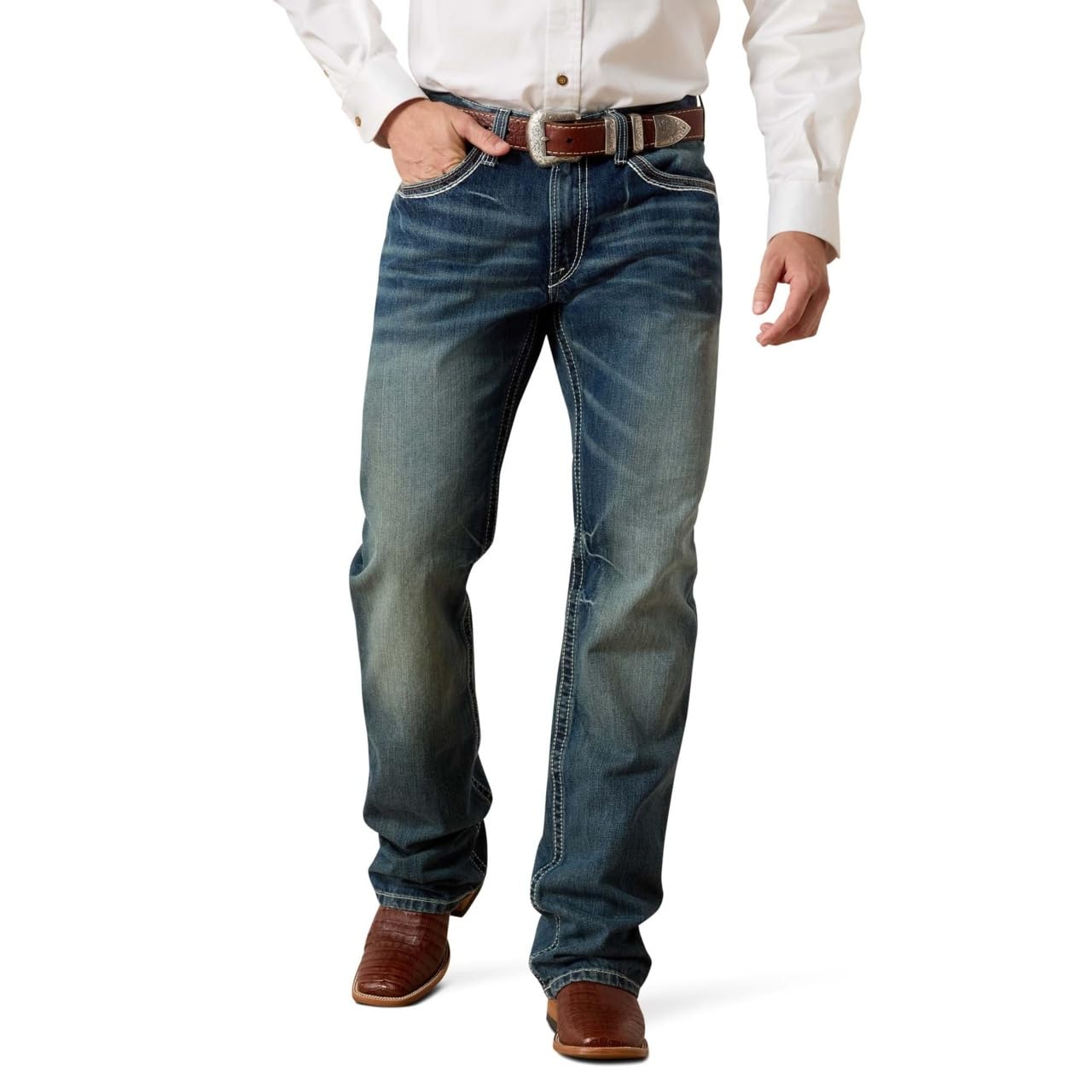
The ARIAT M4 Low Rise Coltrane is one of those jeans that sits at an intersection most denim doesn’t bother with: it’s built for people who spend their day around horses, trailers, and barns, but it’s cut to look at home in a truck stop diner or a Saturday night dance hall. Ariat has been making this general style for years, and the Coltrane wash is one of the more subdued versions of the M4 silhouette. It’s worth understanding what you’re actually getting before deciding whether it fits how you dress.
The M4 is Ariat’s low-rise boot cut, and the geometry matters more than the marketing. The rise sits below the natural waist, the thigh is relaxed without being baggy, and the leg opens into a boot cut that’s wide enough to drape over a cowboy boot shaft without bunching. That last detail is the whole point of the category. If you wear ropers or western boots regularly, a straight-leg jean will either ride up over the shaft or catch on the pull straps. The Coltrane’s leg opening clears most standard boot shafts, and the fabric has enough weight to hang cleanly rather than cling.
In practice, these get worn for the kind of work where you’re in and out of a truck, crouching to check hooves, or standing in a dusty arena for a few hours. The denim is a mid-weight cotton blend with a small amount of stretch, which is the detail that divides people. The stretch helps when you’re swinging into a saddle or kneeling, and it keeps the jeans from feeling like cardboard on day one. The trade-off is that stretch denim doesn’t hold a sharp crease and tends to relax through the seat and knees over a long day. If you want a jean that stays exactly where you put it, this isn’t that jean.
Construction is where Ariat tends to earn its price. The Coltrane has reinforced stitching at stress points, a heavier pocket lining than you’d find on fashion denim, and rivets that don’t pull through after a season of use. The waistband is decently structured, and the belt loops are sized for a real work belt rather than a dress belt. None of this is exotic, but it’s the difference between a jean that survives two years of actual use and one that blows out at the crotch in eight months.
- Fabric: Cotton blend with a modest amount of elastane for movement; mid-weight, not stiff
- Fit: Low rise, relaxed through thigh, boot cut leg opening
- Details: Reinforced stress-point stitching, riveted pockets, structured waistband
- Wash: Dark-to-medium indigo with light fading; subdued rather than distressed
The fit is the most common point of friction. A low rise is genuinely low, and if you’re used to a mid-rise jean, the M4 will feel like it’s sitting on your hips rather than your waist. That’s fine when you’re standing or riding, but it means the jeans can gap at the back when you bend or squat, and you’ll want a belt that actually holds. Men with longer torsos or a fuller seat often find the M4 runs a bit short in the rise; sizing up helps the waist but doesn’t fix the rise itself. It’s worth trying on in person if you can, because Ariat’s numbering (M4, M5, M7) corresponds to distinct fits, and the differences aren’t cosmetic.
Compared with a standard straight-leg work jean from a brand like Carhartt or Wrangler, the Coltrane leans more western in both cut and finish. The boot cut is wider than a typical straight leg, the rise is lower, and the detailing is cleaner, which makes it easier to wear off the job. Against a dedicated fashion boot cut, the Ariat is heavier and more utilitarian, with less taper and a more forgiving thigh. It’s a middle ground, and that’s roughly how it should be judged: not as the toughest work pant on the market, and not as a style piece, but as a functional jean for people whose daily life involves boots.
Durability expectations should be realistic. The stretch content means these won’t last as long as a rigid 100% cotton denim under hard abuse; the knees and seat will show wear first, and the fabric will fade faster than raw denim. Wash them inside out and sparingly, and they’ll hold their color reasonably well for the first year or so. The Coltrane wash is dark enough to pass as smart-casual early on, then settles into a broken-in look that suits the intended use.
Who should consider these: riders, ranch and barn workers, and anyone who wears western boots regularly and wants a jean that accommodates them without looking like costume. They also work for people who simply prefer a lower rise and a relaxed thigh. Who should look elsewhere: anyone who needs a high-rise for back coverage, workers who want maximum abrasion resistance and no stretch, and shoppers who prefer a slim or tapered leg. If you’re between sizes or unsure about rise, the M4 is not a forgiving first purchase, and trying a couple of fits before committing is the sensible move.