
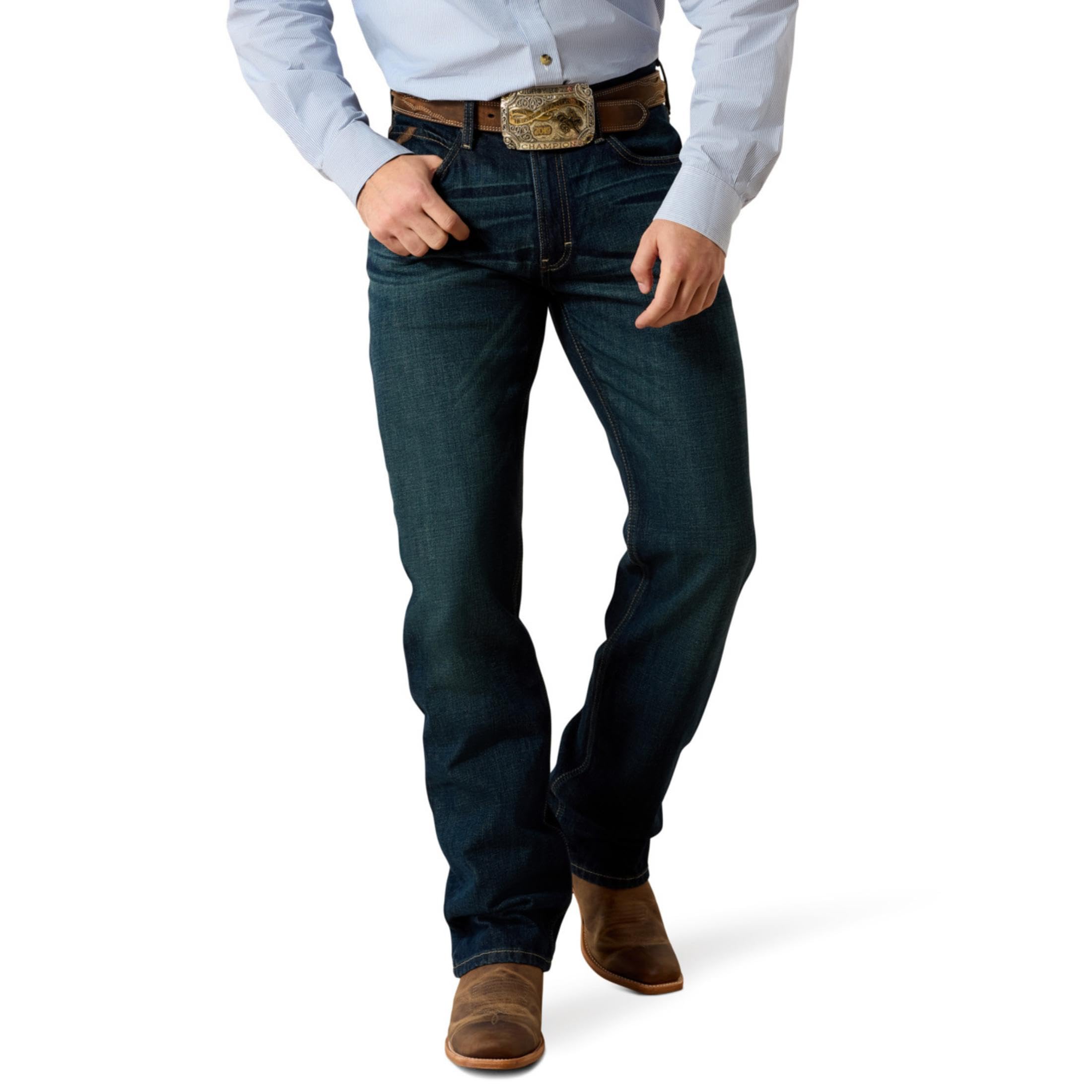
The ARIAT M4 Low Rise Legacy Boot Cut Jean sits in a crowded but specific niche: denim built for people who spend part of their day in a saddle, on a horse, or around livestock, and the rest of it doing ordinary things. Ariat has a long history in equestrian and ranch footwear, and its apparel line follows the same logic — clothes that need to hold up to barn work but still look presentable when you walk into town. The M4 is one of the brand’s core men’s fits, and the Legacy version is the more straightforward, work-oriented take on it.
The first thing to understand about the M4 is the cut. It is a low-rise, boot-cut jean, which means the waistband sits below the natural waist and the leg opens gradually from the knee to accommodate a boot shaft. That combination is not accidental. A boot cut exists so that a pair of cowboy or work boots can sit underneath the hem without the fabric bunching or riding up over the boot top. The low rise is a matter of preference and proportion — it suits men with shorter torsos or those who simply dislike high-waisted denim, but it is not a universal fit.
In real use, these jeans tend to show up in two contexts. The first is functional: ranch work, riding, fence repair, hauling feed, and other tasks where you are on your feet or in a saddle and need denim that moves without binding. The second is social: casual wear where the boot cut and Western styling are part of the look rather than a work requirement. The M4 handles both reasonably well, which is largely the point of the fit. The fabric has enough structure to feel durable without being stiff enough to restrict movement, and the leg opening is wide enough to clear most boot shafts without looking exaggerated.
Functionally, the Legacy line uses a cotton-heavy denim blend with a small amount of stretch, which is a meaningful departure from traditional rigid Western denim. That stretch helps in the saddle and during bending and squatting, and it makes the jeans more comfortable for all-day wear. The trade-off is that stretch denim tends to lose its shape faster than rigid denim and can develop sagging at the knees and seat over time, especially with heavy use. Anyone expecting the structured, break-in-over-years feel of old-school raw denim will find these softer and more forgiving from day one, but also less likely to hold a crisp shape long-term.
Construction details are consistent with what you would expect at this price point: reinforced stitching at stress points, a sturdy waistband, and pockets deep enough to be useful. The boot cut itself is moderate rather than extreme, so it reads as a working jean rather than a costume. Sizing runs in the standard waist-and-inseam format, and the low rise means the waist sits lower than many men are used to — trying a pair on before committing is advisable, particularly if you are between sizes or coming from a mid-rise fit.
There are real limitations worth naming. The low rise is the biggest one. Men with longer torsos, or anyone who prefers a higher waistband for coverage while bending or riding, may find the M4 sits uncomfortably low, especially when mounted or crouching. The stretch factor, while practical, means these are not the most durable jeans in the category over a multi-year horizon; heavy abrasion at the knees and seat will show sooner than on a rigid 100% cotton pair. And the boot cut is a deliberate style choice — it works with boots and casual shoes but looks out of place with slim sneakers or a more tailored outfit.
Compared with a straight-leg work jean from a general workwear brand, the M4 offers a more Western-specific silhouette and a boot-friendly hem, but it gives up some of the abrasion resistance and higher rise that pure work jeans provide. Compared with fashion-oriented boot cuts, it is more honestly built for actual riding and outdoor use, though it is not as rugged as heavy-duty ranch denim. It occupies a middle ground: more functional than a lifestyle jean, less armored than a dedicated work pant.
As for who should consider it, the M4 Legacy suits riders, ranch and barn workers, and men who want a boot-cut jean that can transition from chores to errands without looking like they just came in from the field. It also works for anyone who prefers a lower waistband and a leg opening that clears boots. It is less suitable for men who need a high-rise for coverage, for those who want maximum long-term durability from rigid denim, or for anyone whose daily wardrobe leans toward slim or tapered fits. It is a solid, specific tool for a specific job — not a universal pair of jeans, and it does not pretend to be.