
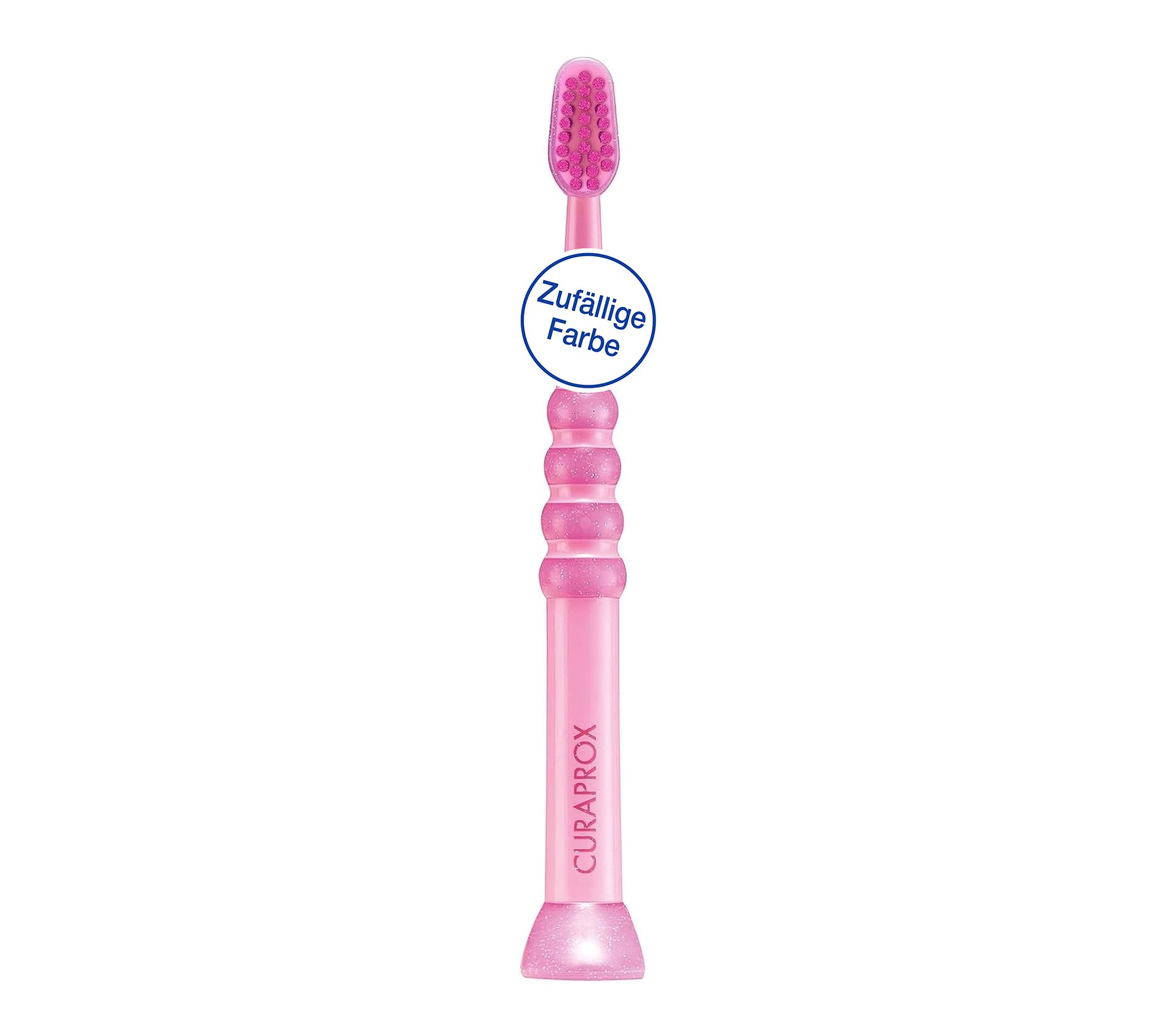
The Curaprox Baby toothbrush is one of those products that looks almost too small to matter until you actually watch a parent try to brush a toddler’s teeth. At that point, the design choices start to make sense. This is a Swiss-made manual toothbrush aimed at infants and very young children, sold as a single pack in a random color. It is not a gadget, it does not vibrate, and it does not connect to an app. Its entire pitch rests on a very small head and extremely soft bristles, and whether that is worth the price depends heavily on the age of the child and the patience of the adult holding it.
In real-world use, the brush is typically deployed during that awkward stage when a child has a few teeth but no ability to cooperate. Parents generally sit the child on their lap, tilt the head back, and try to reach the upper molars before the child clamps down. The Curaprox Baby’s head is compact enough to fit into that space without triggering a gag reflex, which is a genuine practical advantage. The bristle field is dense and noticeably soft, and the handle is short and slightly chunky, sized for an adult hand guiding the brush rather than for a child gripping it independently. That last point is worth noting: this is a brush the parent operates, not one the toddler uses alone.
Functionally, the key details are straightforward. The bristles are described as ultra soft, with a high filament count that gives the brush a cushiony feel against gums. The head is small, roughly the width of a few baby teeth, which helps with precision around the gumline. The handle has a slight curve and a textured grip area, and the overall construction feels solid in a way that cheaper baby brushes often do not. Curaprox manufactures it in Switzerland, and the build quality reflects that, though it is still a plastic toothbrush at the end of the day. The random color packaging means buyers do not choose the shade, which is a minor annoyance if you are trying to match a nursery theme or buy multiples for siblings.
Where the product becomes less convincing is in longevity and cost. The ultra-soft bristles are gentle, but they also tend to splay faster than firmer bristles, especially if a child chews on the brush, which most do. Replacement intervals end up being shorter than the typical three-month guidance, and at the price Curaprox charges for a single brush, that adds up. The random color also means that buying a multi-pack does not guarantee variety, and the packaging is not resealable, so storage between uses is a small consideration. None of these are dealbreakers, but they are the kind of details that matter when you are buying a consumable item every few weeks.
Compared with the broader category of toddler toothbrushes, the Curaprox Baby sits at the premium end. Standard drugstore brushes for the same age group often cost a fraction of the price and offer similar head sizes, though usually with coarser bristles and less refined finishing. Electric toddler brushes are another alternative, and for some families they are more effective because the vibration does some of the work. The trade-off is that electric brushes can be louder and more intimidating for a very young child, and they require charging or batteries. The Curaprox Baby’s advantage is simplicity: nothing to charge, nothing to assemble, and a bristle feel that is genuinely gentle on tender gums. Its disadvantage is that it offers no mechanical assistance, so the quality of the clean depends entirely on technique.
Who is this for? It suits parents of infants and toddlers who are still building the brushing habit and who prioritize softness over scrubbing power. It is also a reasonable choice for children with sensitive gums or those who resist firmer brushes. It is less suitable for older children who have transitioned to independent brushing, since the short handle and tiny head are not designed for that. Families on a tight budget may find the per-brush cost hard to justify when cheaper alternatives exist, and anyone who wants a specific color will be frustrated by the random selection. It is also not a substitute for flossing or for professional guidance on fluoride use, and it should be replaced as soon as the bristles show wear.
The honest summary is that the Curaprox Baby is a well-made, thoughtfully designed brush for a narrow window of childhood. It does its job gently and without fuss, and the Swiss manufacturing is evident in the details. But it is a premium consumable with a short useful life, and the random color and lack of mechanical assistance mean it is not the obvious choice for every household. Parents who value softness and are willing to pay for it will likely be satisfied; those looking for value or convenience may find better fits elsewhere.