
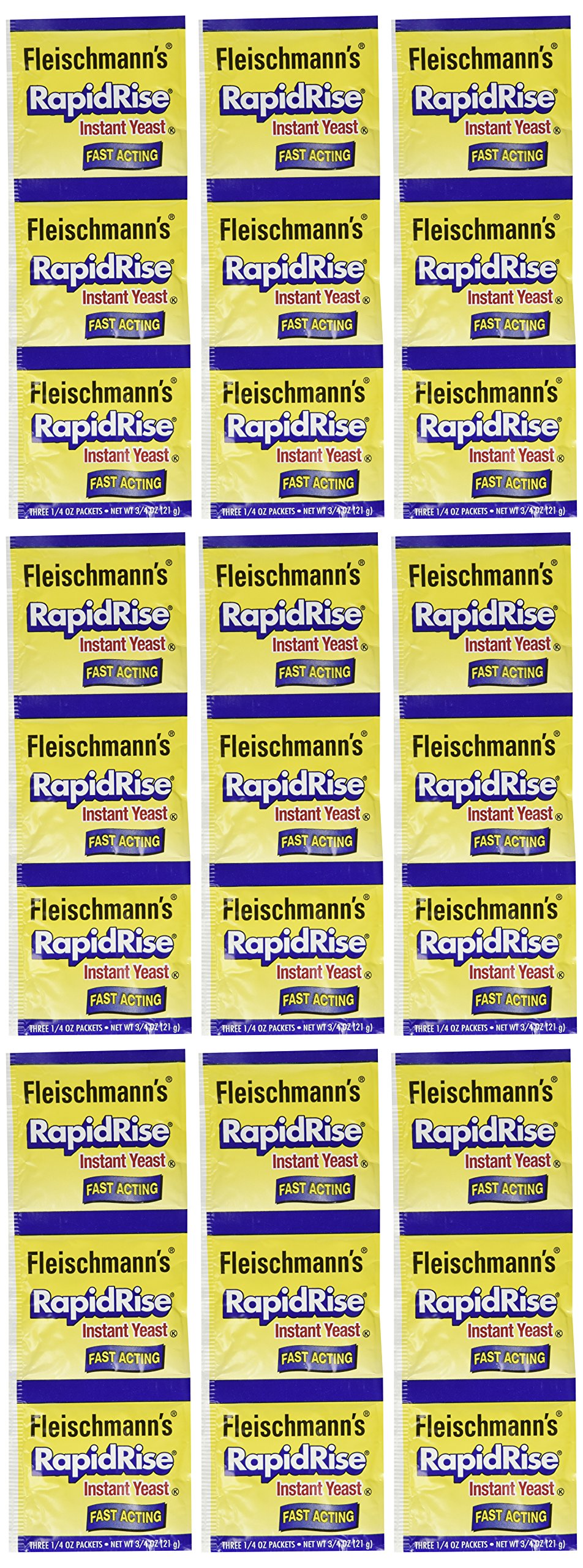
Fleischmann’s RapidRise is a dry yeast sold in small foil envelopes, and this particular listing bundles nine of the three-envelope packs, for twenty-seven envelopes total. That is a lot of yeast for a casual baker, so the first question worth asking is who actually needs this quantity and whether the convenience of RapidRise justifies its trade-offs against a standard active dry yeast or a jar of instant yeast.
RapidRise is an instant-style yeast designed to be mixed directly into dry ingredients rather than dissolved in warm water first. The pitch is simple: skip the proofing step, add the yeast with the flour, and let the dough rise once instead of twice in many recipes. In practice, this suits bread machines, stand-mixer doughs, pizza crust, dinner rolls, and sandwich loaves where the recipe calls for a single rise. The envelopes are sized for a typical home recipe, roughly one envelope per three to three-and-a-half cups of flour, which removes the guesswork of measuring from a jar.
Functionally, the yeast is a standard Saccharomyces cerevisiae strain formulated for fast hydration. The granules are finer than active dry yeast, which is why they can be added dry. It performs best with liquid between roughly 120°F and 130°F, warmer than the 105°F to 115°F range usually recommended for active dry yeast. That difference matters: if you treat RapidRise like regular yeast and use cooler water, it will still work, but more slowly, and if you go too hot you risk killing the culture before it has a chance to ferment.
One limitation is the single-rise design. Recipes that depend on a long, slow fermentation for flavor development, such as sourdough-adjacent country loaves, overnight pizza dough, or enriched holiday breads, generally benefit from a slower yeast and a longer schedule. RapidRise gets dough to rise quickly, but speed is not the same as flavor. Bakers who care about a deeper, more complex crumb will often find that a poolish or a cold retard with a different yeast produces a better result, even if it takes longer. The yeast is reliable for what it does, but it is not a flavor-building ingredient.
Another practical issue is storage and waste. Once an envelope is opened, it should be used promptly, and the foil packets are not resealable. Buying twenty-seven envelopes means committing to a fair amount of baking before the yeast’s viability declines, typically within a year or so of the printed date if kept cool and dry. A jar of instant yeast is more forgiving for occasional bakers because you can measure what you need and reseal the container, though it requires a little more attention to measuring accuracy. For someone who bakes a loaf or a batch of rolls most weeks, the envelope format is convenient and the bulk pack makes sense. For someone who bakes a few times a year, the pack is likely to outlast its usefulness.
Compared with active dry yeast, RapidRise saves a step and a few minutes of waiting, but it offers less visual confirmation that the yeast is alive. Proofing active dry yeast in warm water with a pinch of sugar lets you see foaming before you commit the rest of the ingredients. With RapidRise, a dead packet may not be obvious until the dough fails to rise, which is a real drawback for anyone using older stock or baking in a cool kitchen. That said, the trade-off is usually minor for bakers who store yeast properly and check dates.
In terms of who this suits: it is a reasonable fit for bread machine owners, weeknight bakers who want a single-rise dough, and households that go through yeast steadily. It is less suitable for slow-fermentation enthusiasts, very occasional bakers, and anyone who prefers the feedback of proofing yeast before mixing. The nine-pack bundle is best treated as a pantry staple for a committed home baker rather than an impulse purchase, and the envelopes should be kept in a cool, dry place, ideally the refrigerator or freezer, to preserve viability over the months it takes to work through them.
Overall, RapidRise does what it claims with little fuss, and the envelope format is tidy and consistent. The main caveats are the single-rise orientation, the lack of a proofing visual check, and the volume commitment of a twenty-seven-envelope pack. Bakers who understand those limits will find it a dependable everyday option; those who want more control over fermentation and flavor may prefer a jarred instant yeast or a traditional active dry yeast instead.