
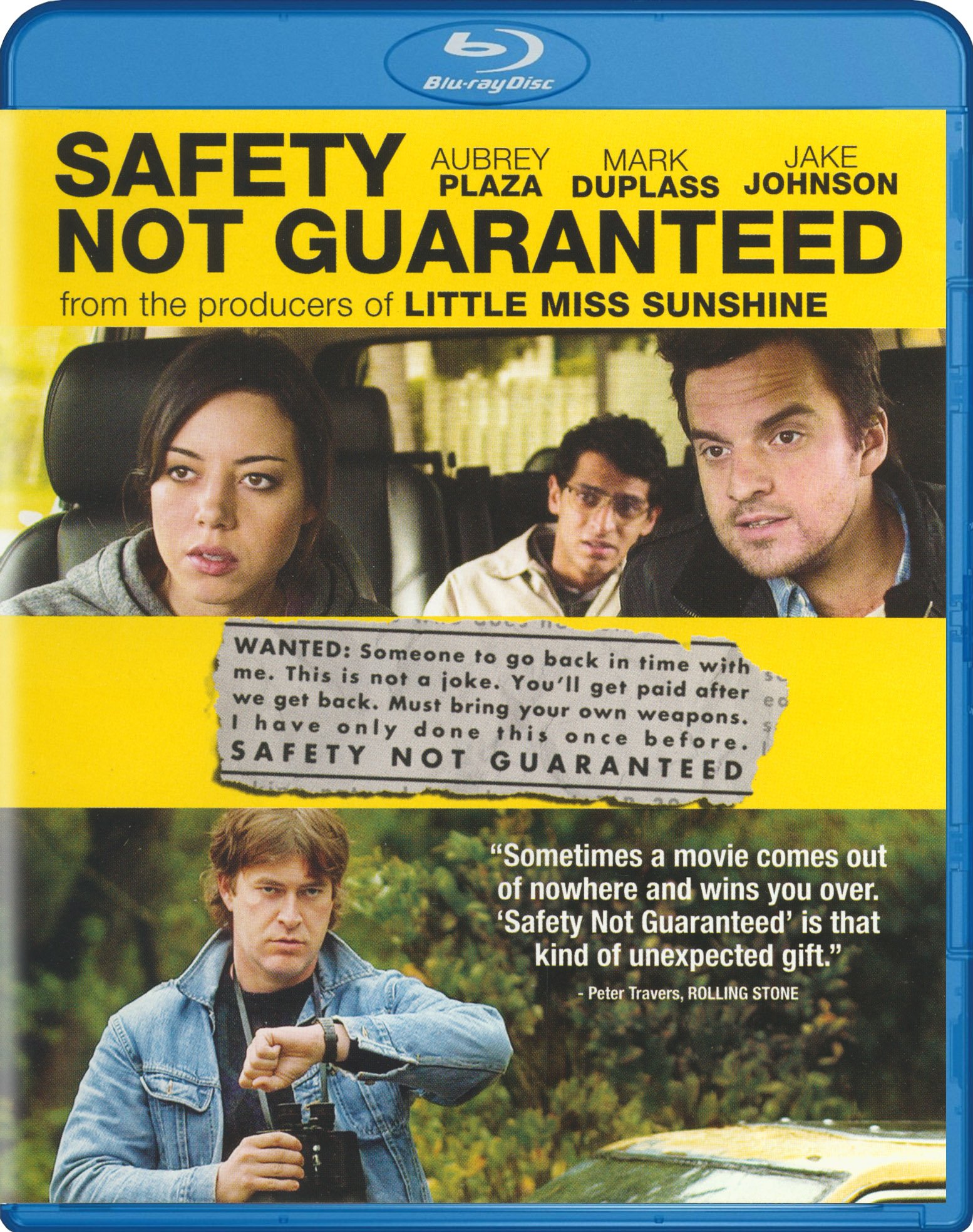
Safety Not Guaranteed is a 2012 independent film directed by Colin Trevorrow, built around a classified ad in which a man seeks a partner for time travel and warns applicants that safety is not guaranteed. The premise sounds like science fiction, but the movie spends most of its runtime as a low-key character study about lonely people in a small Pacific Northwest town. The film is best understood as a comic drama with a speculative hook rather than a genre piece, and viewers expecting either hard sci-fi or a broad comedy will find something quieter than advertised.
The setup follows Darius, a magazine intern played by Aubrey Plaza, who is sent with a cynical reporter and a younger colleague to investigate the ad’s author, Kenneth, played by Mark Duplass. Much of the film is spent in Kenneth’s cluttered workshop, where he trains Darius for the mission and explains his theories about the government, his past, and the physics of his homemade device. The screenplay, written by Derek Connolly, keeps the question of Kenneth’s sanity deliberately unresolved for long stretches, and that ambiguity is the engine of the movie rather than its gimmick.
In real-world terms, this is the kind of film people tend to encounter through word of mouth, streaming catalogs, or festival buzz rather than a major theatrical campaign. It runs roughly 85 minutes, which makes it an easy single-evening watch and a common pick for film clubs that want a discussion-friendly title. The tone sits somewhere between mumblecore and mainstream indie, with handheld camerawork, naturalistic dialogue, and a soundtrack that stays understated until the final act.
Functionally, the movie’s strengths are its performances and its patience. Plaza plays against her usual deadpan persona just enough to show a character who is guarded but not unfeeling, and Duplass makes Kenneth strange without turning him into a punchline. The supporting cast, including Jake Johnson as the self-absorbed reporter and Karan Soni as the younger intern, adds texture and keeps the film from becoming a two-hander. The humor is dry and often comes from awkward silences rather than jokes, so viewers who prefer rapid-fire comedy may find the pacing slow.
That pacing is also the film’s main trade-off. The middle section lingers on training montages and small-town conversations, and some viewers will feel the story circling rather than building. The ending, which resolves the central question in a way that divides audiences, is either a satisfying payoff or an abrupt shift depending on tolerance for ambiguity. The movie also handles its romantic subplot in a way that some viewers find uncomfortable given the age gap and the power dynamic between the characters, and that criticism is worth taking seriously rather than dismissing as nitpicking.
Compared with a more conventional time-travel film such as Primer or About Time, this one is far less interested in mechanics. There is no elaborate explanation of paradoxes or timelines, and the device itself is mostly a prop. Compared with a straightforward indie romance, it has a sharper hook but a looser structure. The closest comparison might be a character-driven dramedy like Lars and the Real Girl, which uses an eccentric premise to examine loneliness and trust rather than to deliver plot twists.
The film is well suited to viewers who enjoy small-scale stories about odd people, who are comfortable with unresolved questions, and who appreciate humor that comes from character rather than setup. It is less suitable for those who want a clear science-fiction payoff, a fast-moving plot, or a tidy romantic resolution. Parents should note that the film includes some language and mature themes, and it is not aimed at younger audiences.
On a practical level, Safety Not Guaranteed holds up as a modest, well-acted indie that uses its premise as a way into questions about regret and connection. It does not overdeliver on spectacle, and it does not pretend to. The film’s reputation has grown since its 2012 release, partly because of Trevorrow’s later career and partly because the cast has become more familiar, but it remains a small movie with small ambitions. That is both its appeal and its limit.