
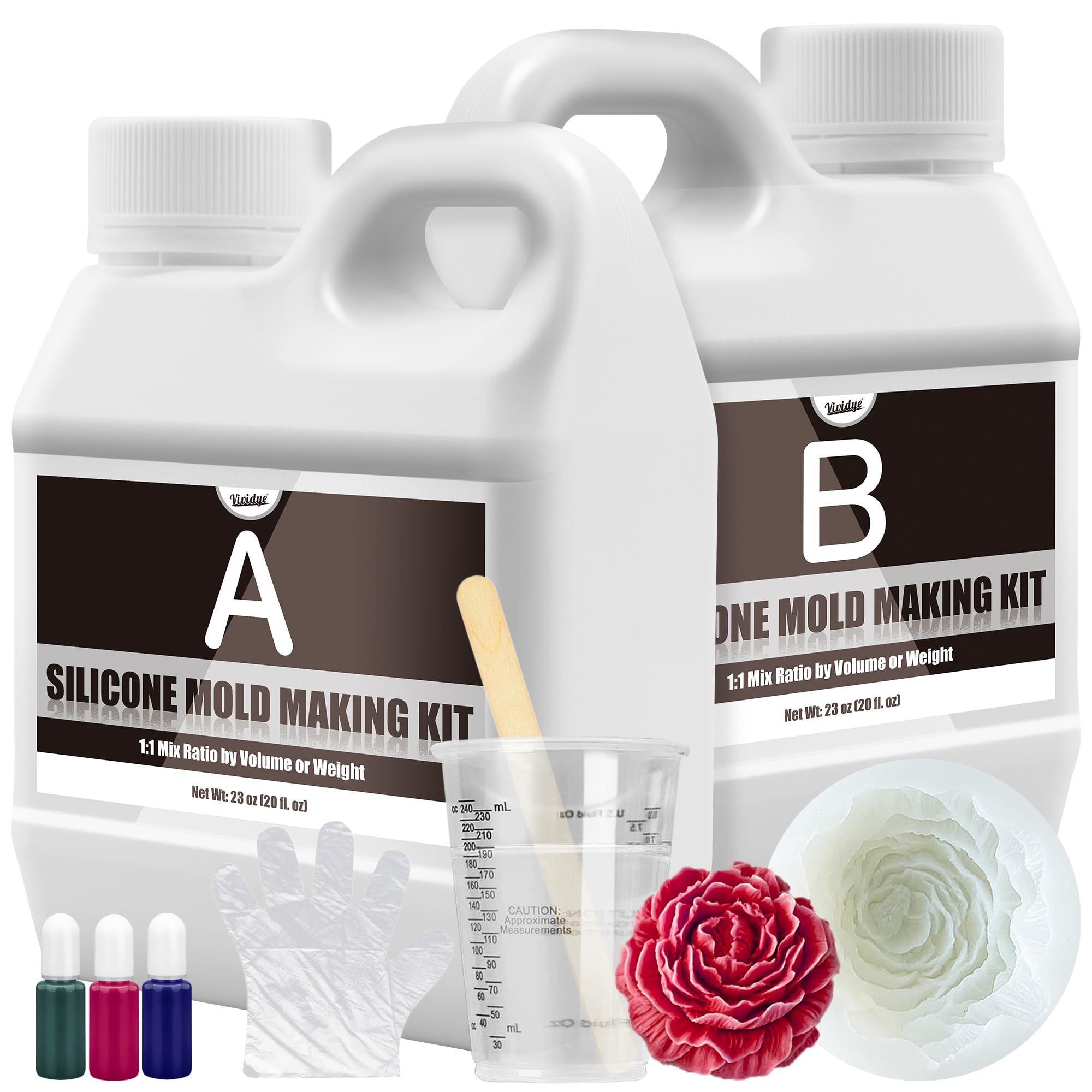
Silicone mold making sits somewhere between craft project and small-scale manufacturing, and the material you pour determines how much of the experience feels like either one. This 46oz (1.2L) kit of 15A liquid silicone rubber is aimed at people making flexible molds for resin, plaster, wax, soap, and low-temperature casting materials. It is a two-part system, typically supplied as equal parts A and B that are mixed by volume or weight before pouring. The 15A figure refers to Shore A hardness, which puts the cured rubber on the soft side of the mold-making range.
In practice, a kit like this is used to make block molds or brush-on molds around a master object. You build a containment box, secure your model, mix the silicone, degas it if you have a vacuum chamber, pour it slowly to reduce bubbles, and let it cure. The 46oz size is enough for a few small-to-medium molds or one larger one, depending on the volume of your master and the thickness of the mold walls you want. Most users will get through it faster than expected once they start experimenting.
The 15A hardness is the defining characteristic here. Soft silicone is forgiving when demolding delicate or undercut shapes, and it flexes enough that thin-walled castings can be removed without cracking. That same softness becomes a liability for larger molds, which may need a rigid mother mold or support shell to hold their shape. If you are casting something tall or wide with thin sections, a firmer silicone in the 20A–30A range will hold dimensional accuracy better. This kit is not the right choice for every mold, and buyers should think about the geometry of their project before committing.
Functional details worth knowing: the two components are usually colored differently to help you judge whether mixing is complete, which matters because unmixed silicone will never cure properly. Pot life and cure time vary by formulation, but most kits in this category give a working time of roughly 30–40 minutes and a demold time of several hours, often overnight for full strength. The 1.2L total volume is split between parts A and B, so the usable mixed silicone is roughly half the advertised number if the kit is sold as two equal bottles. That is a common point of confusion and worth checking on the specific listing before buying.
Realistic expectations matter with any platinum-cure or tin-cure silicone. This type of product is generally sensitive to cure inhibition from certain materials — sulfur-based clays, some 3D-printed resins, and certain woods can prevent proper curing at the surface. Testing a small batch first is wise, especially with resin prints. Bubbles are the other recurring issue; without vacuum degassing, you will get some surface bubbles, and a pressure pot helps for casting but not always for the mold itself. The kit will not fix technique problems, and beginners should budget for a failed mold or two while learning.
Compared with alternative mold-making materials, silicone rubber occupies a specific niche. Alginate is cheaper and food-safe for life casting but tears after one or two uses and shrinks. Polyurethane mold rubber is firmer and cheaper per volume but bonds to some masters and has a shorter shelf life once opened. Silicone is the more durable, flexible option, and 15A sits at the soft end of that spectrum. For simple flat molds or one-off casts, a cheaper alternative may be adequate; for repeated use with undercuts, the flexibility here earns its place.
Who is this for? Hobbyists making resin jewelry, soap molds, plaster casts, or small figurines will find the volume and softness workable. People casting larger architectural pieces or needing tight dimensional tolerances should look at firmer silicones and plan for support shells. Professionals doing production runs will likely buy silicone in larger quantities and may prefer a faster-curing or degassing-friendly formulation. Complete beginners may want a smaller trial kit first, since the learning curve and the risk of cure inhibition can waste material.
The trade-offs are mostly about softness, volume accounting, and cure sensitivity. It is a reasonable mid-range option for small mold work, provided you read the mixing ratio carefully, test on your master material, and accept that some bubbles and a learning curve are part of the process.