
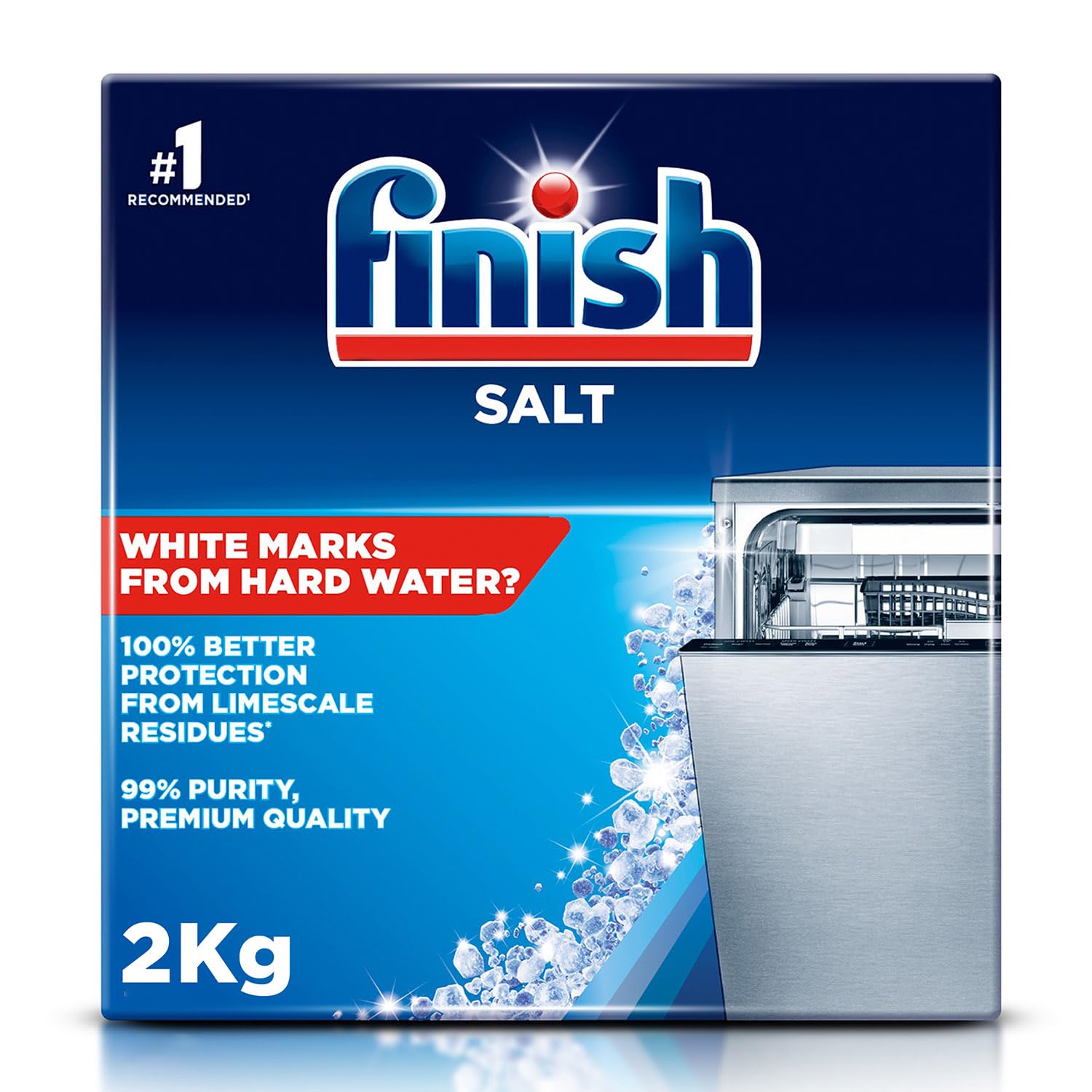
Dishwasher salt is one of those consumables that most people ignore until a machine starts leaving cloudy film on glasses or a heating element begins to scale up. Finish Dishwasher Salt is a straightforward 2 kg bag of granular sodium chloride designed for the salt reservoir in dishwashers that have a built-in water softener. It is not a detergent, not a rinse aid, and not a cleaning product — it does one job, and the review below is about how well that job is handled in practice.
The way it is used is simple but easy to get wrong. The salt goes into the dedicated salt compartment at the bottom of the dishwasher, usually under a screw cap, and the reservoir is topped up with water first on the initial fill. The machine’s water softener then regenerates its resin with the brine, which reduces the calcium and magnesium in the incoming supply. Finish sells this in a 2 kg bag, which is a reasonable size for a mid-sized household — typically lasting several weeks to a few months depending on water hardness and how often the dishwasher runs. The granules are coarse and designed to dissolve gradually rather than clump, which matters because fine table salt can cake in the reservoir and cause bridging.
On the functional side, the product is essentially pure sodium chloride with no anti-caking additives that could damage the softener unit, and the coarse grain size is intended to match the fill rate most dishwasher softeners expect. The bag is resealable in principle, though in practice the opening is wide and the granules are heavy, so decanting into a small jug before pouring is safer than tipping straight from the bag. There is no measuring scoop included, which is a minor annoyance — most reservoirs are filled until the water overflows slightly, so a scoop is not strictly necessary, but it would help.
Performance is what you would expect from a commodity salt. In a hard-water area, using it consistently keeps glassware clearer and reduces the white chalky buildup on heating elements and spray arms. It does not remove existing limescale on its own — that is a job for a dedicated descaler — and it will not fix a machine whose softener is set to the wrong hardness level. The real limitation is that results depend heavily on the dishwasher’s settings. If the water hardness is not programmed correctly, even regular salt use will underperform, and some users will conclude the salt is at fault when the setting is the actual problem. There is also the usual trade-off of any dishwasher salt: it is a recurring cost and a recurring chore, and households with naturally soft water will see little benefit from using it at all.
Compared with alternative approaches, the main alternatives are supermarket own-brand dishwasher salts, which are often cheaper and chemically similar, and combined detergent-and-salt tablets. The tablets are convenient but the salt dose is fixed and often insufficient for very hard water, which is why separate salt remains the more reliable option for hard-water households. Finish’s salt is not meaningfully different from most own-brand equivalents in composition; the brand premium buys consistency of granule size and availability more than superior softening. For anyone on a tight budget, a store-brand salt is a reasonable substitute.
Who is it for? It suits households in medium-to-hard water areas with a dishwasher that has a salt reservoir and a softener setting — typically European-style machines. It is also sensible for anyone who has noticed filming on glasses or scale on the machine’s internals and wants to address the cause rather than the symptom. Who is it not for? People in soft-water regions, owners of dishwashers without a salt compartment (many US-style models rely on combined detergents instead), and anyone expecting the salt alone to clean or descale an already-scaled machine. It is also not a substitute for rinse aid if spotting is the main complaint.
Overall, this is a functional consumable that does its job without much to distinguish it from cheaper rivals. The 2 kg bag is a sensible size, the granules behave as they should, and the main caveats are the lack of a scoop and the fact that results hinge on correct machine settings. It is a reasonable buy for hard-water households, but there is little reason to seek it out over a store-brand salt unless it happens to be on offer.