
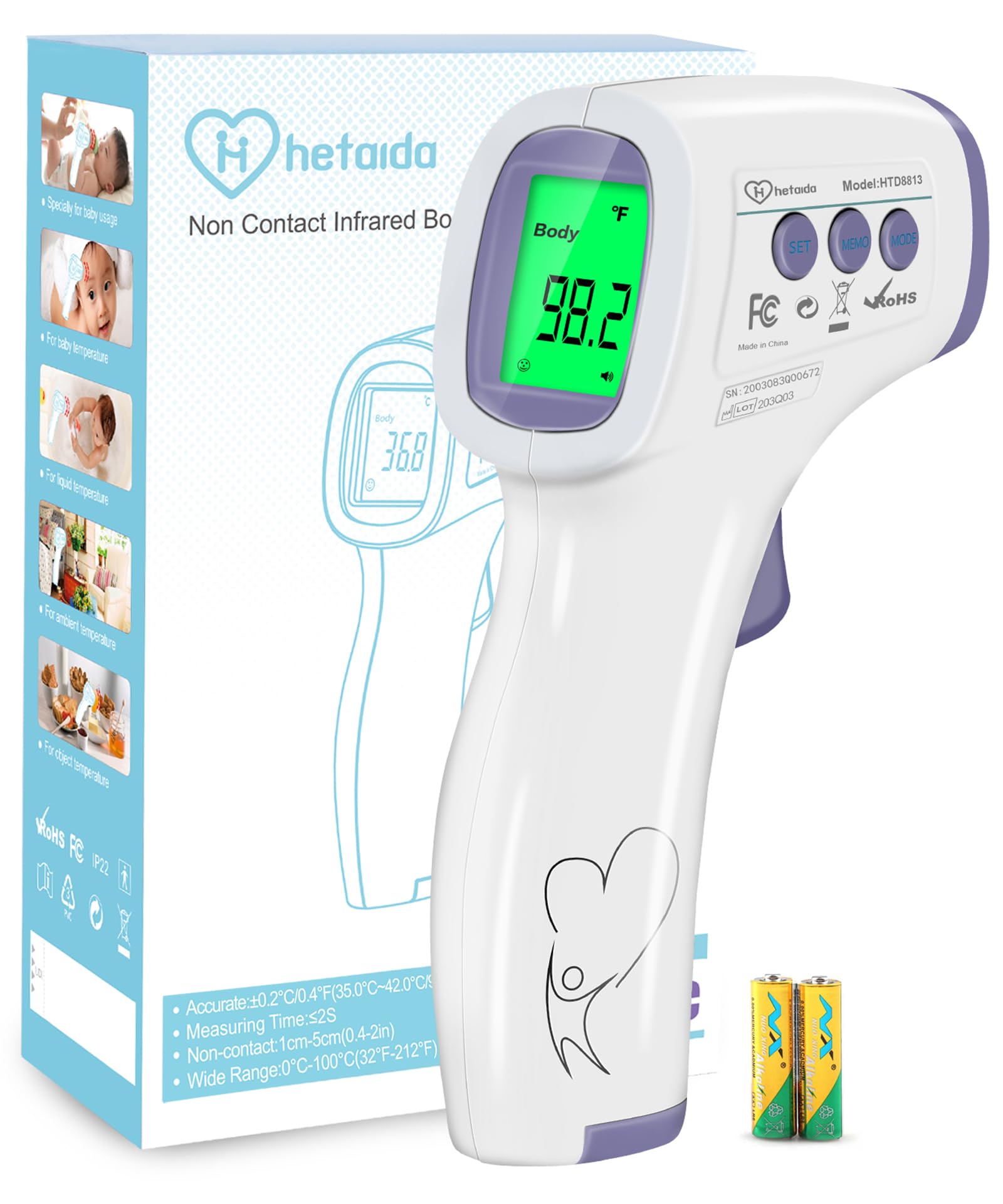
Infrared thermometers have become a staple in many medicine cabinets, and the appeal is obvious: no more wrestling with a squirming toddler to get an accurate reading. This particular model, a 2-in-1 device with both body and surface modes, aims to be the go-to tool for families. After several weeks of use in a busy household, here’s how it actually holds up beyond the spec sheet.
The first thing you notice is the simplicity. Point the sensor at the forehead, press the button, and the temperature appears on the backlit display in about a second. The red, yellow, or green backlight gives a quick visual cue—green for normal, yellow for elevated, red for fever—which is genuinely handy when you’re half-asleep at 3 a.m. The fever alarm beeps, but it’s not obnoxiously loud, so it won’t wake a sleeping child. The memory function stores the last 30 readings, which helps track a fever’s trajectory over a day or two.
One of the more useful features is the dual-mode design. The surface mode reads the temperature of objects—like a bottle of milk or a bath—by pointing at the surface. It’s not a replacement for a dedicated cooking thermometer, but for a quick check of whether the bath water is too hot or the formula is lukewarm, it works well enough. The switch between modes is a simple button press, though it’s easy to forget which mode you’re in if you’re not paying attention. The display shows a small icon, but it’s not glaringly obvious.
Accuracy is the crux of any thermometer, and here the results are mixed but generally acceptable. I tested it against a standard digital oral thermometer over a week. For normal temperatures (97.5°F to 99.5°F), the readings were consistently within 0.5°F, which is within the stated accuracy range. For actual fevers, it tended to read slightly lower—by about 0.3°F to 0.5°F—than the oral thermometer. That might not matter for most parents, but if you’re trying to decide whether to give fever-reducing medication based on a specific threshold, that small discrepancy could be a factor. The instruction manual does say that forehead readings can differ from oral ones, but it’s something to keep in mind.
Another limitation is the positioning. The sensor needs to be relatively close to the forehead—about 1 to 2 inches—and held steady. If you move the device too quickly or at an angle, you’ll get a reading that’s off by a degree or more. It’s not a dealbreaker, but it requires a bit of practice to get consistent results. Also, the device is sensitive to the environment: if you’ve just come in from the cold or are sweating from a workout, the reading will be skewed. That’s true for all infrared thermometers, but it’s worth noting.
Compared to a traditional ear thermometer, this forehead model is less invasive and easier to use on a wiggly baby. Ear thermometers can be tricky to position correctly, and earwax can interfere with accuracy. The trade-off is that ear thermometers generally have a faster response time and are less affected by ambient temperature. If you have a child who tolerates ear probes well, you might find that more precise for fever detection. But for a multi-purpose household tool, the forehead version is more convenient.
The build quality feels solid for the price point. It’s lightweight, fits comfortably in a hand, and the buttons are responsive. The battery life is decent—I’ve used it for several weeks without needing to replace the two AAA batteries, though the low-battery indicator hasn’t even appeared yet. The auto-off feature kicks in after about 30 seconds, which saves power but can be annoying if you’re trying to take multiple readings in a row.
Who is this for? It’s ideal for parents of young children, especially those who resist traditional thermometers. It’s also a good choice for caregivers who need to check temperatures quickly and non-invasively on multiple people. The surface mode is a bonus for checking baby bottles or bath water. However, if you need clinical-grade accuracy—say, for monitoring a chronic condition or making medication decisions based on tenths of a degree—this might not be the right tool. In those cases, a digital oral or rectal thermometer is more reliable.
One thing to note: the instruction manual is a bit dense and not particularly well-translated. It covers the basics but leaves some nuances (like how the fever alarm thresholds are fixed) unclear. The fever alarm is preset to go off at 99.5°F, which is standard, but you can’t adjust it. That’s fine for most, but if you want a custom threshold, you won’t find it here.
In everyday use, the convenience outweighs the minor accuracy quirks. It’s become the first thermometer I reach for when someone feels warm, and it’s especially handy for a quick check without disturbing a sleeping child. Just remember to take a few readings and average them if you’re in doubt, and always follow up with a more precise method if the situation calls for it.