
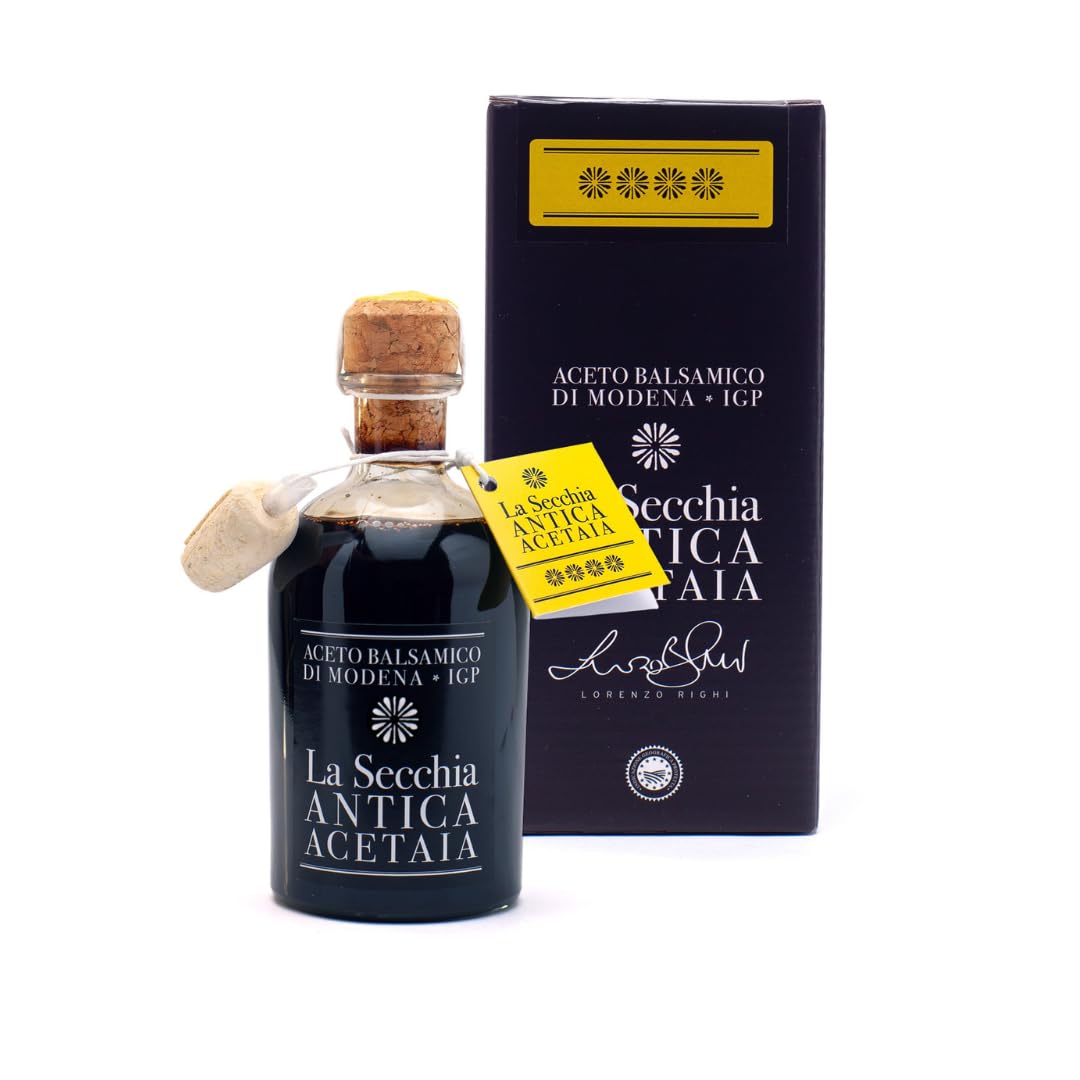
There’s a certain kind of kitchen staple that sits on the counter not just for cooking, but for finishing—the last flourish that turns a bowl of strawberries or a wedge of Parmigiano into something more deliberate. La Secchia’s “Four Stars” balsamic vinegar of Modena PGI aims for that role, and its packaging certainly signals intent: a 250 ml bottle with a cork pourer, aged in 16 juniper barrels, and labeled with a medium-high density rating. It’s a product that invites scrutiny, especially when you consider the price per drop.
Let’s talk about what “medium-high density” actually means in practice. This is not the syrupy, almost treacle-like texture you’d find in a 25-year-old traditional balsamic, nor is it the thin, sharp stuff you’d use for a salad dressing. It sits somewhere in the middle—viscous enough to coat a spoon, but still pourable. That’s a useful sweet spot. You can drizzle it over vanilla gelato without it pooling into a puddle, and it also holds its own when reduced into a pan sauce. The juniper barrel aging is the headline feature, and it’s not just a gimmick. There’s a faint, resinous note that comes through on the nose, something like pine and black pepper, which adds a curious edge to the usual grape must sweetness. It’s subtle, not overpowering, but it does make this vinegar feel different from the generic supermarket balsamics.
In real-world use, this is where the Four Stars earns its keep. A few drops over roasted root vegetables—carrots, parsnips, maybe some beets—brings a brightness that cuts through the caramelization. It also works surprisingly well with aged cheeses; the juniper note seems to latch onto the funk of a good Gorgonzola. On the flip side, I found it less convincing in a classic balsamic vinaigrette. The density makes it a bit stubborn to emulsify, and the juniper character can clash with raw garlic or shallots. You’re better off using a cheaper, thinner vinegar for dressings and saving this for finishing.
Compared to a standard Modena PGI balsamic—the kind you’d pick up for under ten euros—the Four Stars is a clear step up in complexity. It has more depth, a longer finish, and that woody note that you won’t find in mass-produced versions. But it’s also not in the same league as a true Traditional Balsamic of Modena (DOP), which is aged for a minimum of 12 years in a series of different wood barrels. The Four Stars is a middle ground, and that’s fine, but you should know what you’re paying for. It’s a step up, not a leap.
One limitation worth noting is the bottle itself. The cork pourer is elegant, but it’s not the most practical. It tends to drip a little after pouring, and the opening is narrow, which makes it hard to get a spoon in if you need to measure for a recipe. Also, the 250 ml size feels small for the price—you’ll go through it quickly if you use it daily. That’s not a dealbreaker, but it’s a consideration for something that costs more than your average condiment.
Who is this for? If you’re someone who enjoys experimenting with finishing oils and vinegars, who keeps a shelf for “special” bottles, then the Four Stars is a worthy addition. It’s also a decent gift for a foodie friend who already has the basics. But if you’re looking for a workhorse vinegar to use liberally in marinades and sauces, this isn’t it. You’d be better off with a cheaper PGI or even a decent red wine vinegar. And if you’re a purist chasing the deep, almost prune-like intensity of a DOP, you might be disappointed by the lighter body here.
There’s also the matter of expectations. The “Four Stars” label isn’t an official grading system—it’s La Secchia’s own designation, so don’t read too much into it. The juniper aging is real, but the flavor is subtle enough that you might miss it if you’re not paying attention. On a blind taste test, you’d notice it’s more interesting than the generic stuff, but it won’t knock your socks off. That’s not a knock; it’s just a reminder that this is a condiment, not a magic potion.
In summary, La Secchia’s Four Stars is a well-made, distinctive balsamic that fills a specific niche. It’s a finishing vinegar, not a cooking one, and it rewards those who take the time to use it thoughtfully. Just be prepared for the quirks—the drippy pourer, the small bottle, and the price. If those are acceptable, you’ll find plenty of uses for it. If not, there are simpler, cheaper options that will do the job without the fanfare.