
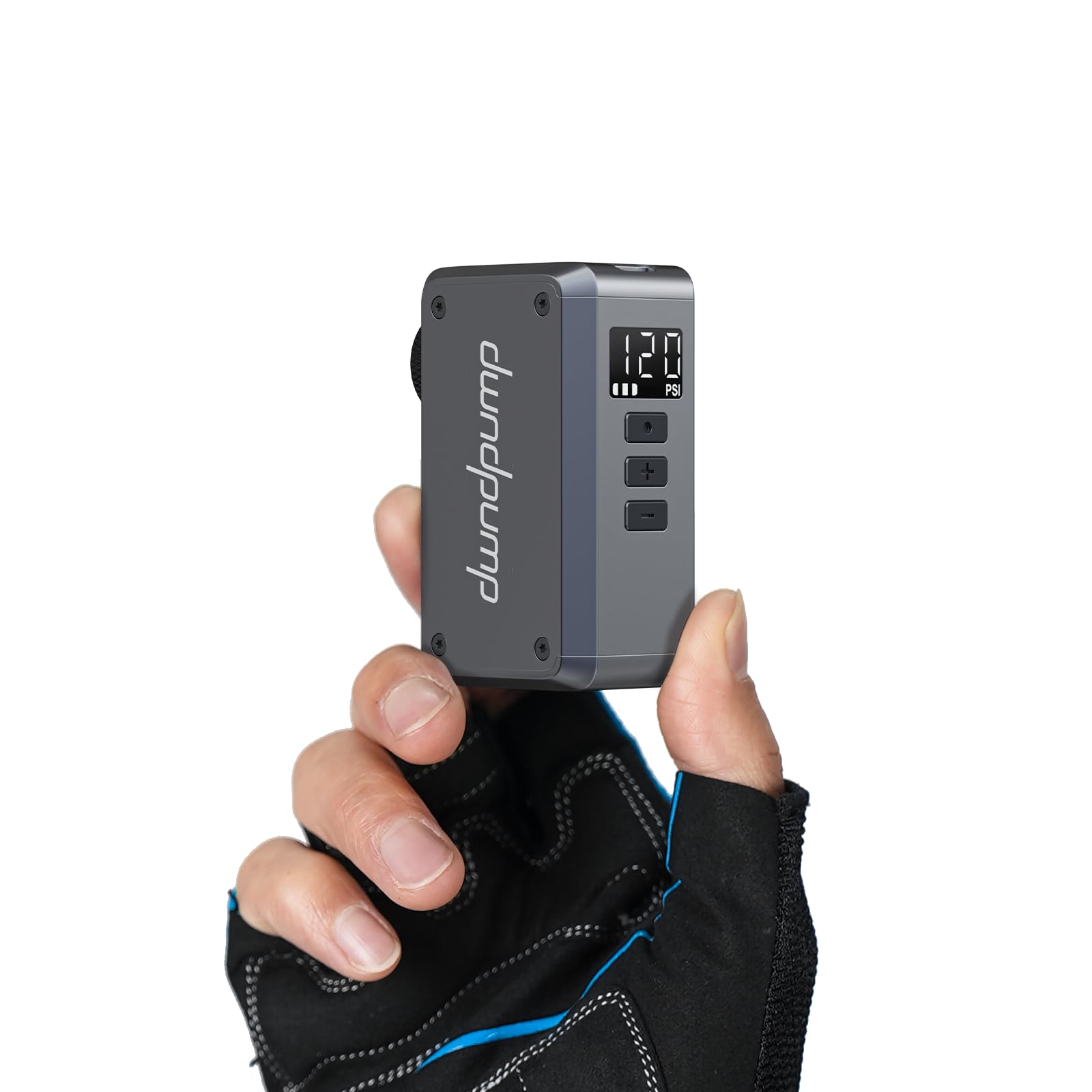
There’s a certain ritual to inflating bike tires that most cyclists know all too well: dig out the hand pump, attach the head, and then spend the next few minutes pushing up and down while trying to keep an eye on the pressure gauge. The dwndpump Mini Bike Pump with Gauge aims to replace that routine with a rechargeable electric unit that fits in a jersey pocket. After several weeks of use on commuter bikes, a road bike, and even a kid’s trailer tire, it’s clear this little pump has a specific place in the cycling world—but it’s not without its quirks.
The first thing you notice is the size. It’s roughly the length of a large marker and about as thick as a standard handlebar grip. That makes it genuinely portable, and it comes with a small fabric pouch that can attach to a frame or slide into a backpack. The built-in digital gauge is a welcome addition; it reads pressure in PSI or BAR and turns off automatically when the set target is reached. That auto-off feature is the headline here, and it works as advertised. You dial in your desired pressure with two small buttons, press the start button, and the pump runs until it hits the number. No over-inflation, no guessing.
In practice, the pump is best suited for topping off tires that are already close to their target. On a 700c road tire that was at 80 PSI and needed to reach 100, it took about three minutes and a couple of battery bars. That’s not lightning fast, but it’s hands-free, so you can check your phone or adjust your helmet while it works. For a completely flat tire, though, you’ll want to be patient. It took nearly ten minutes to bring a 28mm tire from zero to 90 PSI, and the unit got noticeably warm—not hot enough to be alarming, but enough to make you wonder about long-term durability. The motor also gets a bit whiny at higher pressures, which is common for compact electric pumps but worth noting if you’re inflating in a quiet garage early in the morning.
The pump’s hose is short, about six inches, and the head is a standard Presta/Schrader combo that flips over. It works fine on both valve types, though the head feels a little plasticky and requires a firm push to get a good seal. You’ll want to hold it steady while the pump is running, otherwise the vibration can cause it to wiggle loose. That’s a minor annoyance, but it’s the kind of thing that matters when you’re in a hurry.
Battery life is decent for a device this size. A full charge (via USB-C, which is a plus) handled about eight top-off sessions on a 700c tire and one full inflation from flat before needing a recharge. The included cable is fine, but there’s no wall adapter, so you’ll need your own USB charger. The battery indicator is a simple three-LED setup that gives you a general idea of remaining power—not precise, but enough to avoid getting caught short.
Compared to a traditional floor pump, this isn’t a replacement. A floor pump will fill a tire faster, with less effort, and without worrying about battery life. But a floor pump doesn’t fit in a saddlebag. Compared to a manual mini pump, the dwndpump is undeniably easier on your arms, and the auto-off gauge removes the guesswork that often leads to under- or over-inflated tires. For a rider who values convenience over speed, that trade-off makes sense.
There are a few limitations to keep in mind. The pump is rated for 120 PSI, but it struggles to get there on larger volume tires. On a 700x32c commuter tire, it plateaued around 110 PSI and took a long time to reach that. If you ride very high-pressure tires (like track bikes that run 140+ PSI), this won’t cut it. Also, the lack of a pressure release valve means you can’t easily bleed air if you overshoot—though the auto-off makes that less likely. The noise level, as mentioned, is not a dealbreaker but is noticeable.
Who should buy this? Commuters who check their tires weekly and want a quick top-off without dragging out a floor pump will appreciate it. Road cyclists who want a backup for a ride and don’t mind the extra few ounces will find it useful, especially if they’re tired of manual pumping after a flat. It’s also a good option for people with mobility issues in their hands or shoulders, as the electric motor does the work.
Who shouldn’t? If you’re a mountain biker running tubeless tires at low pressures, the auto-off feature is less useful, and the pump’s small cylinder makes it inefficient for filling large volumes. If you’re a mechanic or ride multiple bikes with very different pressure needs, the single-setpoint design (you have to re-enter the target each time) might feel tedious. And if you’re looking for a tool to use for car tires or other high-volume tasks, this is not it—stick with a dedicated compressor.
In the end, the dwndpump Mini Bike Pump with Gauge is a well-executed niche product. It doesn’t replace a good floor pump, and it won’t win any speed awards, but it does what it promises: inflate a bike tire to a precise pressure with minimal effort and in a package that disappears into a pocket. For the right rider, that’s a worthwhile addition to the gear bag.