
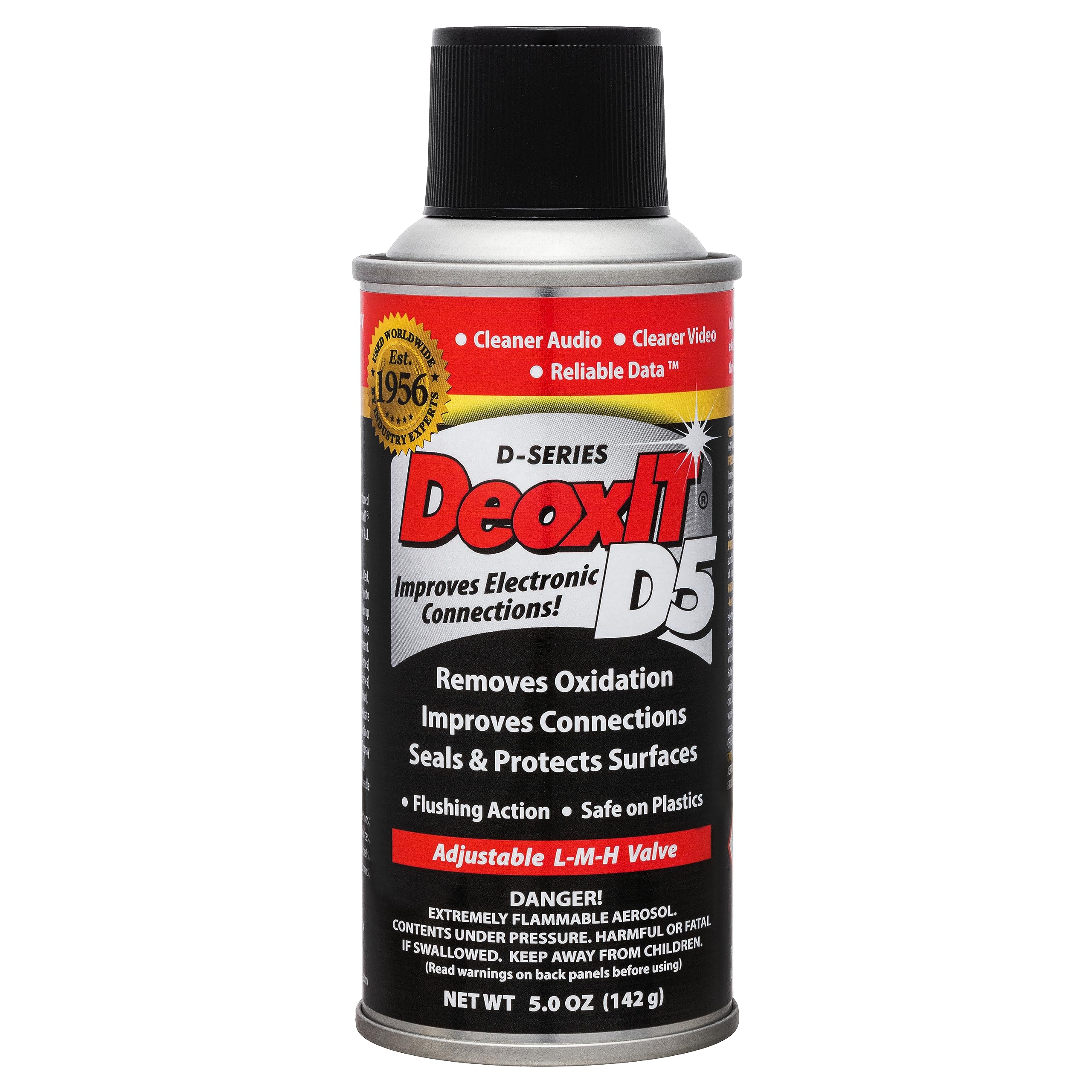
There are certain products that audio technicians, guitar players, and electronics hobbyists swear by, and CAIG Laboratories DeoxIT is definitely one of them. The D5S-6, a 5-ounce spray can of their flagship contact cleaner, has been a staple in repair kits for years. But does it live up to the near-legendary status it enjoys? After spending time with it on a variety of messy, intermittent connections, the answer is mostly yes—with a few caveats worth knowing before you buy.
The primary use case for DeoxIT D5 is straightforward: you spray it on electrical contacts—think jacks, potentiometers, switches, battery terminals—and it dissolves oxidation, corrosion, and general grime that builds up over time. It also leaves behind a thin, protective film that helps prevent future oxidation. I’ve used it on a crackling guitar amp volume knob, a noisy mixer channel fader, and a set of corroded RCA jacks on an old stereo receiver. In each case, the results were noticeable. The crackling in the amp knob disappeared after a quick spray and a few turns. The fader, which had been cutting out entirely, became usable again. The RCA jacks, after a spray and a bit of re-seating, no longer dropped the left channel.
What makes DeoxIT stand out from cheaper contact cleaners is its active chemistry. Most generic electrical cleaners are just solvents that blast away dirt and then evaporate, leaving the metal bare and ready to oxidize again. DeoxIT, on the other hand, contains a proprietary formula that actually neutralizes the oxidation on a molecular level and deposits a micro-thin lubricant layer. This is why it’s often called a “treatment” rather than just a cleaner. The D5S-6 is the 5% solution version, which means it has a lower concentration of the active ingredient compared to the heavier-duty D100 series. For most consumer electronics and audio gear, 5% is plenty. It’s strong enough to tackle years of tarnish but gentle enough not to damage plastics or delicate components.
The spray can itself is well-designed. The nozzle delivers a fine, controlled mist that doesn’t drown the area you’re working on. That’s important when you’re spraying into a small jack or a tight switch mechanism—you want precision, not a flood. The 5-ounce size is also a good middle ground; it’s big enough to handle a few projects without running out, but small enough to keep in a drawer or a gig bag. I’ve had my can for about six months, using it on maybe a dozen different items, and it’s still going strong.
However, there are some trade-offs. First, DeoxIT is not cheap. A single can costs roughly three to four times what you’d pay for a generic contact cleaner from an electronics store. If you’re just looking to blow out a dusty switch and don’t care about long-term protection, a cheaper option will do the job. Second, the solvent has a strong odor—it’s not overpowering, but it’s definitely chemical, and you’ll want to use it in a well-ventilated area. I made the mistake of using it in a small, enclosed workshop once, and the smell lingered for a while. Third, it’s not a miracle worker. If a pot is physically worn out or a jack is mechanically broken, no spray will fix it. DeoxIT can only clean what’s there; it won’t rebuild missing metal or repair a cracked solder joint.
Compared to something like WD-40 Specialist Contact Cleaner, DeoxIT is a different beast. WD-40’s version is faster-drying and leaves almost no residue, which is great if you want a quick fix and don’t mind reapplying. But it doesn’t offer the same protective layer that DeoxIT does. In my experience, DeoxIT’s effects last longer—treatments on my guitar amp have held up for months, whereas a WD-40-style cleaner would have required a re-spray sooner. That longevity is part of what justifies the higher price for many users.
Who is this for? If you’re a musician with a pedalboard full of scratchy pots, a home studio owner with aging gear, or someone who likes to repair rather than replace electronics, DeoxIT D5S-6 is a worthwhile investment. It’s also handy for car audio connections, battery terminals, and even some household items like doorbell buttons or thermostat contacts. On the flip side, if you rarely touch electronics or you’re just doing a one-off clean of a single item, the cost might be hard to justify. A generic cleaner or even isopropyl alcohol with a cotton swab could get you through that one job for a fraction of the price.
One more practical note: the spray can be messy if you overdo it. The liquid is thin and tends to creep, so you should protect surfaces underneath the component you’re cleaning. I’ve had it drip onto a wooden desk and leave a slight residue, though it wiped off easily. Also, let the solvent dry completely before powering the equipment on—it’s not conductive, but it can take a minute or two to evaporate fully, and rushing that step can lead to a brief crackle as the excess burns off.
Overall, the Hosa CAIG DeoxIT D5S-6 is a reliable, effective contact cleaner that lives up to its reputation for most real-world applications. It’s not the cheapest, and it’s not a cure-all, but for anyone who regularly deals with dirty, oxidized connections, it’s a tool that earns its place in the drawer. Just don’t expect it to fix things that are truly broken—and use it with some ventilation.