
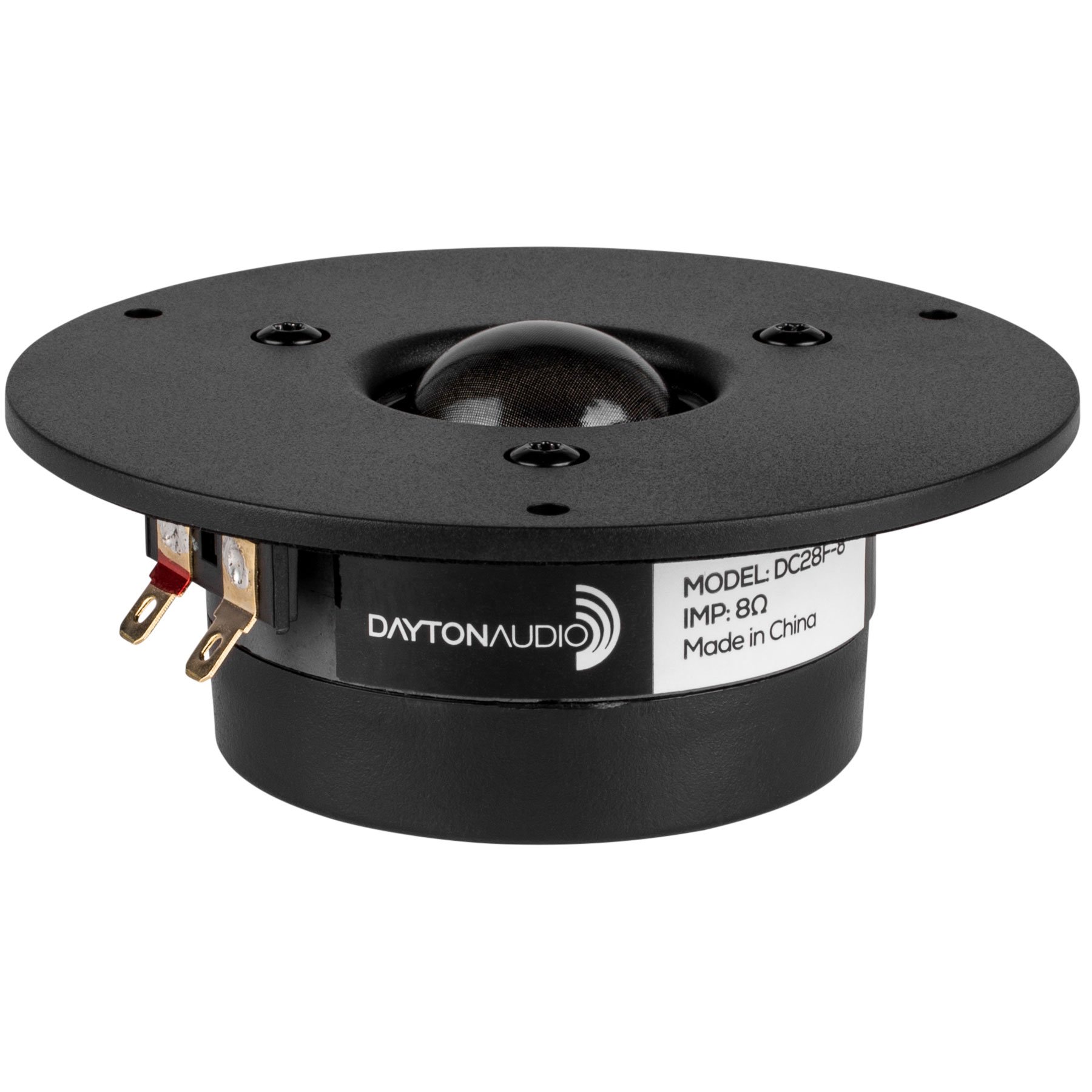
The Dayton Audio DC28F-8 is one of those parts that shows up again and again in DIY speaker builds, and for fairly practical reasons. It is a 1-1/8 inch silk dome tweeter sold as a raw component, not a finished product, so the people buying it are usually building or repairing something rather than plugging it into a shelf system. At its price point it occupies a specific niche: a competent, affordable high-frequency driver for hobbyists who want reasonable performance without spending boutique money.
In real-world use, this tweeter is most often found in two-way bookshelf designs, small monitors, and replacement jobs where a damaged tweeter needs to be swapped out. It has a nominal impedance of 8 ohms and a rated power handling in the range of 50 watts RMS, which places it in the moderate category for a dome tweeter. The faceplate is a standard flush-mount design with a fairly compact footprint, so it fits into many common baffle layouts without requiring unusual cutouts. Builders typically pair it with a midwoofer in the 5- to 7-inch range and cross it over somewhere in the 2,000 to 3,000 Hz region, which is where most of its usable output sits.
Functionally, the silk dome is the defining feature. Silk tends to produce a softer, less forward top end than metal domes, and that character is what draws many people to this driver. It is not a detail-retrieval champion in the way a good hard-dome tweeter can be, but it rarely sounds harsh or fatiguing, which matters for long listening sessions and for rooms with reflective surfaces. The motor uses a ferrofluid-cooled voice coil, a common approach that helps with thermal management and damping. Sensitivity is listed around 90 dB, so it does not demand a high-power amplifier to reach reasonable output levels.
The frequency response is reasonably flat through its intended range but should not be read as perfectly linear. There is a mild rise toward the upper treble in many measurements, and off-axis behavior is typical for a dome of this size rather than exceptional. In practice this means the tweeter works best when crossed over cleanly and aimed reasonably toward the listening position. Builders who expect it to smooth over a poorly designed crossover will be disappointed; it responds to good implementation and exposes lazy ones.
- Type: 1-1/8 inch silk dome tweeter, sold as a raw driver
- Impedance: 8 ohms nominal
- Power handling: roughly 50 watts RMS
- Sensitivity: approximately 90 dB
- Recommended crossover: around 2,000 Hz and up, depending on slope
- Mounting: flush-mount faceplate with standard cutout
One limitation worth stating plainly is that this is not a high-output tweeter. Push it hard in a large room or in a system crossed over too low, and it will run out of headroom before the midwoofer does. The recommended crossover point exists for a reason, and builders who ignore it tend to get distortion or compression at higher volumes. It is also a component with no enclosure, no crossover, and no instructions beyond a datasheet, so it assumes a certain level of comfort with speaker design. Someone looking for a drop-in upgrade with guaranteed results will find the experience frustrating.
Compared with a hard-dome alternative, the DC28F-8 trades some perceived detail and sparkle for smoothness. A metal dome in a similar price bracket might reveal more texture in strings and cymbals, but it can also sound brighter and less forgiving with imperfect recordings. Neither is objectively better; the choice comes down to taste and to how the rest of the system is voiced. Against more expensive silk domes, the Dayton holds its own in tonal character but gives up some refinement and consistency unit to unit, which is a normal trade-off at this price.
As for who should consider it: this tweeter suits DIY builders putting together a first or second pair of speakers, people repairing a cabinet where the original tweeter failed, and anyone who wants a soft-dome sound on a tight budget. It is a sensible choice for a two-way bookshelf crossed over conservatively and driven by a modest amplifier. It is less suitable for high-volume PA use, for three-way designs that need a tweeter to reach very low, or for listeners who prioritize maximum treble detail and air. Those users are better served by a hard-dome unit or a more expensive soft dome with tighter tolerances. Within its intended role, the DC28F-8 does what it is asked to do without drama, which is roughly what a budget raw driver should deliver.