
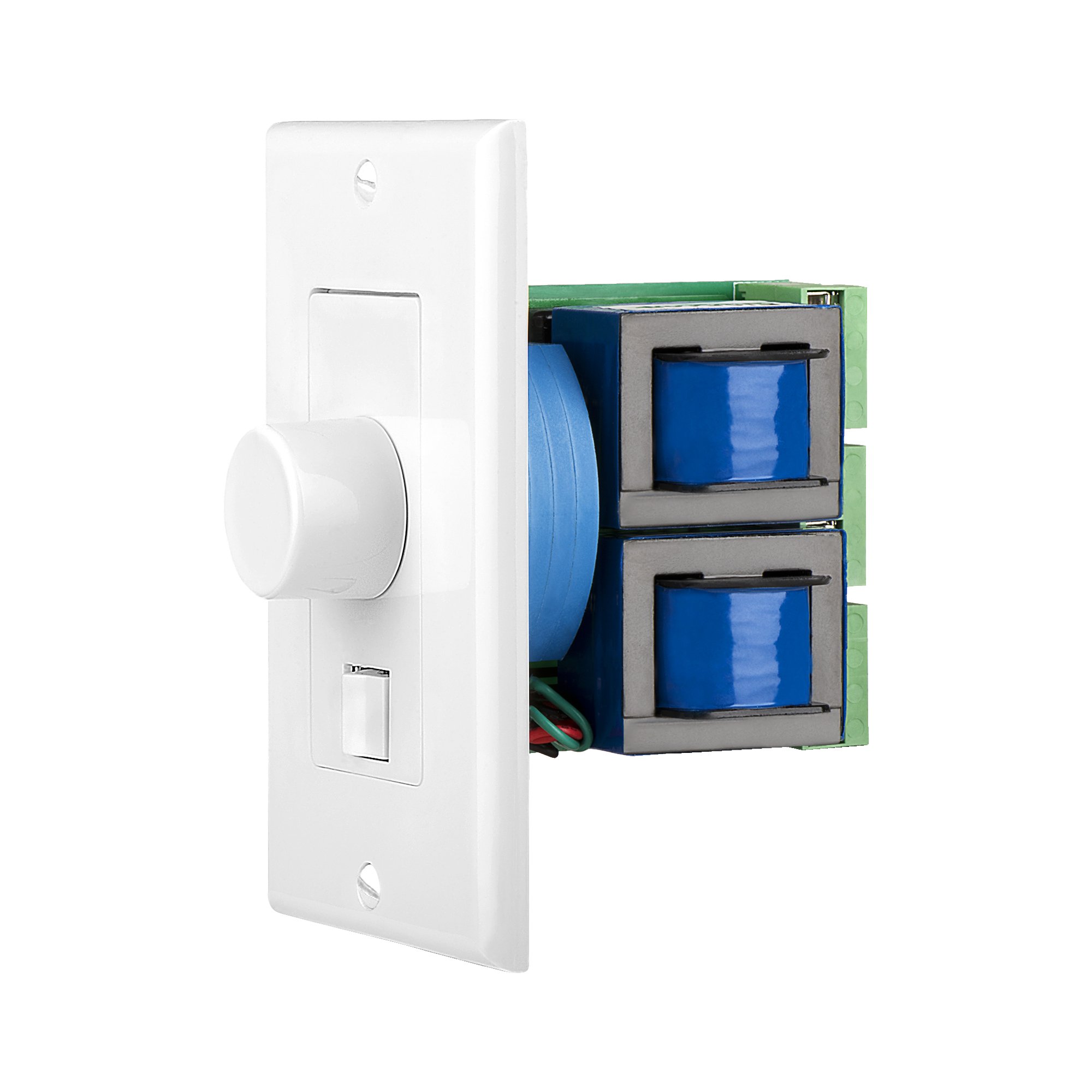
The OSD SVC405 is a passive in-wall volume control aimed at homeowners running a single amplifier across multiple pairs of speakers. It combines a 300-watt rating, impedance matching, and A/B speaker switching in one white wall plate. That combination is less common than it sounds, and it shapes both what the unit does well and where it asks for patience.
Most people encounter a product like this during a renovation or a retrofit. You have an amplifier in a closet or a rack, speakers in a kitchen, a deck, and maybe a bedroom, and you want local control without walking back to the source. The SVC405 installs in a standard single-gang box and sits between the amplifier and the speakers. The front dial handles level, while the A/B selector lets you route signal to one speaker pair or the other from the wall rather than from the amp. In practice, that is useful when two zones share a wall location or when you want to shut off the patio speakers without touching the main system.
The impedance matching is the feature that matters most for multi-zone setups. When several pairs of speakers hang off one amplifier channel, the combined load can drop below what the amp is rated to handle. The SVC405 provides switch-selectable impedance matching so the amplifier sees a safer load. It is a passive solution, which means it does not add power or correct for long cable runs, but it does address the most common cause of amplifier shutdowns in whole-house audio. The 300-watt power handling figure is generous for typical residential speakers and gives headroom for larger amplifiers, though it should be read as a ceiling rather than an invitation to run a high-output amp at full tilt through a passive attenuator.
Construction is functional rather than refined. The plate is white and blends into drywall, and the dial has a positive feel with clear detents. The A/B switch is a physical selector, not a relay-driven remote control, so there is no IR input, no app, and no smart-home integration. That is a deliberate trade-off: fewer parts means fewer failure points and no need for power at the wall location. The downside is that any change to speaker routing requires a walk to the wall plate. If you are used to app-based zone control, this will feel manual.
Real-world performance is best described as transparent when used within its intended range. Passive volume controls of this type attenuate the signal, and at low settings they can introduce a slight loss of high-frequency detail and channel balance drift, particularly with long runs or low-impedance speakers. The SVC405 is no worse than typical competitors in this class, but buyers should not expect the precision of an active preamp or a transformer-based high-end attenuator. At moderate listening levels the difference is minor. At very low levels, the usable range of the dial narrows, which is a common characteristic of passive designs rather than a defect specific to this model.
Compared with a simple single-zone volume control, the SVC405 costs more and takes the same wall space, so the A/B switching has to earn its place. It does if you genuinely have two speaker pairs in one location or want a convenient local mute for a second zone. Compared with a multi-zone amplifier or a networked audio system, the SVC405 is far cheaper and simpler, but it offers no independent source selection, no EQ, and no remote control. It is infrastructure, not a feature set.
Installation assumes basic comfort with low-voltage wiring. The unit needs adequate depth in the wall box, and the wiring is straightforward but polarity-sensitive. Because it is passive, there is no power supply to run, which simplifies the job. The main practical caution is planning: impedance matching settings should be chosen based on how many speaker pairs are connected, and getting that wrong can still stress an amplifier. The manual covers this, but it is not a plug-and-play device for someone unfamiliar with speaker loads.
Who it suits:
- Homeowners with a single amplifier feeding two or more speaker zones who want local level control and A/B routing
- Retrofit or renovation projects where running power to a wall plate is impractical
- Users who prefer physical controls over apps and do not need smart-home integration
Who it does not suit:
- Listeners expecting active gain, EQ, or app-based zone control
- Systems with very low-impedance speaker arrays or unusually long cable runs where passive attenuation losses become audible
- Anyone wanting independent source selection per zone, which requires a different class of hardware
The SVC405 is a sensible, unglamorous piece of gear. It does a specific job, does it without requiring power or network setup, and carries the usual compromises of passive attenuation. Buyers who understand those compromises will find it a practical fit; those expecting modern convenience should look at active or networked alternatives instead.