
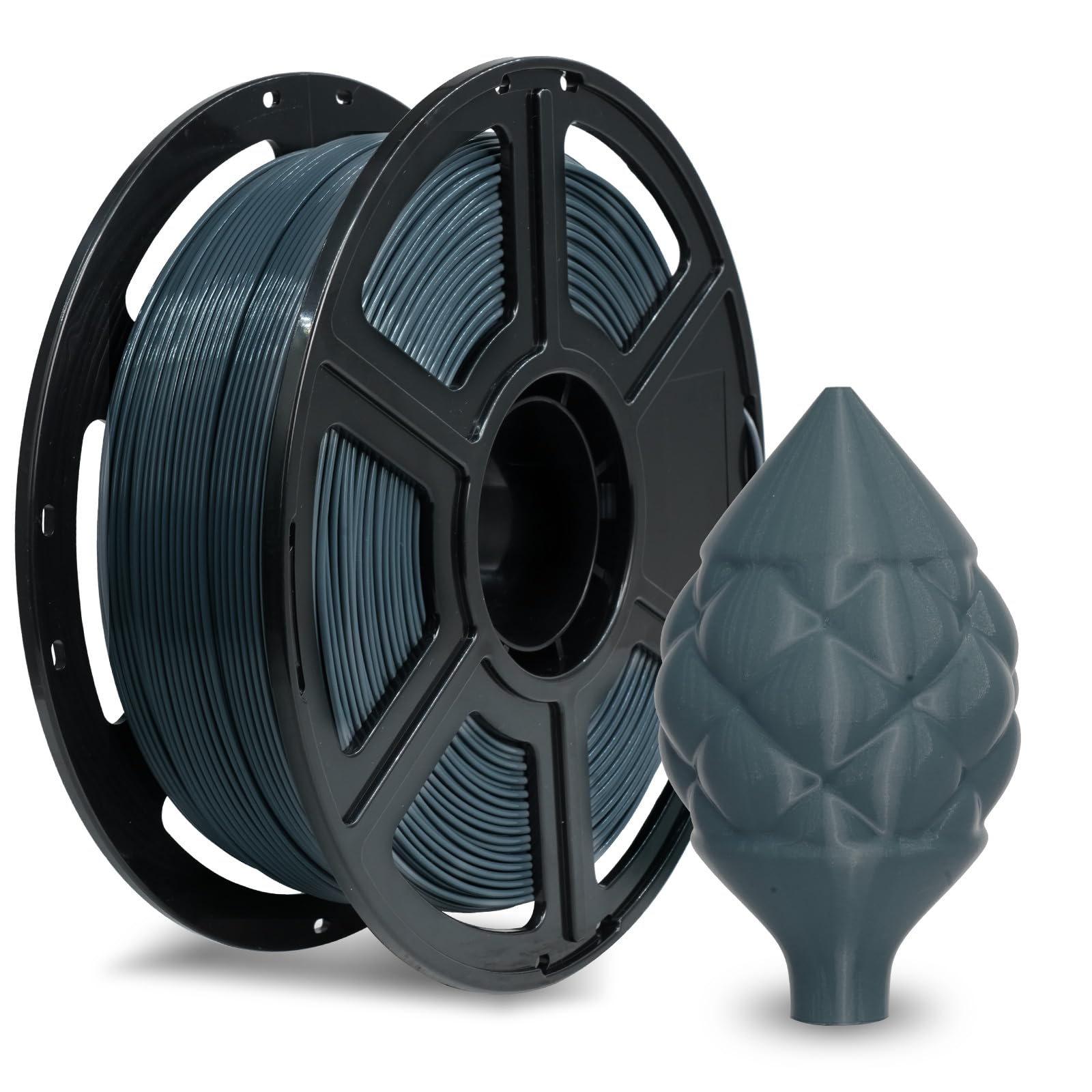
ABS filament remains a staple for makers who need parts that can handle heat and moderate stress, but it’s not without its quirks. FLASHFORGE’s ABS Pro in grey aims to address some of the material’s shortcomings, offering a 1.75mm filament with a claimed dimensional accuracy of ±0.02mm and a hot deformation temperature below 90°C. We put it through its paces to see how it performs in real-world printing scenarios.
Right out of the box, the spool is neatly wound with no obvious tangles, and the grey color is consistent throughout. The filament feels slightly softer than standard ABS, which might be due to the ‘Pro’ formulation—likely a blend designed to reduce warping. FLASHFORGE doesn’t disclose the exact composition, but the printing temperature range (240–260°C) is typical for ABS, and a heated bed is required (80–100°C). We printed on a glass bed with a slurry of ABS juice for adhesion, and results were mixed: small parts adhered well, but larger prints showed corner lifting despite the ‘Pro’ label.
Dimensional accuracy is where this filament shines. Measuring across multiple points, the diameter consistently fell within 1.75mm ±0.02mm, which translated to smooth extrusion and minimal under- or over-extrusion artifacts. Layer adhesion was solid at 250°C, and inter-layer bonding seemed better than generic ABS, likely due to the modified formulation. However, stringing was noticeable, especially on travel moves, requiring retraction tuning (we settled on 2mm at 40mm/s).
The heat resistance claim is worth examining: ‘hot deformation below 90°C’ means the filament starts to soften around that temperature, which is lower than some high-performance materials like polycarbonate but adequate for many functional parts. We tested a bracket left in a car on a sunny day—cabin temperatures can exceed 60°C—and it held up without deformation. For applications near engines or hot machinery, however, 90°C might be insufficient.
Printing ABS Pro requires an enclosure to minimize warping and fumes. Even with the ‘Pro’ formulation, we noticed a distinct odor during printing, though less pungent than standard ABS. Proper ventilation is essential. The filament also benefits from a filament dryer if your environment is humid, as ABS absorbs moisture and can cause popping during extrusion.
Compared to PLA, ABS Pro offers superior heat resistance and impact strength, but PLA is easier to print and doesn’t require an enclosure. Compared to PETG, ABS Pro is tougher and more heat-resistant but trickier to dial in. For those needing engineering-grade parts, ASA is a close alternative with better UV resistance, but ABS Pro is more widely available and often cheaper.
Who is this for? ABS Pro suits experienced users with an enclosed printer who need functional parts that withstand moderate heat and stress—think mechanical prototypes, tool holders, or automotive interior components. It’s also a good choice for those transitioning from PLA to more durable materials.
Who is it not for? Beginners without an enclosure or ventilation will struggle with warping and fumes. Those needing high-temperature resistance (above 90°C) should look to polycarbonate or PEEK. Also, if you prioritize ease of printing and surface finish, PLA or PETG are better options.
Overall, FLASHFORGE ABS Pro delivers on its dimensional accuracy promise and offers improved layer adhesion over standard ABS, but it’s not a miracle cure for warping. It’s a solid choice for makers who understand ABS’s limitations and are willing to put in the tuning work. At around $25–30 per kilogram, it’s priced competitively, but be prepared to invest in an enclosure and ventilation if you haven’t already.