
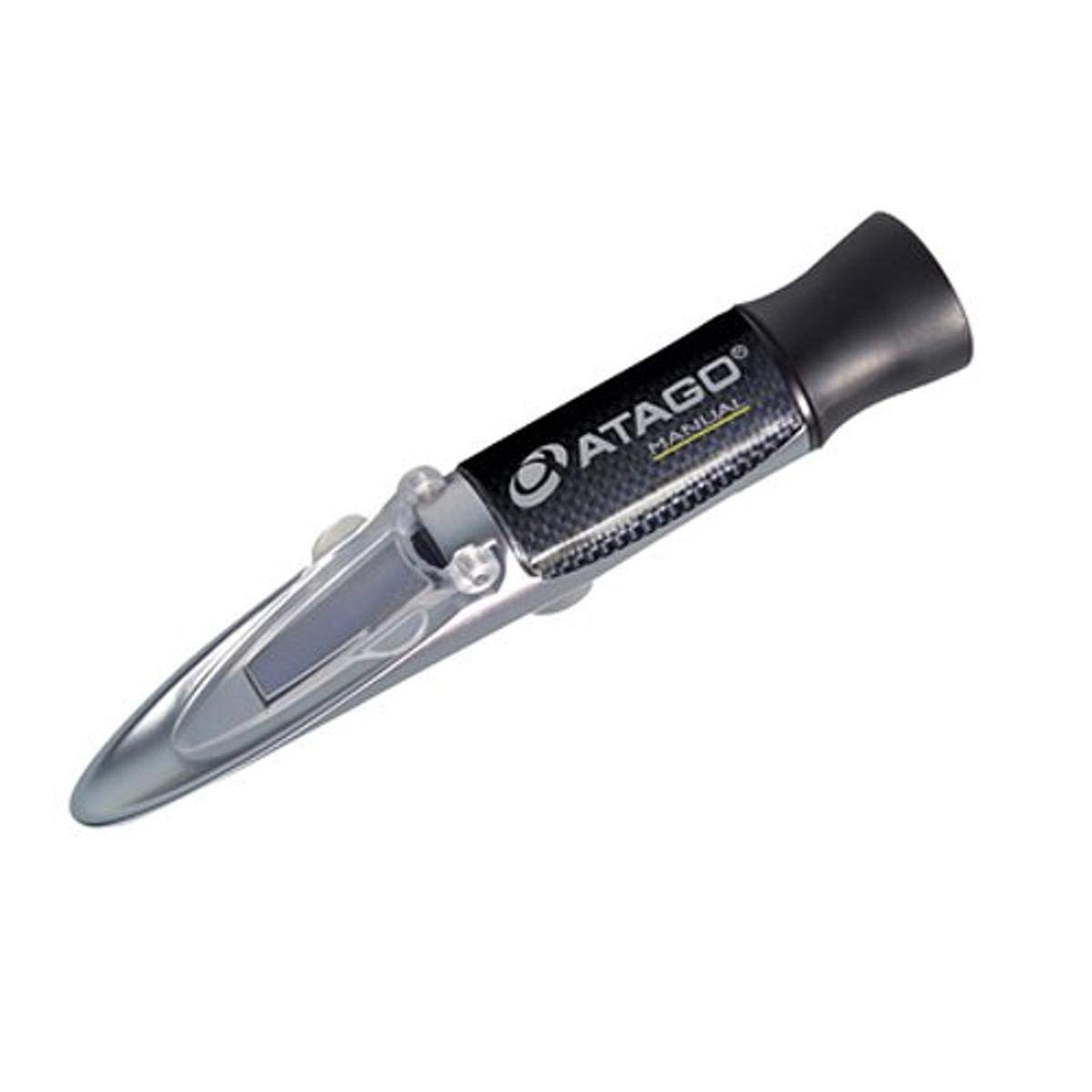
The Atago MASTER-53M is a hand-held refractometer aimed at people who need to measure sugar concentration in samples that run higher than the typical 0–32% Brix range covered by entry-level units. Its 0.0–53.0% scale puts it in the territory of concentrated juices, syrups, jams, and some industrial process liquids, where a standard refractometer would simply run out of scale. Atago is a long-established Japanese optics manufacturer, and the MASTER series is one of its more recognizable product lines in food and beverage quality control.
In practice, a refractometer like this is used by holding a small sample against the prism, closing the cover plate, and looking through the eyepiece against a light source. The boundary line between the light and dark regions of the view indicates the Brix value. This is a routine measurement in juice production, winemaking, jam and confectionery manufacturing, and incoming-ingredient checks at food processing facilities. The MASTER-53M is designed for that kind of repeated bench or field use, and its body is built to be handled rather than babied.
What the instrument actually offers
- Brix range of 0.0 to 53.0%, with 0.5% graduations — a coarser step than laboratory digital units, but workable for most production checks.
- Manual temperature compensation, which means the user must account for sample temperature rather than relying on automatic correction. This is the central trade-off of the model.
- A measurement accuracy of roughly ±0.5% Brix at the specified reference temperature of 20°C.
- An analog optical design with no batteries, no electronics, and no calibration drift from sensors — only periodic zero-setting with water.
- A compact, rubberized body that is easy to carry and reasonably resistant to the knocks of everyday use.
The manual temperature compensation deserves emphasis because it shapes how the device is used. Atago builds automatic temperature compensation (ATC) into several other models in the MASTER line, and those are more forgiving when samples arrive warm from a process line or cold from a cooler. With the 53M, the reading is only reliable when the sample and instrument are near the reference temperature, or when the user applies a correction. In a busy QC setting where samples come straight off a production line, that extra step is a real inconvenience, not a minor footnote.
Where it fits and where it does not
This refractometer makes the most sense for operations that routinely measure high-Brix products and can control sample temperature — for example, a jam producer checking batches at the kettle, or a beverage plant verifying concentrated syrup dilution. It is also a reasonable choice for a small producer who wants a durable, battery-free instrument and is willing to let samples equilibrate before reading. The lack of electronics is genuinely appealing in wet or humid environments where digital units can fog or fail.
It is less suitable for anyone who needs fast readings on samples of varying temperature, or who wants finer resolution than 0.5% Brix. A digital refractometer with automatic temperature compensation will be faster and less operator-dependent, though it costs more and depends on batteries or mains power. For winemaking specifically, many users prefer a scale that reads in both Brix and potential alcohol, which this model does not provide. And for low-sugar applications such as checking cutting fluid or verifying dilute solutions, the 0–53% range is unnecessarily wide and the precision at the low end is limited.
Realistic expectations
This is a dependable optical instrument, not a precision laboratory analyzer. Readings should be treated as accurate to about half a Brix point under good conditions, and operators should expect to zero the unit with distilled water regularly and to clean the prism carefully after sticky samples. The analog eyepiece requires a decent light source and a steady hand; it is not a one-second point-and-read experience. Those who have used cheaper refractometers will notice the build quality, but they will also notice that the manual temperature step slows things down. Buyers should weigh that against the price difference versus an ATC or digital model before committing.