
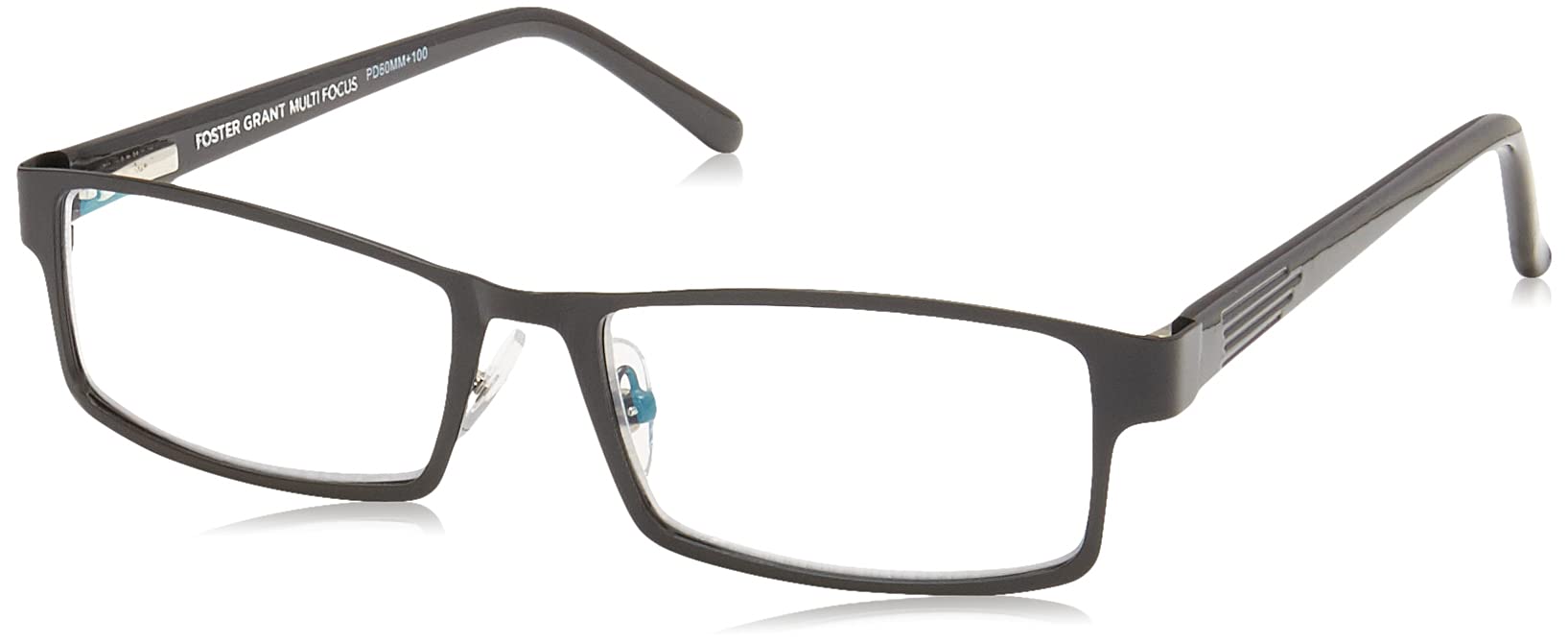
Progressive reading glasses occupy an awkward space in the eyewear market. They promise the convenience of multiple focal zones without the cost of prescription lenses, but they often stumble on execution. The Foster Grant Men’s Sawyer Multi Focus Progressive Reading Glasses, +2.5, are a case study in that compromise: they get some things right, but they also make clear where the limits of over-the-counter progressives lie.
The Sawyer model is aimed at men who need a little help up close but don’t want to swap glasses every time they glance at a screen or across the room. The +2.5 strength is at the higher end of the reading spectrum, typically for people who need significant magnification for close work. The glasses feature a multi-focus lens design: a reading zone at the bottom, an intermediate zone in the middle, and a distance zone at the top. The idea is that you can wear them continuously and shift your gaze rather than your eyewear.
In real-world use, that’s the appeal. Imagine you’re at a hardware store comparing part numbers on a box (close), then looking up to find the aisle sign (distance). Or you’re in a meeting, glancing between your laptop (intermediate) and a whiteboard (distance). The Sawyers are meant to handle those transitions without the hassle of removing your glasses. The frames are a classic rectangular shape with a matte finish, and they feel reasonably sturdy for the price. The lenses have a slight tint—not enough to distort color, but enough to take the edge off bright indoor lighting.
But the multi-focus design comes with trade-offs. The reading zone is relatively small, so you need to position your head precisely to get a clear view. The intermediate zone is narrow, which can make computer work feel like you’re constantly adjusting your posture. And the distance zone, while present, isn’t as sharp as what you’d get from a dedicated distance pair. These aren’t flaws unique to Foster Grant; they’re inherent to the progressive format, especially in lower-cost lenses. The Sawyers perform about as well as you’d expect for the price, but they won’t match the seamlessness of prescription progressives.
One limitation that stands out is the adaptation period. Progressive lenses, even simple ones, require your brain to learn to ignore the peripheral distortion. For some users, that takes days; for others, it never fully clicks. The Sawyers have noticeable swim in the periphery, and the transition between zones is more abrupt than on higher-end lenses. If you’re new to progressives, be prepared for a learning curve. Also, the +2.5 strength is strong enough that the reading zone is quite magnified, which can make the distance zone feel comparatively weak. That’s physics, not a defect, but it’s worth noting.
Compared to a dedicated pair of single-vision reading glasses, the Sawyers offer more versatility but less optical clarity for close work. Single-vision readers are simpler, cheaper, and provide a wider field of view for reading. If your day is mostly reading and you only occasionally need distance vision, a single-vision pair might serve you better. On the other hand, if you’re constantly switching between near and far tasks, the Sawyers could reduce the juggling. They’re also a step up from bifocals in terms of appearance—no visible line—though the progressive design means you’ll still need to point your nose at what you want to see.
Who are these glasses for? They suit men who are already comfortable with progressive lenses and want a spare pair for home or light outdoor use. They’re also a reasonable option for someone who needs occasional help with intermediate distances (like computer work) but doesn’t want to commit to prescription eyewear. The +2.5 strength is best for those who need strong magnification for close tasks—think reading fine print or doing detailed hobbies. Who are they not for? Anyone who demands crisp vision across the entire lens, or who is sensitive to peripheral distortion. They’re also not ideal for driving, since the distance zone isn’t designed for that, and the tint might be problematic at night. And if you’ve never worn progressives, trying to adapt to them in a cheap pair might sour you on the concept entirely.
In terms of build, the Sawyers have a plastic frame that feels lightweight but not flimsy. The hinges are standard spring hinges, which add a bit of durability. The lenses are acrylic, which is common at this price point; they’re more prone to scratching than glass or polycarbonate, so you’ll want to store them in a case. The glasses come with a cleaning cloth and a soft pouch, but no hard case—a minor omission.
Ultimately, the Foster Grant Sawyer Multi Focus Progressive Reading Glasses are a utilitarian solution for a specific need: cheap, convenient eyewear for people who want some degree of seamless vision without a prescription. They’re not a replacement for proper optometric care, and they won’t wow you with optical performance. But for the price, they offer a practical way to experiment with progressives or to have a backup pair. Just go in with realistic expectations: these are a compromise, and they perform like one.