
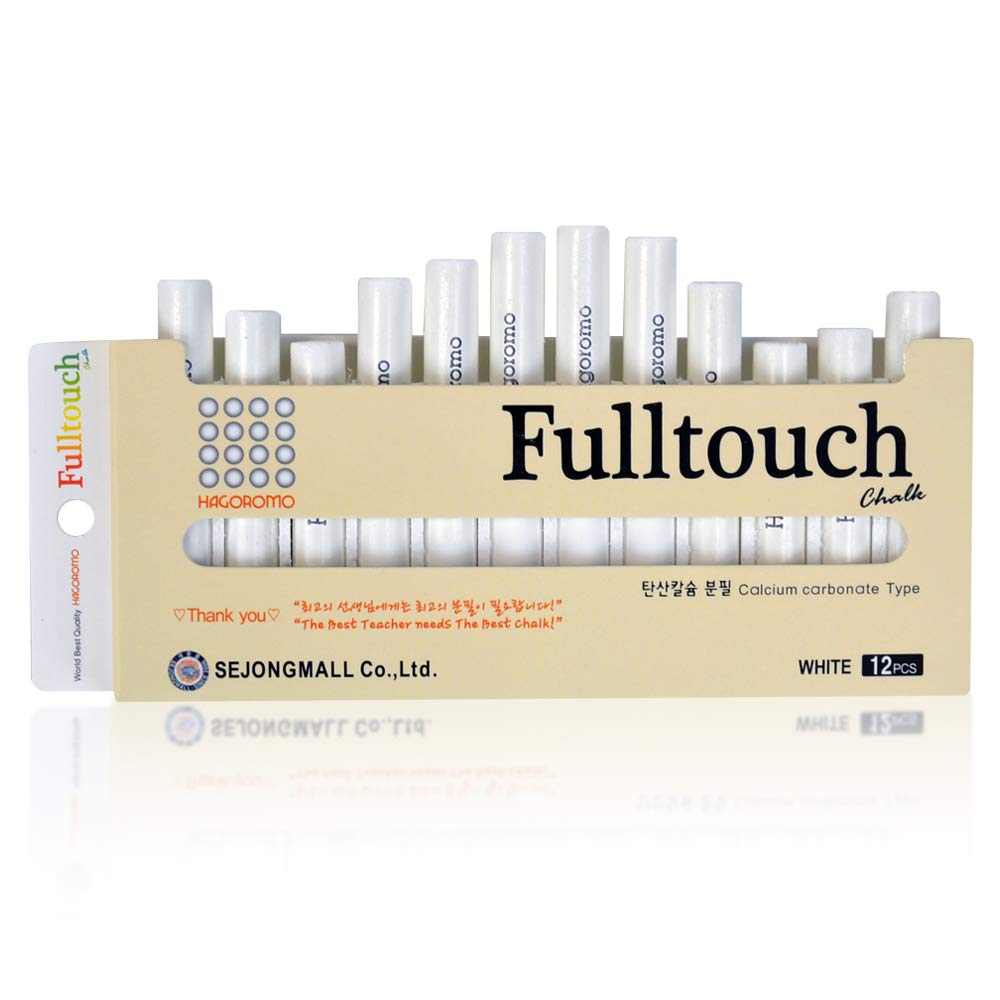
Chalk is one of those products most people stop thinking about after grade school, but anyone who still writes on a blackboard—teachers, math lecturers, coaches diagramming plays, restaurant owners updating a sidewalk board—knows the difference between a decent stick and a bad one is felt immediately. The Hagoromo Fulltouch is a Japanese chalk that developed a cult following among mathematicians and educators, and a box of 12 white pieces is the most common way it’s sold. This review looks at what that box actually delivers in day-to-day use, and where it falls short of the reputation that precedes it.
The first thing to understand is that Fulltouch is a softer, denser chalk than the cheap dust-producing sticks sold in bulk office packs. In practice, that means it lays down a more opaque line with less pressure. On a standard green or black porcelain board, a single pass produces a solid white stroke rather than the faint, scratchy trail you get from harder chalk. That opacity is the main reason lecturers like it: equations and diagrams remain legible from the back of a large room, and you don’t have to press hard enough to fatigue your hand during a long session. The 12-piece box is a practical quantity for a classroom or a home office—enough to keep a couple of pieces in rotation without committing to a case of 72.
Dust is the other half of the chalk equation, and here the Fulltouch is better than average but not magical. It produces noticeably less airborne dust than generic school chalk, and what does fall tends to be heavier and settle rather than hang in the air. Anyone who has wiped down a board after a long lecture will notice the difference. That said, it is still chalk. If you are sensitive to dust or work in a room with poor ventilation, no stick of calcium carbonate is going to solve that for you; a dustless liquid marker or a whiteboard is the more sensible choice. The reduced-dust claim should be read as relative, not absolute.
On feel, the Fulltouch has a slightly waxy, smooth glide that many users describe as pleasant. It doesn’t squeak or catch on the board the way harder chalks sometimes do, and it holds its shape reasonably well. Breakage is a real consideration, though. Because the sticks are softer, they snap more easily if dropped or pressed at an angle, and a piece that breaks in half is annoying mid-lecture. The box itself is a simple cardboard sleeve—functional, not protective—so storing the chalk loose in a bag will cost you a few pieces over time. A small tin or a dedicated chalk holder helps, and many regular users pair the Fulltouch with a holder for exactly this reason.
How does it compare to alternatives? Against standard economy chalk, the Fulltouch is clearly denser and more opaque, and the reduced dust is a genuine quality-of-life improvement for daily board work. Against dustless or low-dust specialty chalks from other brands, the gap narrows; some competitors are comparably smooth and cost less per box. Against whiteboard markers, chalk still wins on tactile feedback and the absence of solvent smell, but loses on mess and cleanup. The honest framing is that Fulltouch sits near the top of the conventional chalk category rather than transcending it—you are paying a premium for a better-than-average stick, not a different product category.
Value is where expectations need calibrating. A 12-piece box of imported Japanese chalk costs meaningfully more than a bulk pack of domestic chalk, and for occasional use—a grocery list on a kitchen board, a child’s easel—that premium is hard to justify. The people who get their money’s worth are those writing on a board for hours a week: math and science instructors, tutors, calligraphers practicing on chalkboards, and anyone who cares about line quality and dust. For a casual user, a cheaper box will do the job with only minor compromise.
It is worth noting the color question as well. This box is white only, which is fine for general writing and diagrams but limits you if you color-code—underlining in yellow, marking corrections in red. Buyers who want a multicolor set will need to purchase those separately, and the white-only box is best treated as a refill for a system that already includes other colors.
Overall, the Hagoromo Fulltouch is a well-made, genuinely pleasant chalk that earns its reputation among heavy board users, with the caveats that it breaks more readily than harder chalk, costs more than commodity options, and still generates dust despite the low-dust billing. It is a sensible purchase for teachers and frequent blackboard writers who notice the difference; it is overkill for light, occasional use.
- Best suited to: teachers, lecturers, tutors, and anyone writing on a blackboard for extended periods who wants opaque lines and less airborne dust.
- Less suitable for: casual or occasional users, people in poorly ventilated rooms, and anyone who needs multiple colors in one purchase.
- Watch for: easier breakage than harder chalks and a simple cardboard box that offers little protection in transit or storage.