
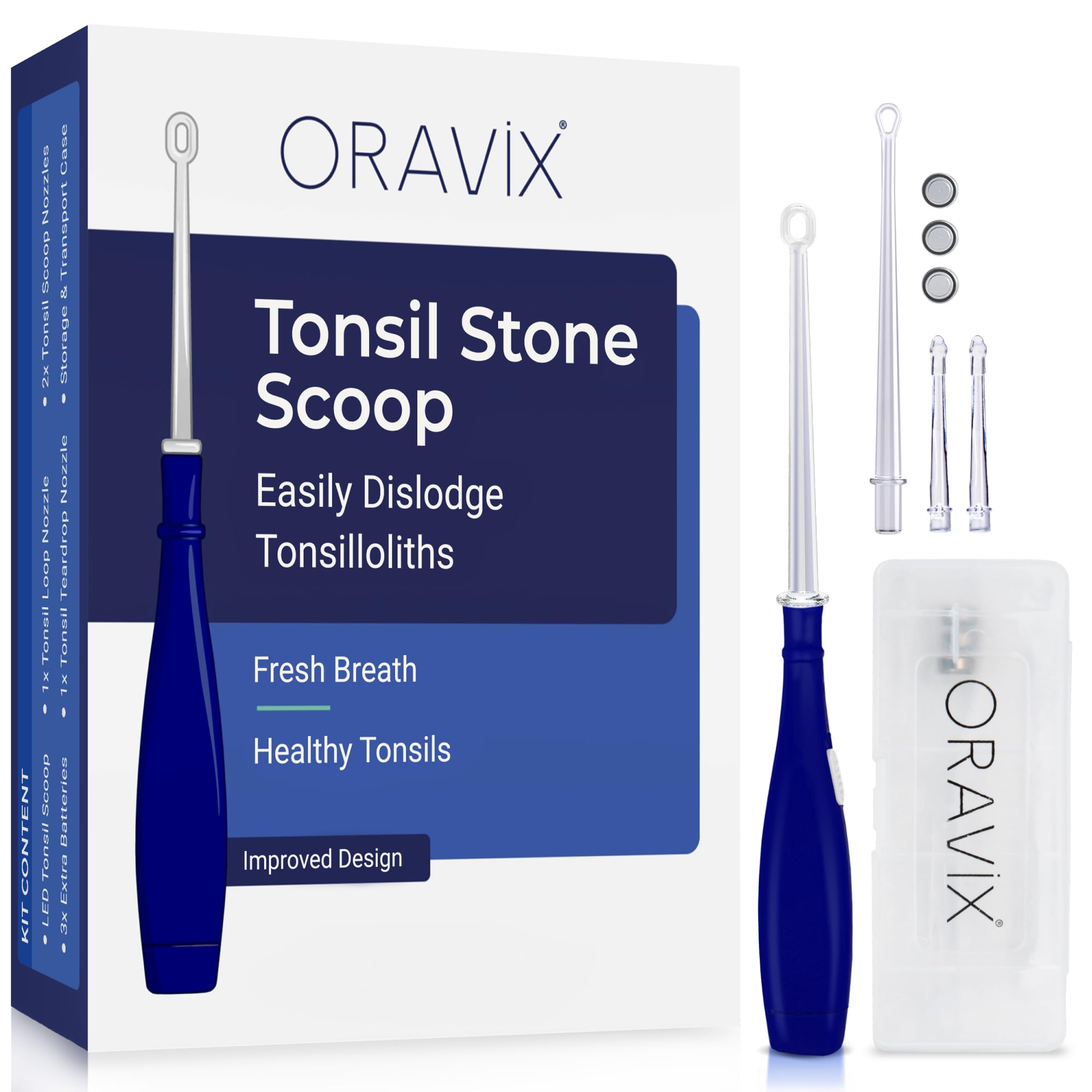
Tonsil stones are one of those problems that most people don’t discuss until they notice a persistent sour taste, a nagging cough, or a small pale lump lodged in the back of the throat. The Oravix Tonsil Stone Remover is a two-piece kit aimed at people who have already identified the problem and want a way to deal with it at home rather than in a clinic. The package includes a lighted handle, three interchangeable nozzles, and a separate curettage pick, sold as a two-pack.
The core idea is straightforward: a slim wand with a small tip that can reach into the tonsillar crypts, paired with an LED so you can see where you’re aiming. The three nozzles vary in shape, presumably to suit different crypt sizes and angles, and the curette pick is a curved metal-style tool for hooking stones out rather than flushing or suctioning them. It is not a water irrigator and it does not vibrate—this is a manual, mechanical approach.
In real use, the process looks like this: you stand in front of a mirror, tilt your head back, open wide, and use the light to locate the crypt openings. The wand goes in, the tip nudges around the edges of a stone, and the pick or nozzle helps dislodge it. Most people will find the first few attempts awkward, partly because the gag reflex is unforgiving and partly because the tonsils are not the easiest anatomy to self-instrument. The LED helps more than you might expect in a dim bathroom, though it also creates glare on saliva, which can obscure the view.
What the kit actually offers
- A lighted handle with a small LED near the tip, intended to illuminate the back of the throat
- Three nozzle tips of differing shapes for navigating crypts
- A separate curved curettage pick for hooking or lifting stones
- Two complete sets in the box, which is useful for a household or as a spare
Functionally, the nozzles are the part that matters most. Narrow crypts need a thin tip, and wider ones can take a broader tool, so having options is a reasonable design choice rather than a gimmick. The curette pick is the more decisive instrument—when a stone is partially exposed, a curved hook can pop it free in seconds where a blunt tip just pushes it around. The trade-off is that the pick requires more precision and a steadier hand, and pressing too firmly against tonsil tissue is uncomfortable at best.
The most obvious limitation is the learning curve combined with the gag reflex. No tool design fully solves the fact that reaching the back of your own throat triggers a retch response in many people. The slim profile helps, but this is still a device that some users simply cannot tolerate, and that is worth knowing before buying. The LED is also modest—bright enough to be useful, not bright enough to replace a good overhead light and a mirror. And because this is a manual tool, it only removes stones you can see and reach; deeply embedded stones or large cryptic collections may need professional attention.
It is also worth comparing this to the alternatives. A water flosser with a soft tip is a common DIY option and can flush out small stones without touching tissue, but it is bulkier, messier, and easy to aim too aggressively. A simple cotton swab or the rounded end of a toothbrush is the zero-cost option, though neither offers light or a purpose-built tip. The Oravix sits between those: more precise than a swab, less forceful than irrigation, and cheaper than a dental visit. It is also less intimidating than the curved dental instruments some people buy, though the curette here is essentially a small version of the same idea.
Hygiene deserves a mention. Anything that goes into the mouth and contacts tonsil tissue should be cleaned before and after each use, and the nozzles should be sanitized regularly. The two-pack helps here—you can rotate sets—but the tool is small enough that storage and cleaning are minor chores rather than major ones.
Who it suits and who it doesn’t
This kit makes sense for adults who get occasional, visible tonsil stones and have a reasonably strong gag reflex. It is also a reasonable pick for someone who has tried swabs and wants something with light and a proper tip. It is not a good fit for people with a strong gag reflex, children, anyone with active throat infections or sore tonsils, or those whose stones are large, deep, or recurrent enough to warrant an ENT evaluation. People expecting a suction device or an irrigator will be disappointed—this removes stones mechanically, one at a time.
Overall, the Oravix is a modest, functional tool that does what it claims within the limits of a manual device. It won’t eliminate the underlying tendency to form stones, and it demands some patience and practice. But as a low-cost, at-home option for visible stones, it is a sensible addition to a bathroom cabinet—provided you can tolerate the reach.