
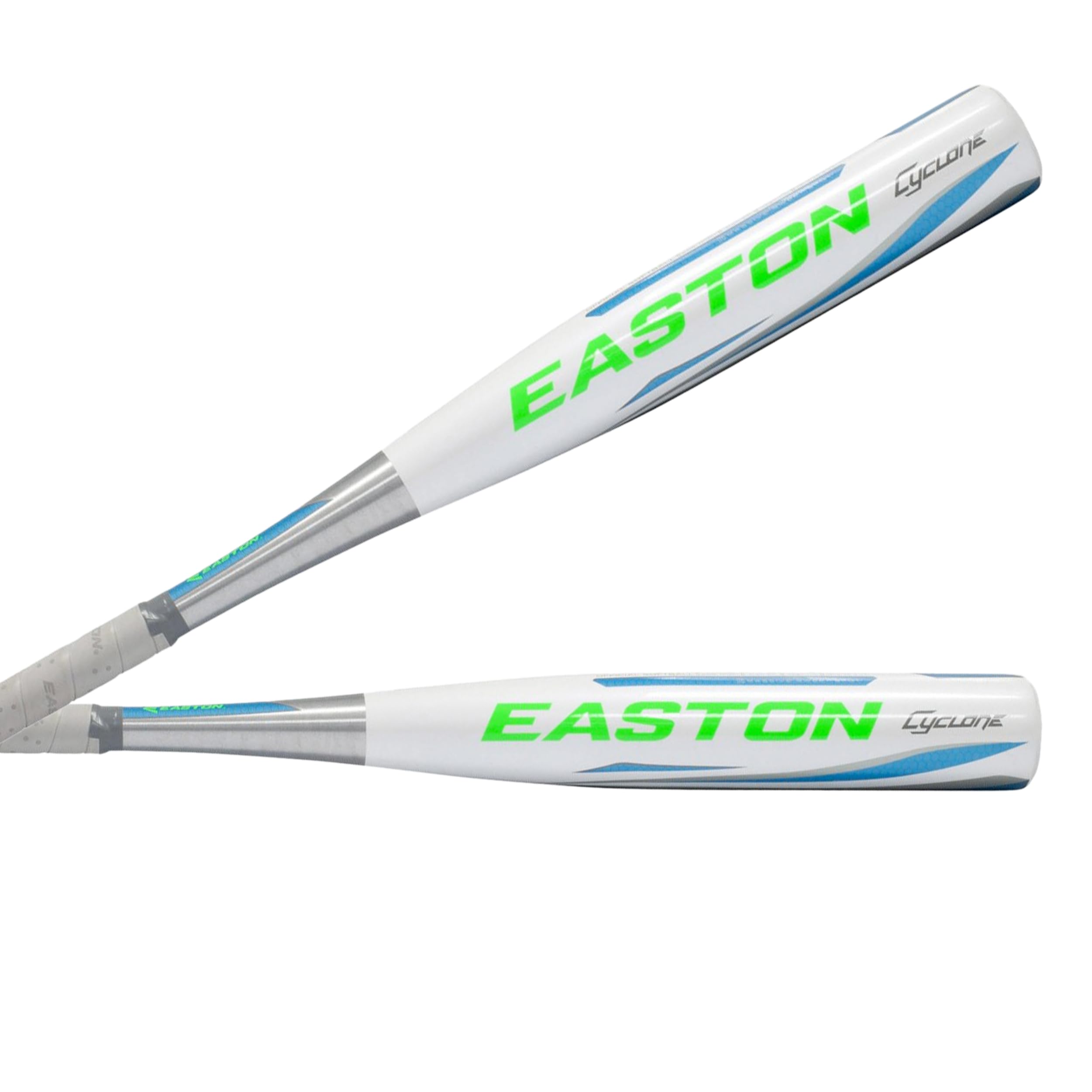
The Easton CYCLONE sits in a crowded tier of fastpitch bats aimed at players who are either new to the sport or moving up through youth divisions. At a -10 drop with a 31-inch length, this particular configuration targets a specific slice of the market: hitters who have outgrown their first tee-ball or coach-pitch bats but aren’t yet ready for the heavier, higher-performance composites that dominate travel ball. Understanding where that line falls is the key to deciding whether this bat makes sense.
In practice, the CYCLONE is most often seen in rec league dugouts, middle school programs, and backyard batting cages. It’s the kind of bat a parent buys when a daughter is transitioning from a 28- or 29-inch bat into something with more reach, or when a coach needs a durable team bat that can survive a season of shared use. The 31-inch, 21-ounce build (that’s the -10 drop in action) is light enough for most pre-teen and early-teen hitters to swing without dragging through the zone, which matters more than raw pop at this stage of development.
The construction is aluminum alloy, which is the defining characteristic here. Easton doesn’t publish an elaborate multi-piece composite story for the CYCLONE, and that’s appropriate for its price point. What you get is a one-piece alloy design with a fairly traditional barrel profile. The balance leans toward the handle, which helps younger hitters get the barrel around on inside pitches without fighting the bat. The grip is a standard cushioned wrap, functional if unremarkable, and the knob is contoured enough to avoid the sting you’d get from a bare metal edge.
Where the CYCLONE earns its keep is durability and consistency. Alloy bats in this class tend to hold their performance longer than entry-level composites, and they don’t require the same break-in period. There’s no worrying about whether a composite barrel has been properly broken in before a big game. For rec programs that hand bats from player to player, that’s a genuine practical advantage. The sweet spot is moderate rather than generous, so mishits toward the end of the barrel will produce noticeable vibration and reduced exit velocity. Hitters who consistently find the middle will get reasonable results; those who don’t will feel it.
It’s worth being candid about performance ceilings. The CYCLONE is not a bat that will transform a hitter’s power numbers. Compared to a two-piece composite fastpitch bat in the $250–$350 range, the difference in ball exit speed on well-struck balls is real, even if it’s not dramatic for a developing player. The alloy barrel also tends to feel stiffer on contact, and some hitters—particularly those who’ve spent time with composites—describe the feedback as harsh. That stiffness can be useful for teaching players to feel where they made contact, but it’s not a forgiving feel.
Another trade-off is the -10 drop itself. It’s a sensible middle ground, but it won’t suit every 31-inch hitter. A stronger, more experienced player at that length will likely want a -9 or -8 for better mass behind the ball, while a smaller player might be better served by staying at 30 inches with the same drop. The 31/-10 combo is a compromise, and like most compromises, it fits a range of players adequately without being ideal for any single one.
Compared to a similar entry-level alloy bat from another brand—think of the general category of sub-$100 one-piece aluminum fastpitch bats—the CYCLONE is competitive but not distinctly superior. Fit and feel come down to individual preference, and there’s little in the spec sheet that separates it from the pack. Where it does have an edge is availability and brand support; Easton’s warranty process is well-established, and replacement or repair is straightforward if something goes wrong.
Who should consider it: families looking for a first “real” fastpitch bat for a player aged roughly 9 to 12, rec league coaches needing durable team equipment, and anyone who wants an alloy bat for practice or cage work without spending composite money. The CYCLONE is also a reasonable backup bat for a player who has a primary composite but wants something sturdier for cold-weather practices, where composite bats are more prone to cracking.
Who should look elsewhere: advanced travel-ball players in the 12U and up range who need maximum pop, hitters who prefer the softer feel of a two-piece composite, and anyone at 31 inches who is physically strong enough to handle a heavier drop. Players with a well-developed swing will likely outgrow the CYCLONE’s performance ceiling within a season or two.
The honest summary is that the Easton CYCLONE is a competent, no-frills alloy bat that does what an entry-level bat should do: it’s durable, reasonably balanced, and priced for families testing the waters of competitive fastpitch. It won’t be the bat a player remembers fondly a decade later, but it will get a young hitter through practices and games without drama. That’s a modest goal, and the CYCLONE meets it without pretending to be more than it is.