
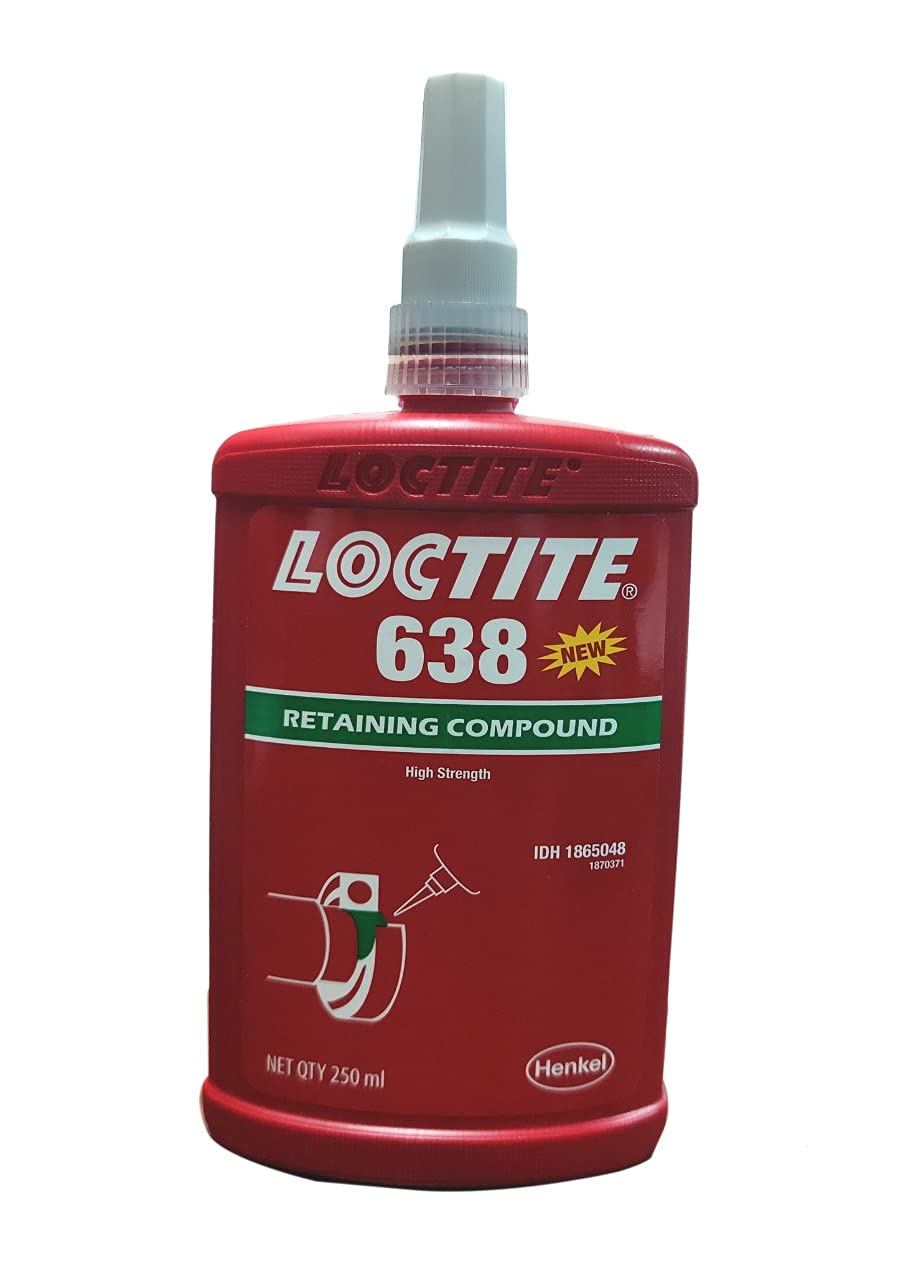
Loctite 638 is a green, high-strength anaerobic retaining compound intended for cylindrical fitting applications—the kind of assembly where a bearing, bushing, or gear is pressed onto a shaft and needs to stay put. It is a specialist product, not a general-purpose adhesive, and it makes more sense once you understand what it is actually designed to do. The 250 mL bottle is a workshop-sized container aimed at people who use the material regularly rather than a single repair job.
In practice, 638 fills the microscopic gaps between mating cylindrical parts and cures into a hard, load-bearing plastic when air is excluded. It is commonly used to retain bearings in housings, secure worn shafts and keyways, mount bushings, and take up clearance in loose-fitting assemblies where a press fit has lost its interference. The green color is a Loctite convention that distinguishes it from threadlockers and other retaining grades. Typical application involves cleaning both surfaces, applying a bead around the shaft and inside the bore, assembling promptly, and allowing the compound to cure—often with a primer on inactive metals or at low temperatures. Full strength develops over roughly 24 hours, though handling strength comes much sooner.
Functionally, the product is defined by its high shear strength and its ability to withstand sustained loads once cured. Loctite rates it for shear strengths in the range of several thousand psi on steel, and it resists moderate heat and oil exposure better than general-purpose retaining compounds. It is also designed to fill larger gaps than some lower-viscosity grades, which matters when a fit is genuinely worn rather than merely loose. The 250 mL bottle suits repeated use, but it is worth noting that anaerobic compounds cure in the presence of metal and the absence of air—so the bottle itself stays liquid, but shelf life is finite and the date matters.
The main trade-off is disassembly. High-strength retaining compounds are not meant to come apart easily. Removing a part secured with 638 typically requires heat—often around 250°C—and mechanical force, which can damage bearings or seals in the process. For components that need routine service or adjustment, a medium-strength retaining compound or a conventional press fit with a lower-strength grade is usually the more sensible choice. There is also the matter of surface preparation: oily or contaminated parts will compromise the bond, and the compound performs poorly on certain plastics and on some plated or anodized surfaces without a primer. It is not a substitute for proper machining when a fit is badly out of tolerance, either; it takes up small clearances, not structural damage.
Compared with a general-purpose epoxy or a liquid metal filler, 638 is more specialized but better suited to cylindrical assemblies. Epoxies bond a wider range of materials and fill larger voids, but they are less predictable in dynamic, load-bearing shaft fits and are harder to apply evenly around a bore. A medium-strength retaining compound such as Loctite 641 offers easier disassembly at the cost of load capacity, which is the more appropriate trade for equipment that gets serviced. Threadlockers are a different category altogether and should not be confused with retaining compounds despite the shared brand and anaerobic chemistry.
Who is this for? It suits mechanics, machinists, and maintenance technicians dealing with bearing retention, worn shafts, and press-fit repairs where a permanent, high-strength joint is acceptable. It also works for hobbyists rebuilding machinery who understand the disassembly implications. It is not a good fit for anyone who may need to remove the part later without heat, for bonding non-cylindrical joints, or for plastics and materials that the anaerobic chemistry does not suit. The 250 mL size is generous for occasional users—a smaller bottle may be more practical unless the volume will genuinely be consumed before it ages.
Performance expectations should be realistic: 638 holds well when surfaces are clean, the gap is within its fill range, and the cure is given time. It will not rescue a badly worn shaft or a cracked housing, and it will not match a properly machined interference fit in high-load or high-vibration applications. Treated as a retaining compound for the jobs it was designed for, it is a dependable workshop staple; treated as a universal fix, it will disappoint.