
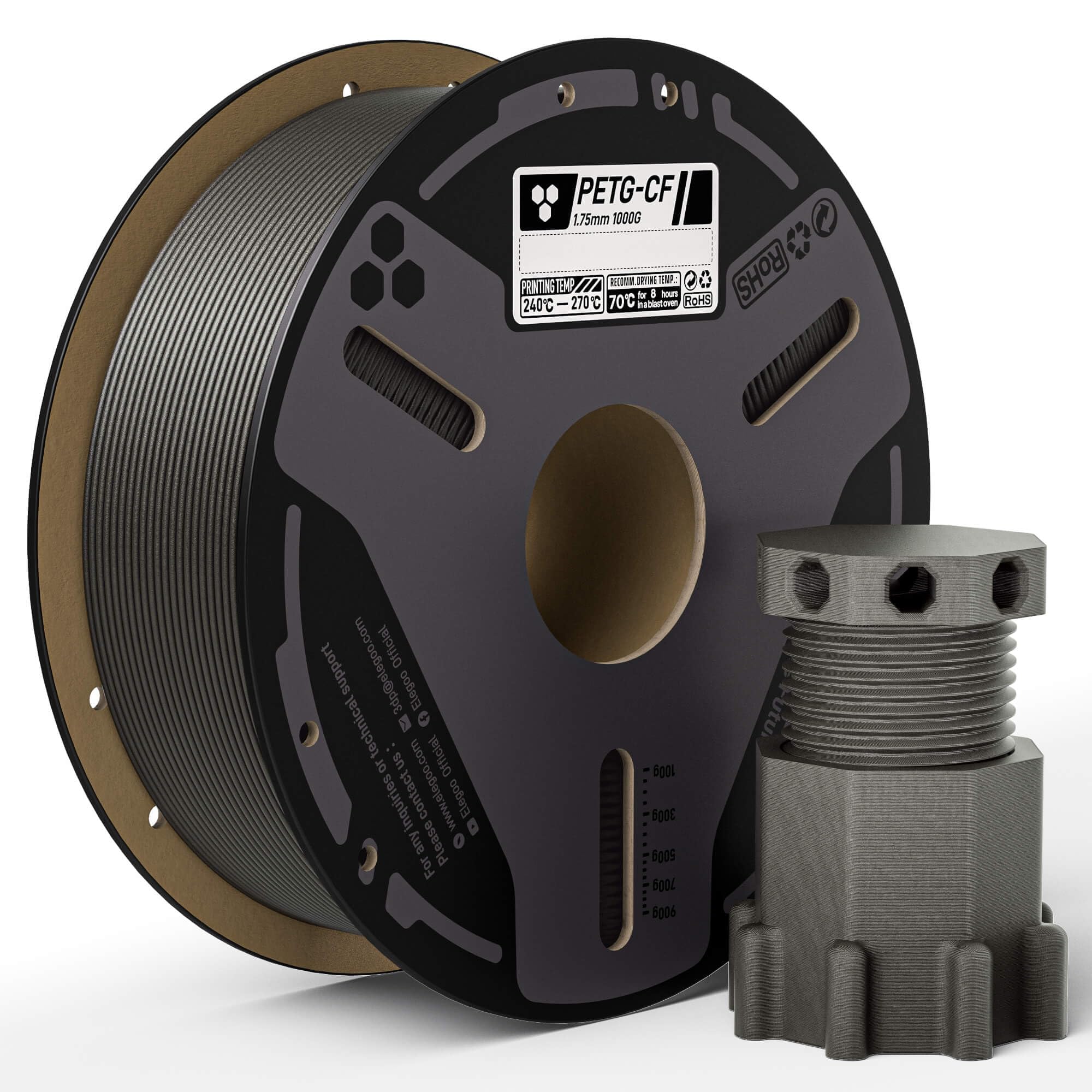
PETG-CF (carbon fiber reinforced PETG) sits in a middle ground between standard PETG and engineering-grade materials like polycarbonate or nylon. ELEGOO’s version, sold in a 1 kg spool of 1.75 mm gray filament, is aimed at users who want improved stiffness and a matte finish without stepping up to more demanding composites. In practice, it behaves like a slightly more brittle, more abrasive PETG—which is both its appeal and its main caveat.
In real-world use, this filament is typically chosen for functional parts: brackets, jigs, enclosures, and mechanical prototypes where appearance matters less than rigidity. The carbon fibers add stiffness and reduce the slight flex you get with plain PETG, and the gray color hides layer lines better than glossy filaments. It prints on most FDM machines with a hardened nozzle, though the abrasive fibers will wear down brass nozzles over time. Layer adhesion is generally good, but the material is more prone to stringing and oozing than unreinforced PETG, so retraction tuning is often necessary.
Key functional features include a 1.75 mm diameter with typical tolerance of ±0.03 mm, a recommended printing temperature range of 230–260°C, and a bed temperature of 70–80°C. The 1 kg spool is standard, and the filament comes vacuum-sealed with a desiccant. It’s worth noting that PETG-CF absorbs moisture like regular PETG, so drying before use is advisable if the spool has been open for a while. The carbon fiber content also means you’ll want a wear-resistant nozzle—hardened steel or ruby—to avoid replacing brass nozzles frequently.
One limitation is that PETG-CF is not a substitute for true engineering composites like carbon-fiber nylon. It’s stiffer than PETG but not as strong or heat-resistant as PA-CF, and it can be more brittle under impact. Compared to standard PETG, it offers better dimensional stability and a more matte surface, but at the cost of reduced layer adhesion if printed too cool. Compared to PLA, it’s tougher and more heat-resistant, but also more stringy and less forgiving on overhangs. In terms of printability, it’s less demanding than ABS but more finicky than PLA.
Who is it for? This filament suits makers who already have some experience with PETG and want a stiffer, more matte material for functional parts. It’s also a reasonable choice for those who want to experiment with composite filaments without jumping to high-temperature engineering materials. It is not for beginners looking for plug-and-play printing, nor for users who haven’t upgraded to a hardened nozzle. It’s also not ideal for applications requiring high impact resistance or maximum layer strength—plain PETG or ABS may be better there.
In summary, ELEGOO PETG-CF is a competent composite filament that delivers on its promise of increased stiffness and a matte finish, provided you’re willing to deal with the extra tuning and nozzle wear. It’s not a miracle material, but it fills a useful niche for practical, mechanical prints.