
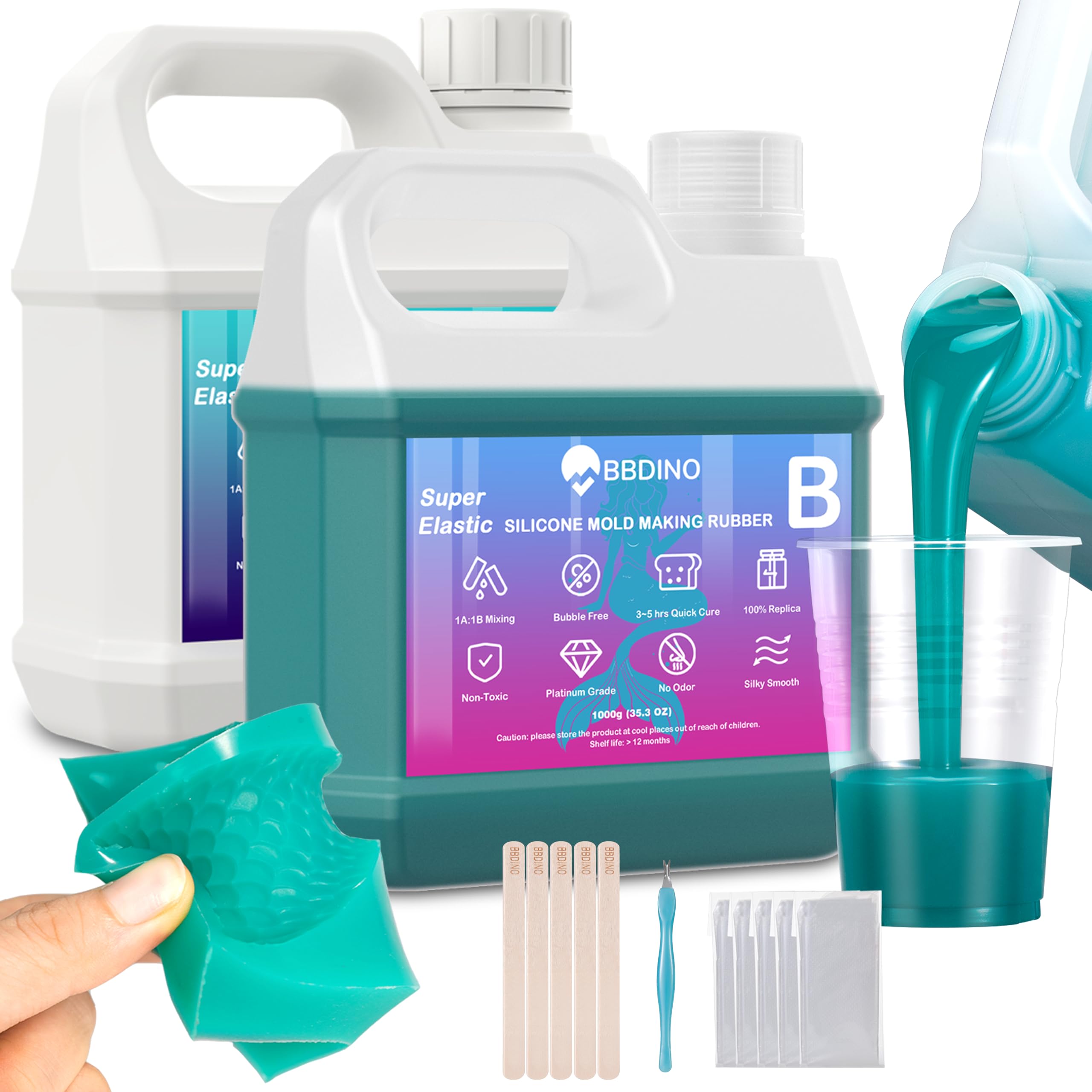
BBDINO’s Super Elastic Liquid Silicone Mold Making Kit sits in a specific corner of the mold-making market: soft, high-stretch silicone intended for parts that need to flex, demold awkward shapes, or survive repeated bending. The 8A Shore hardness and jade green tint are the defining details here, and they tell you most of what you need to know before opening the box. This is not a general-purpose mold rubber for every project, and treating it as one is likely to disappoint. Used with the right expectations, though, it fills a role that stiffer silicones handle poorly.
The kit is a two-part platinum-cure silicone, sold as 4.4 lbs total, which works out to roughly 2 lbs of each component. That is a modest amount by mold-making standards. A single small block mold or a couple of thin brush-on shells is a realistic yield, not a full production run of large molds. Buyers accustomed to gallon kits should plan accordingly, because running short mid-pour is an expensive way to learn the lesson.
Where the 8A hardness matters most is in demolding. Soft silicone stretches over undercuts, thin walls, and delicate protrusions that would tear a 20A or 30A mold or lock a rigid part in place. In practice, this makes the kit useful for casting small figurines with thin limbs, jewelry pieces with fine detail, resin parts with negative draft, and wax or soap shapes that benefit from a mold that peels away rather than pulls. The stretch also helps when casting parts that are themselves flexible, since the mold can accommodate some deformation during release.
The jade green color is a practical choice rather than a cosmetic one. A tinted silicone makes it easier to see air bubbles during mixing and pouring, and it distinguishes the mold from the cast part inside it. That said, the color is not a quality indicator, and buyers who need a neutral or translucent mold for visibility through the walls will find the green a minor annoyance. Pigment can be added, but doing so changes the working characteristics slightly and is best tested on a small batch first.
- Shore hardness: 8A, notably soft and stretchy compared with the 20A–30A silicones most hobbyists start with
- Cure system: platinum-cure, which generally offers better long-term mold life and less shrinkage than tin-cure alternatives
- Mix ratio: typically 1:1 by weight, which keeps measurement simple but still requires a scale for accuracy
- Working time: short enough to demand organized preparation, so mixing small batches is advisable
- Yield: 4.4 lbs total, enough for small to medium molds only
The main trade-off with a very soft silicone is dimensional stability. An 8A mold can distort under its own weight or bulge when filled with heavier casting materials, and thin mold walls may not hold their shape during pouring. For castings that need crisp, repeatable dimensions, a firmer silicone is usually the better tool. The softness that makes demolding easy also makes the mold less rigid, and that is a real limitation rather than a minor footnote. Users casting large flat parts or anything requiring tight tolerances should look at a 20A or higher product instead.
Compared with a standard 20A mold-making silicone, this kit trades rigidity for flexibility. The stiffer product is easier to work with for simple block molds and gives more predictable results, while the BBDINO kit earns its place on complex geometry and delicate masters. Compared with tin-cure silicones, the platinum system here costs more but tends to last longer and resist inhibition better, though platinum cure is more sensitive to contaminants like sulfur-based clays and some 3D-print resins. That sensitivity is worth flagging: a failed cure from an incompletely cleaned master is a common and frustrating outcome, and it is not the product’s fault so much as a characteristic of the chemistry.
Working time and pot life deserve attention. Soft silicones are often mixed in small quantities, and the short working window rewards a clean, rehearsed pour. Mixing by weight with a digital scale, degassing if a vacuum chamber is available, and pouring in a thin stream all improve results. Without degassing, small bubbles are likely, particularly in detailed molds, and the jade tint helps spot them but does not prevent them.
This kit suits hobbyists and small-shop makers working on figurines, jewelry, soap, wax, and small resin pieces with undercuts or delicate features. It is less suitable for anyone making large molds, casting parts that demand tight dimensional accuracy, or working on a tight budget where a stiffer, cheaper silicone would do the job. First-time mold makers may also find a firmer, more forgiving silicone easier to learn on, since soft molds punish sloppy mold-box construction and thin walls. Within its niche, the BBDINO kit is a reasonable, purpose-specific material, provided the buyer understands that softness is both its function and its constraint.