
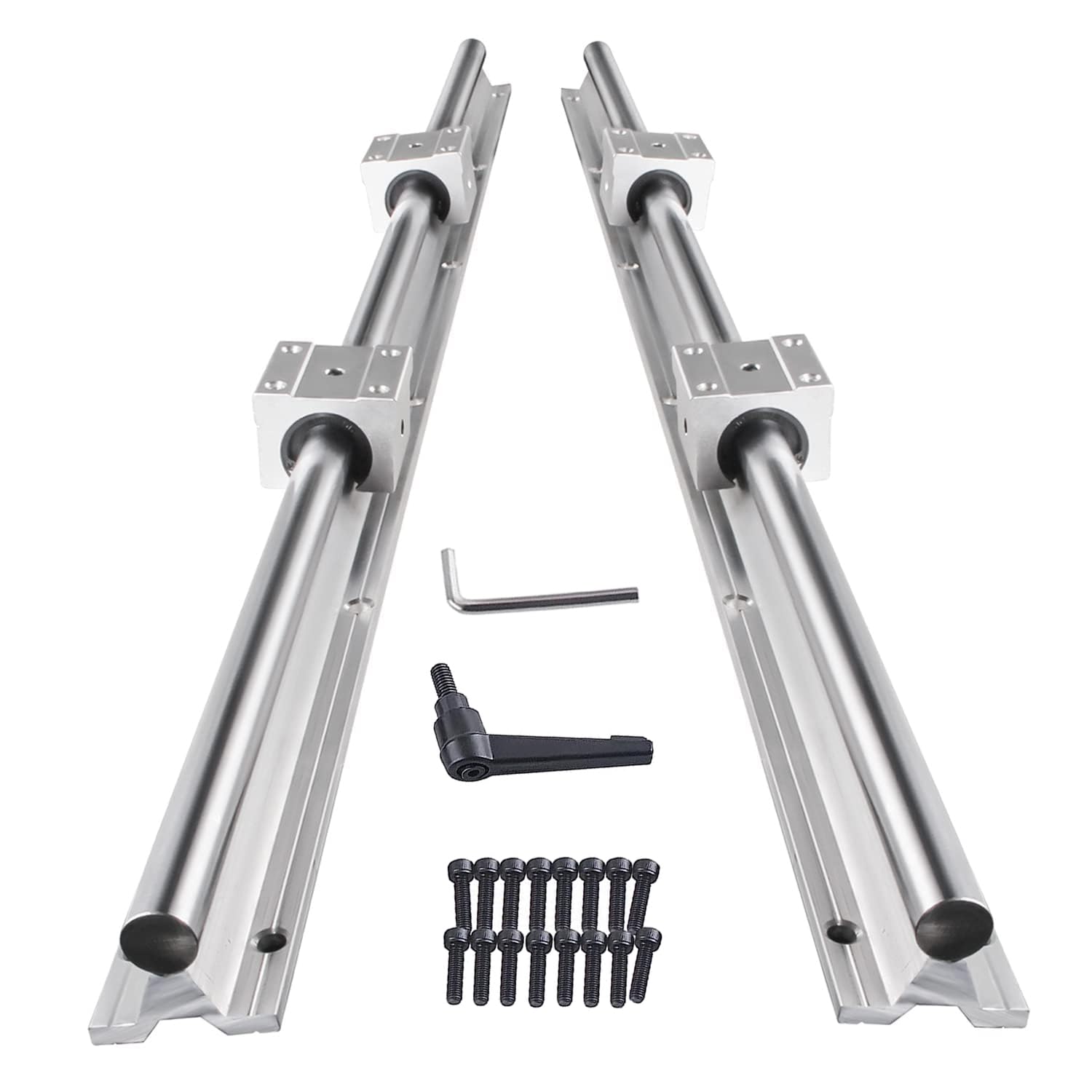
The CNCMANS SBR16 1500mm linear rail guide is a fully supported rail system that includes four SBR16UU slide blocks. It’s aimed at DIY CNC builders, hobbyist machinists, and anyone needing a sturdy linear motion axis for projects like router tables, plasma cutters, or custom automation. With a 16mm rail diameter and 1500mm length, it offers a substantial travel distance for medium-to-large builds. This review examines its features, real-world performance, and where it fits in the broader market of linear motion components.
In practice, these rails are commonly used in the construction of CNC routers, where they support the gantry or Z-axis, and in other DIY machinery like camera sliders or pick-and-place machines. The fully supported design means the rail is backed by an aluminum extrusion along its entire length, which increases rigidity and load capacity compared to unsupported rails. The SBR16UU blocks are self-aligning and come pre-lubricated, though users often add their own lubrication for longevity. The 1500mm length is a popular choice for mid-sized CNC beds, providing ample travel for projects like cabinet doors or signage.
Key functional features include the 16mm hardened steel rail, which is precision-ground for smooth motion. The aluminum support extrusion has mounting holes pre-drilled, simplifying installation. The four SBR16UU blocks are interchangeable and can be adjusted for preload to reduce play. Each block has a dynamic load rating of around 1.5 kN, which is adequate for light-to-medium duty cycles. The rail’s straightness tolerance is typically within 0.1mm per meter, which is acceptable for most hobbyist applications but may not meet the demands of high-precision machining.
One limitation is the weight and bulk of the system. The 1500mm rail with support is heavy, and the blocks add significant mass to a moving gantry. This can affect acceleration and require more powerful motors. Additionally, while the rail is rigid, it is not immune to deflection under heavy loads, especially when mounted horizontally without proper support. Users should ensure the mounting surface is flat and rigid to avoid binding. Another trade-off is that the SBR16UU blocks use ball bearings that can be noisy at higher speeds and may require periodic re-greasing. Compared to profile rails (like HGR series), these round rails offer less torsional stiffness and are generally less precise, but they are also more affordable and easier to align for beginners.
In terms of alternatives, profile linear rails (e.g., Hiwin HGR15) provide higher rigidity and accuracy but come at a higher cost and require more careful mounting. For those on a budget or just starting out, the SBR16 system is a practical entry point. It’s also easier to retrofit because the supported rail can be mounted on uneven surfaces with shims. However, for applications requiring high precision or high speed, profile rails are a better choice.
Who is this for? It suits DIY enthusiasts building their first or second CNC machine, makers who need a reliable linear motion axis for light-duty projects, and educational settings where cost is a factor. It’s not suitable for industrial production environments where uptime and precision are critical, nor for high-speed automation systems that demand low noise and minimal maintenance. Those needing travel longer than 1500mm might find the rail prone to sagging and should consider a larger diameter or additional support.
Overall, the CNCMANS SBR16 kit delivers what it promises: a solid, functional linear rail system at a competitive price. It’s not the most precise or durable option on the market, but for hobbyist use, it strikes a reasonable balance between cost and performance. Buyers should budget for proper mounting hardware and possibly upgraded bearings if they plan to push the system hard. With realistic expectations, this rail can serve as the backbone of a capable DIY CNC machine.