
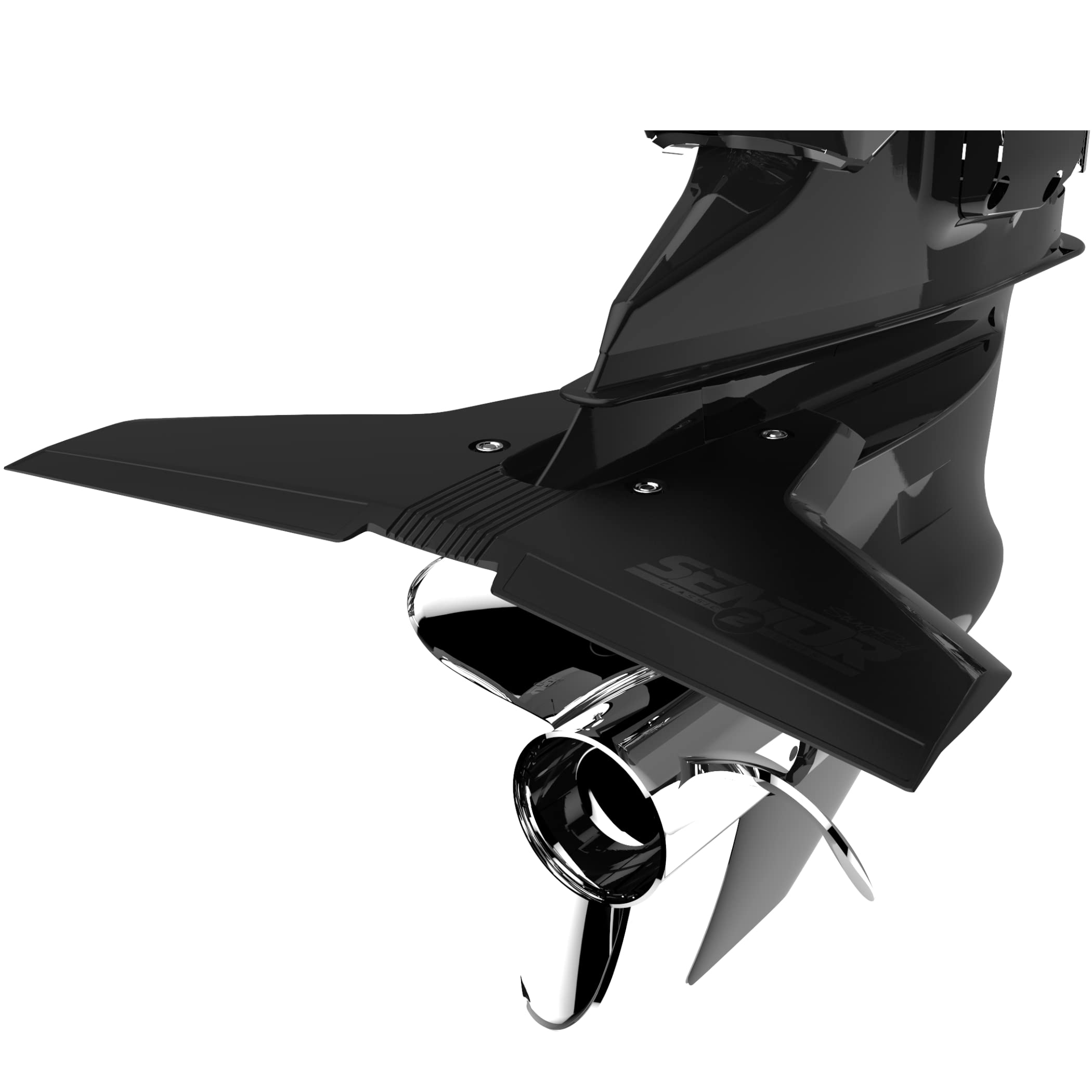
Stingray Hydrofoils has been making bolt-on stabilizer fins for decades, and the Classic Senior 2 is their mid-range model for outboard and outdrive motors from 40 to 300 horsepower. These fins mount to the anti-ventilation plate above the propeller and are intended to help boats plane faster, stay on plane at lower speeds, and reduce porpoising. The Classic Senior 2 is made in the USA from black-painted aluminum and comes with mounting hardware. It’s a straightforward product that addresses a common set of handling complaints, but it’s not a cure-all and has trade-offs worth understanding before you drill holes in your motor’s cavitation plate.
In real-world use, hydrofoils like this are most often installed by owners of aluminum fishing boats, center consoles, and runabouts who want better low-speed planing for watersports or rough-water running. The Classic Senior 2 is sized for mid-range horsepower, so it’s a common choice for 17- to 21-foot boats with 90-150 hp outboards. Installation is a do-it-yourself job for most people: you clamp the fin to the anti-ventilation plate, mark and drill four holes, and bolt it on with the supplied hardware. The process takes about an hour with basic tools. Once mounted, the fin adds roughly a foot of surface area behind the prop, which creates lift at the stern.
The functional benefits are well documented. By adding lift at the stern, the fin helps the boat get on plane at lower speeds and with less bow rise. That can be useful for skiing or tubing, where a smooth pull-up matters, or for running in chop where staying on plane at 15-18 mph instead of 22-25 mph makes for a more comfortable ride. The fin also acts as a stabilizer, reducing side-to-side roll at rest and minimizing porpoising in calm water. The Classic Senior 2’s aluminum construction is more durable than plastic fins, and the black finish blends with most motors. It’s also compatible with both outboards and outdrives, which broadens its appeal.
However, there are limitations. The most obvious is that drilling into the anti-ventilation plate is permanent; if you remove the fin, you’re left with four holes that need sealing. Some owners report that hydrofoils can reduce top-end speed by 1-3 mph due to added drag, though others see no change. The fin can also affect handling in tight turns, making the boat feel less responsive, and in following seas, it may cause the bow to dig in more than without it. The Classic Senior 2 is not a substitute for proper propeller selection or engine height adjustment; if your boat is propped wrong, a fin won’t fix the underlying issue. Additionally, the black paint can chip over time, especially in saltwater use, exposing bare aluminum.
Compared to alternative approaches, a hydrofoil is a relatively inexpensive fix. Trim tabs are more effective at addressing porpoising and listing, but they cost significantly more and require more complex installation. A four-blade propeller can improve hole shot and planing, but it’s also pricier and may not address porpoising. The Classic Senior 2 sits in the middle: it’s cheaper than trim tabs and easier to install, but less adjustable and potentially less effective in rough conditions. For boaters who want a simple, bolt-on solution and don’t mind the permanent mounting, it’s a reasonable option. For those who frequently run in heavy seas or need precise attitude control, trim tabs are a better investment.
Who is this for? The Classic Senior 2 is suitable for owners of mid-sized outboard-powered boats who want to improve hole shot, reduce minimum planing speed, and add stability without spending a lot. It’s also a good fit for anglers who want to stay on plane at lower speeds when navigating choppy bays. It is not suitable for boats with engines outside the 40-300 hp range, nor for those who are unwilling to drill into their motor. It’s also not ideal for high-performance boats where top speed is critical, or for boats that already have trim tabs or other stability systems. If you’re unsure, consider a plastic hydrofoil first to test the concept before committing to aluminum.