
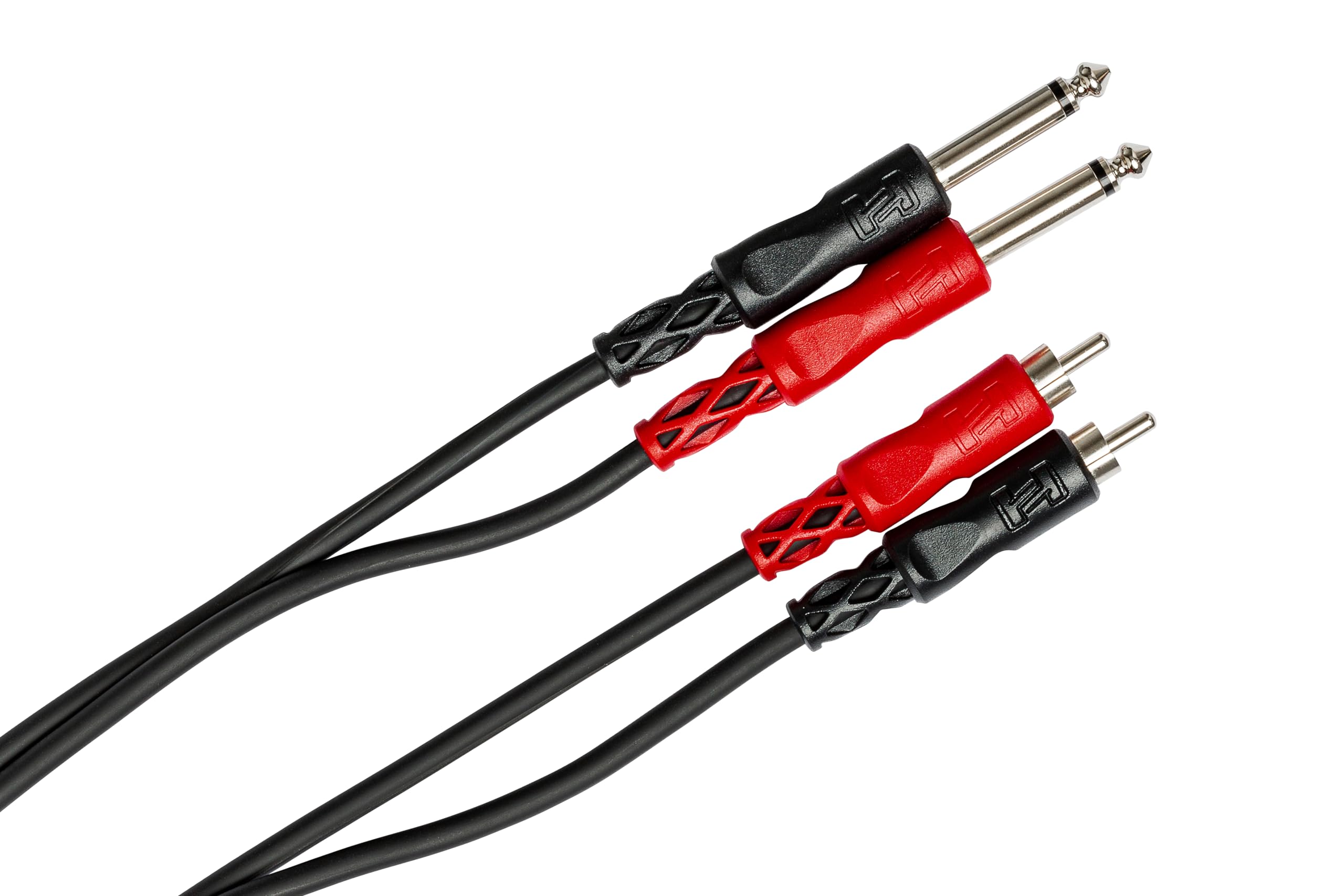
The Hosa CPR-202 is one of those cables that exists to solve a specific routing problem: getting a stereo signal from a pair of 1/4-inch TS outputs into a pair of RCA inputs, or the reverse. It is two meters long, terminated with dual 1/4-inch TS plugs on one end and dual RCA plugs on the other, and it is sold as a single assembly rather than two separate cables. That last detail matters more than it might seem, because the two channels stay together and are less likely to get separated or lost in a drawer.
In practice, this cable shows up in a few predictable places. It connects a DJ mixer’s unbalanced 1/4-inch outputs to a home stereo receiver or a powered speaker with RCA inputs. It links a keyboard or synth with 1/4-inch outs to a consumer audio interface or a sampler. It can also run the other direction, taking RCA outputs from a turntable preamp, CD player, or tape deck into a 1/4-inch input on a mixer or interface. In each case the job is the same: convert connector types without adding active circuitry, and do it over a short-to-medium run.
Functionally, the CPR-202 is straightforward. The 1/4-inch ends are TS, meaning tip-sleeve, unbalanced mono connections. Each channel carries signal on the tip and ground on the sleeve. The RCA ends are also unbalanced, with center pin and outer ring. The cable is wired straight through, channel to channel, with no transformers, no attenuation, and no impedance matching. Hosa lists the conductors as 26 AWG, which is on the thin side but typical for this class of cable. The connectors are molded, and the cable jacket is flexible enough to route around a desk or behind a rack without much fuss.
The most important thing to understand before buying is that this is an unbalanced cable, and it behaves like one. Over two meters in a home studio or living room, that is usually fine. Run it alongside power cables or near dimmers and you may pick up hum or buzz. If you need to cover longer distances, especially in a venue or a room with a lot of electrical noise, balanced cables (TRS to XLR, for example) are the better tool. The CPR-202 is not designed for that job and should not be expected to perform like a balanced line.
Build quality is adequate rather than impressive. Hosa is a budget-oriented brand, and the CPR-202 reflects that. The molded connectors feel solid enough for stationary use, and the strain relief is reasonable, but this is not a cable that invites repeated plugging and unplugging on stage. The thin conductors and molded ends mean that if the cable fails, it will likely fail at the connector, and it is not easily repairable. For a permanent or semi-permanent hookup behind a desk, that is a fair trade-off for the price. For a gigging musician who coils and uncoils cables several times a week, a cable with serviceable connectors and heavier shielding would be a wiser long-term purchase.
There is also the question of channel orientation. Because the two cables are joined only at the ends, it is easy to lose track of which RCA plug corresponds to which 1/4-inch plug when routing behind equipment. The connectors are not color-coded in an obvious way on all units, so labeling them with tape or a marker is a sensible habit. It is a small annoyance, but one that comes up when troubleshooting a reversed channel.
Compared with alternatives, the CPR-202 sits in a crowded field. Two separate 1/4-inch-to-RCA cables from a brand like Hosa, Monoprice, or Amazon Basics would accomplish the same thing and might be easier to replace individually if one channel fails. A single molded dual cable, however, keeps the pair together and reduces clutter. At the other end of the spectrum, cables from pro-audio brands such as Mogami or Canare use heavier conductors and better shielding, but they cost considerably more and are overkill for a short unbalanced run in a home setup. The CPR-202 occupies the middle ground: cheaper than pro cable, more convenient than two loose cables, and honest about what it is.
Who is this for? It suits home studio owners connecting a synth or mixer to an interface, DJs wiring a mixer to a home receiver, and anyone doing a one-time or semi-permanent install where the cable will not be moved much. It is also a reasonable spare to keep in a drawer for occasional adapter duty. Who is it not for? Gigging musicians who need road-worthy cables, anyone running long distances in electrically noisy environments, and users who need balanced connections. Those buyers should look at balanced TRS or XLR options, or at least a heavier-duty unbalanced cable with repairable ends.
Realistic expectations matter here. The CPR-202 will pass audio cleanly in most short unbalanced setups, and it will do so without drama. It will not improve your sound, and it will not fix a grounding problem. It is a utility part, and judged on that basis, it is a sensible choice for the price as long as the limitations are understood.