
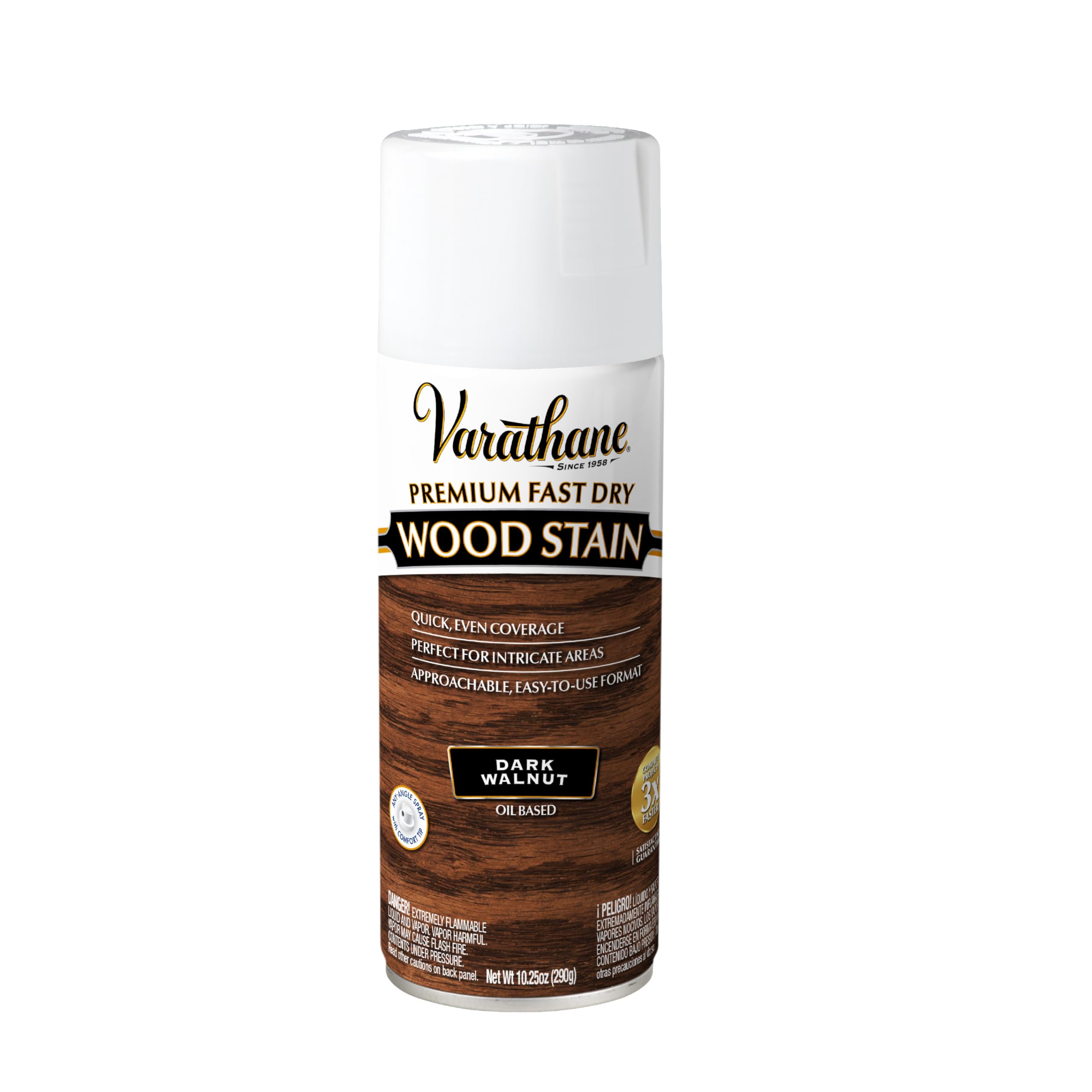
Spray stains occupy a specific niche in woodworking. They are not a replacement for a brush-on stain when you are finishing a dining table, but they solve real problems on smaller or awkward pieces where brushing is slow or impractical. Varathane’s Premium Fast Dry Dark Walnut spray sits squarely in that niche, and whether it makes sense depends heavily on what you are trying to finish.
The product is an aerosol can of oil-based wood stain in a dark walnut tone, marketed around two claims: fast drying and spray application. In practice, both claims hold up, though with caveats that matter more than the marketing suggests.
The most obvious use case is small furniture, trim, craft pieces, and repairs where setting up a brush, rag, and cleanup station feels disproportionate to the job. Aerosol delivery also helps on turned legs, carved details, and recessed areas where a brush tends to pool stain in crevices. For touching up a scratched chair leg or darkening a small shelf, the spray format is genuinely faster than decanting liquid stain.
Dark Walnut itself is a deep, cool-leaning brown. On lighter woods like pine or maple it reads quite dark, while on oak or ash the grain remains visible and the tone lands closer to a medium-dark brown. As with any stain, the final color depends on the species, the sanding preparation, and how much product is applied. The spray does not change that fundamental rule.
On the functional side, the fast-dry formulation is the standout feature. Touch time is short, and recoating can happen relatively quickly, which suits projects where you want to build color in a single session. The aerosol gives reasonably even coverage on flat surfaces if you keep the can moving, and the spray pattern is fine enough to avoid heavy blotching on porous woods, though it will not eliminate blotching entirely on blotch-prone species like pine or cherry.
Coverage is where expectations need calibrating. A single can goes a short distance, and larger pieces will consume multiple cans quickly. Per square foot, spray stain is considerably more expensive than liquid stain bought by the quart. That cost is the trade-off for convenience, and it is a significant one if you are finishing anything beyond small items.
Overspray is the other practical limitation. Aerosol stains produce a cloud of fine particles that settles on surrounding surfaces, so this is an outdoor or well-ventilated, masked-off job. Indoors, overspray can coat floors, walls, and nearby objects in a fine mist that is difficult to remove. A brush-on stain gives you far more control over where the product lands. The solvent smell is also strong, as expected with an oil-based aerosol, and respiratory protection is sensible.
Compared with a traditional liquid penetrating stain applied by rag or brush, the spray wins on speed and reaches awkward geometry more easily, but loses on cost efficiency, control, and the ability to wipe back excess for a more even tone. Wipe-back technique, which many finishers rely on to control color depth, is harder to manage with a spray because the product flashes off quickly. If you want precise control over how dark the piece ends up, a liquid stain remains the more forgiving choice.
It is also worth noting that this is a stain, not a finish. A topcoat is still required, and the fast-dry claim applies to the stain, not to the protective layer on top. Anyone expecting a one-step product will be disappointed.
Who is this for? It suits hobbyists and DIYers working on small furniture, trim, craft projects, and repairs who value speed and do not want to manage liquid stain and cleanup. It is also useful for hard-to-brush shapes. It is not suitable for large surface areas where cost and can count add up, for indoor use without serious ventilation and masking, or for finishers who need precise color control through wipe-back. Professionals doing production work will likely find liquid stain more economical and predictable.
Overall, the Dark Walnut spray does what it claims within its limits. It is a convenience product with a real place in a workshop, provided you go in expecting short coverage, strong fumes, and the need for a separate topcoat.