
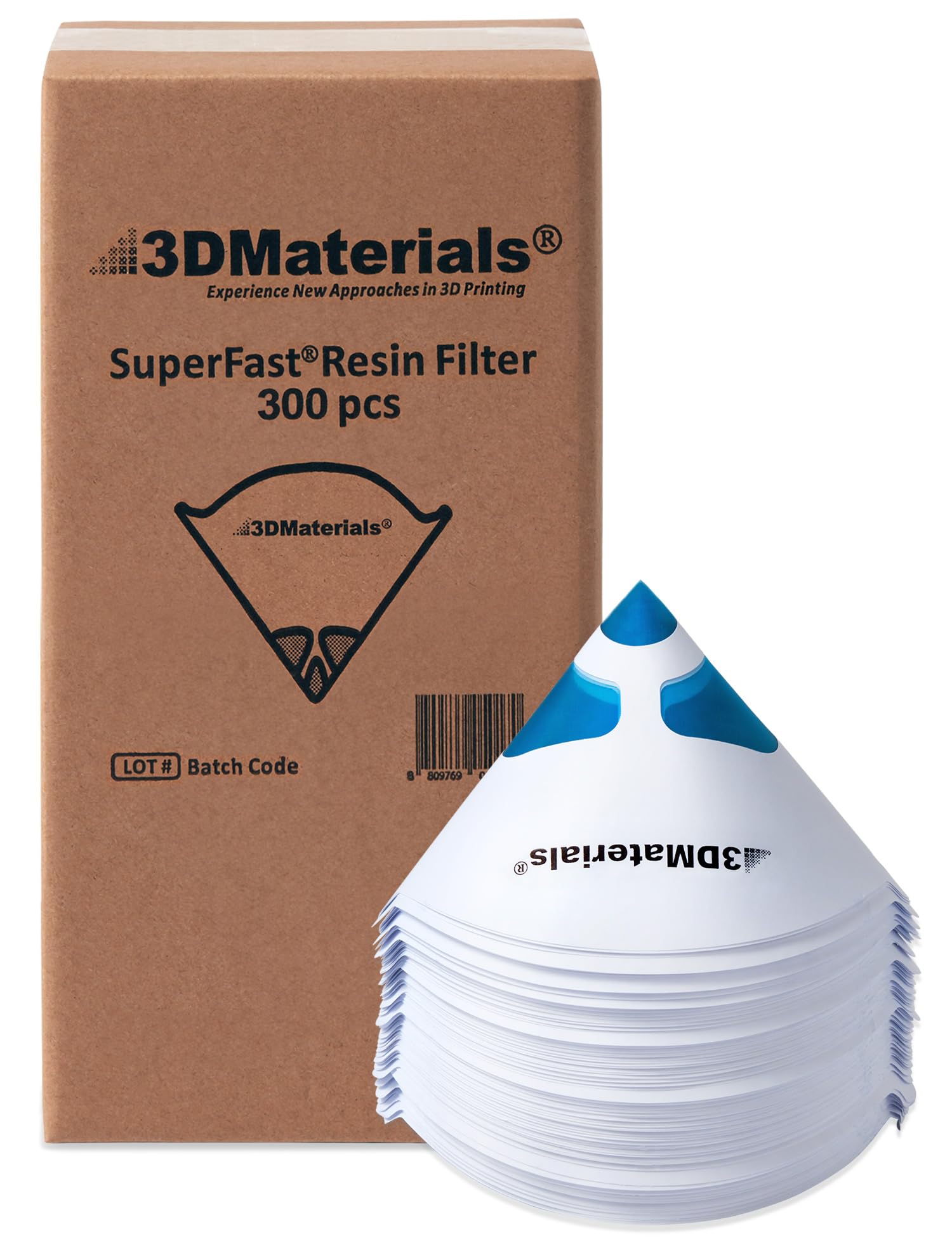
Resin printing generates a surprising amount of small, messy waste. Between filtering partially cured resin out of a vat after a failed print, catching support fragments before they clog a drain, or straining paint and varnish in a workshop, disposable mesh strainers have quietly become a standard consumable in many studios. The SuperFilter 300-pack is a Korean-made bulk box of these cone-style filters, and it is worth understanding what you are actually buying before committing to a box this large.
The core function is simple: a fine mesh cone that fits over a cup, jar, or vat, letting liquid pass through while trapping solids. In resin printing, the most common use is pouring leftover resin from the vat back into its bottle after a print. Cured bits, dust, and support debris get caught in the mesh, and the filtered resin can be reused with less risk of contaminating the next print. The same logic applies to paint: straining old or clumpy paint before it goes into an airbrush or a spray gun is a routine practice, and these cones handle that job with no fuss.
What distinguishes this box from a generic hardware-store strainer is mostly the quantity and the mesh consistency. Three hundred units means you are not rationing them. That matters more than it sounds. The main reason people skip filtering is the hassle of cleaning a reusable strainer, and disposable cones remove that friction entirely. You use one, it goes in the waste bin, and the next one is already there. For anyone who prints regularly, that changes the habit more than any single feature.
On the functional side, the cones are paper-bodied with a mesh that is fine enough to catch the typical debris you encounter in resin work, but not so fine that pouring becomes slow. That balance is the real design decision here. A mesh that is too coarse lets through the particles that cause failed prints; a mesh that is too fine clogs quickly and turns a thirty-second pour into a five-minute ordeal. These sit in a reasonable middle ground, though users pushing very viscous materials should expect slower flow regardless of the filter.
- 300 disposable cone strainers per box, sized for standard cups and resin bottles
- Fine mesh intended for resin, paint, and varnish filtration
- Paper cone body that holds shape when placed in a container
- Korean manufacture, which some buyers associate with more consistent mesh quality than budget imports
The limitations are worth stating plainly. Disposable means disposable. This is a recurring cost, and a 300-pack is an upfront commitment that only makes sense if you will actually use them. Someone who prints once a month may find the box outlasts their interest or their storage space. The cones are also not rigid; they rely on being seated in a cup or bottle neck to stay upright, and a poorly seated cone can tip mid-pour. That is a user-error problem more than a product flaw, but it is a real one, and it is the kind of thing that leads to resin on the workbench. Finally, these are not a substitute for proper PPE or ventilation. Filtering resin does not make it safer to handle, and the strainer does nothing about fumes.
Compared with reusable stainless strainers, the trade-off is straightforward. A metal strainer costs more upfront, can be cleaned with solvent, and lasts indefinitely, but cleaning it is exactly the chore that makes people stop filtering. Disposable cones win on convenience and lose on long-term cost and waste. For a hobbyist doing occasional pours, a reusable strainer plus a small pack of disposables is arguably the more sensible combination. For a shop or a heavy printer, the bulk box is the pragmatic choice.
Who is this for? Primarily resin printers who filter vat remnants regularly, and secondarily painters, airbrush users, and small workshops that strain coatings. It also suits anyone running a shared studio where consumables disappear and a large supply is practical. Who is it not for? Casual users who print rarely, people with limited storage, and anyone expecting a rigid, reusable tool. It is also not for filtering anything corrosive or hot, which should go without saying but occasionally does not.
The realistic expectation is modest: these are consumables that do a small job reliably and in quantity. They will not transform a workflow, but they remove a recurring annoyance, and for the price per unit in a 300-pack, that is a fair trade for the right user.