
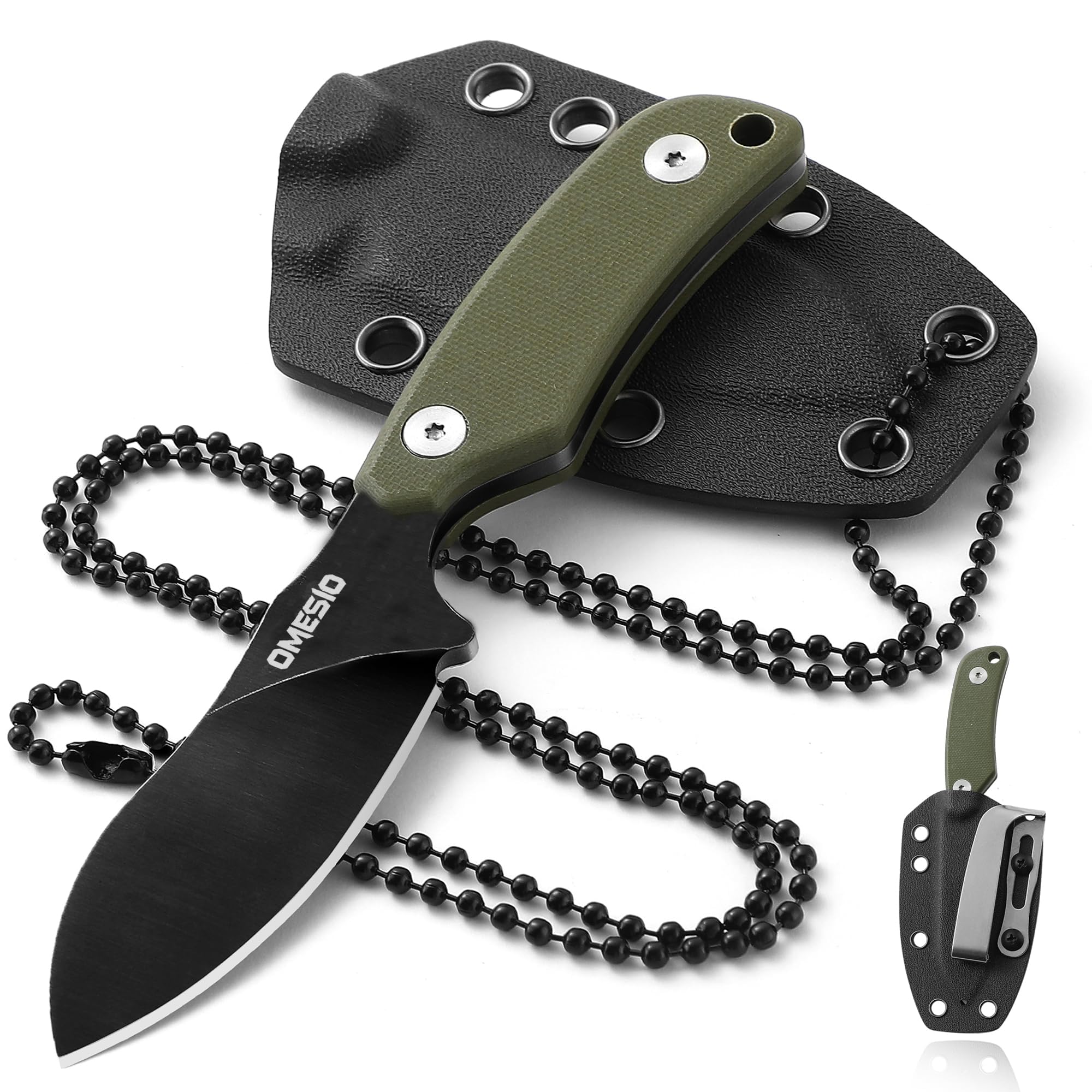
The Omesio Small Fixed Blade Neck Knife sits in a crowded but specific corner of the knife market: the sub-6-inch fixed blade meant to be carried close to the body. With a 5.9-inch overall length and a D2 steel blade paired with a G10 handle, it is clearly aimed at people who want a lightweight fixed blade for daily tasks rather than a dedicated hunting or tactical tool. Whether it makes sense depends heavily on what you expect from a knife this size.
In practice, neck knives get used for opening packages, cutting cordage, trimming tape, breaking down boxes, and the occasional light food prep. The Omesio fits that role on paper. D2 is a semi-stainless tool steel known for good edge retention and wear resistance, which means it holds an edge longer than common budget steels like 8Cr13MoV or AUS-8. The trade-off is that D2 is harder to sharpen and less corrosion-resistant than fully stainless options, so it needs a bit more care in humid environments or around saltwater. The G10 handle is a sensible choice here: it is stable, resistant to moisture, and provides grip without adding much weight.
One thing to note is the blade length. A 5.9-inch overall knife typically translates to roughly a 2.5 to 3-inch blade, which puts it firmly in the small fixed blade category. That is fine for utility work but limits it for tasks that need reach or leverage. Anyone expecting a compact survival knife will likely find it too small for batoning or heavy field use, and that is not a knock on the design so much as a clarification of its intended scope.
The neck carry format itself is worth discussing honestly. Carrying a fixed blade on a cord under a shirt is discreet and keeps the knife accessible, but it is not for everyone. The knife tends to swing or shift during movement, and drawing it cleanly requires some practice, especially if worn under clothing. The sheath design matters enormously here, and buyers should look closely at retention and how the cord attaches. A poorly retained neck knife is a genuine safety concern, so it is worth checking whether the sheath offers adjustable retention or a secondary lock. The Omesio’s sheath setup is functional, but like many budget neck knives, it may benefit from a paracord wrap or aftermarket clip for users who want more stability.
Compared to a folding pocket knife of similar size, the fixed blade design offers a stronger, simpler mechanism with no pivot to loosen or lock to fail. That makes it appealing for people who distrust folding locks or who want a knife that is quick to deploy with one hand. On the other hand, a folder carries more discreetly in a pocket and is generally more socially acceptable in urban settings. A small fixed blade like this is best suited to outdoor use, workshop tasks, or environments where an exposed sheath is not out of place.
Who is this for? It fits reasonably well for hikers, campers, anglers, and tradespeople who want a light, low-profile fixed blade for routine cutting. It is also a reasonable option for someone curious about neck carry without spending a lot. Who is it not for? Anyone needing a primary camp knife, a heavy-duty work blade, or a knife for extended food preparation will want something larger. People who live in areas with restrictive knife laws should also verify local regulations, since fixed blades are treated differently from folders in many jurisdictions.
Realistic expectations matter with D2 at this price point. The steel is capable, but factory edges vary, and some users report needing to touch up the edge out of the box. D2 also rewards proper sharpening equipment; a basic pull-through sharpener will not do it justice. The G10 handle is comfortable for a three-finger grip but will feel short to people with larger hands, which is a common limitation of compact fixed blades. The jimping and handle contouring are adequate rather than exceptional, and the finish is utilitarian.
Overall, the Omesio Small Fixed Blade is a practical, no-frills option for light everyday cutting and outdoor carry. It is not a premium knife, and it does not pretend to be. The D2 steel and G10 handle are sensible material choices at this size, and the neck carry format is convenient for the right user. The main caveats are the small blade, the need for careful sheath retention, and the maintenance demands of D2. Buyers who understand those trade-offs will likely find it a useful companion; those expecting a do-everything blade should look at a larger fixed blade or a sturdy folder instead.