
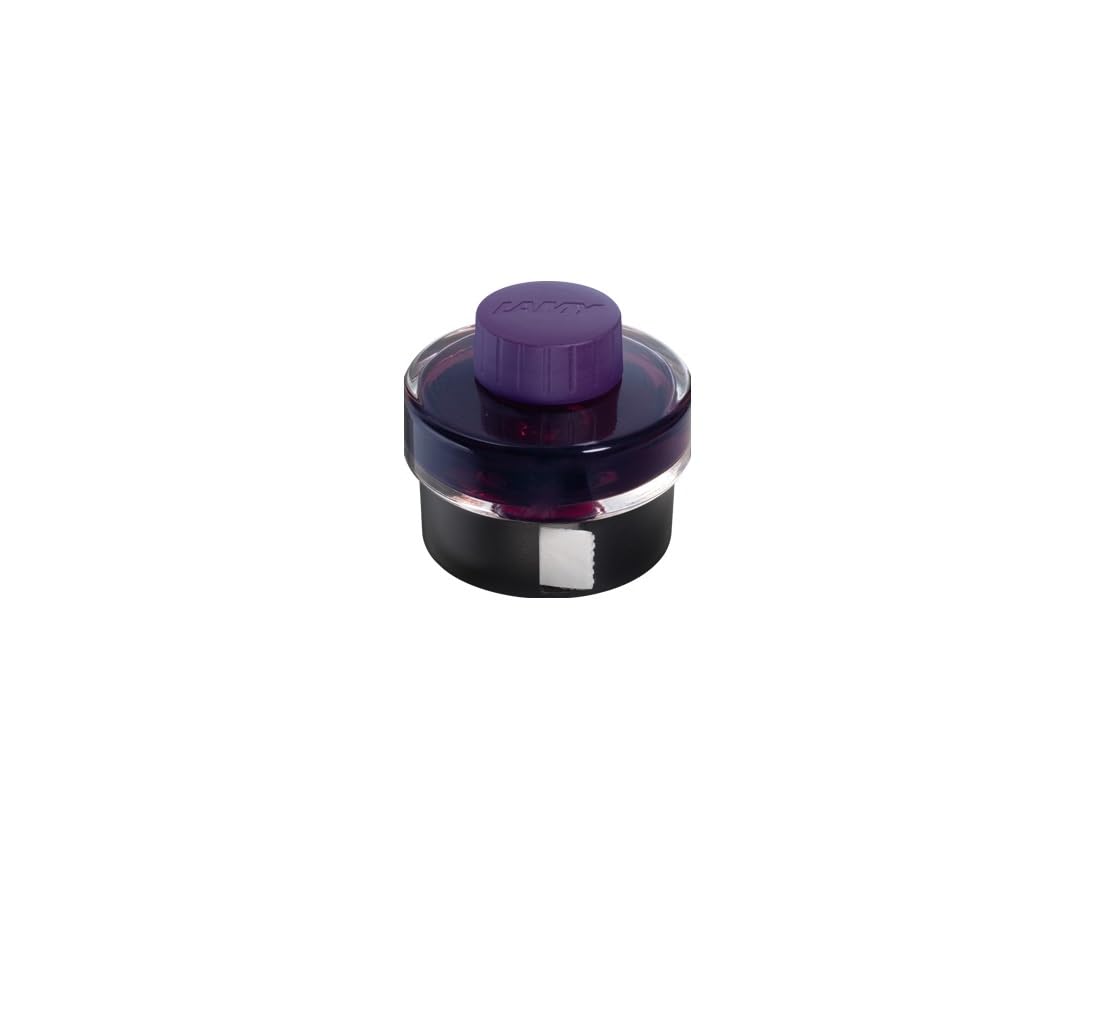
Most fountain pen owners spend far more time thinking about pens than about what goes inside them, which is a little odd given that ink is the part of the equation that actually ends up on the page. Lamy’s T52 bottle in Dark Purple is worth a closer look precisely because it treats the bottle as a working tool rather than a decorative object. The 50 ml glass container is designed around the messy reality of refilling a pen, and that design choice matters more than the color of the label.
The bottle’s defining feature is a built-in collection tank at the base. A slanted interior well gathers ink toward one corner, so when the level drops, you can still submerge a nib without tipping the bottle or resorting to a syringe. Anyone who has tried to fill a pen from the last centimeter of a conventional bottle will recognize why this exists. Lamy pairs the well with an integrated roll of blotting paper tucked into the side of the glass, intended for wiping the section and nib after filling. It’s a small addition, but it addresses the step most people improvise with a paper towel.
In practice, the T52 is a desk ink rather than a travel ink. The glass is reasonably thick and the base is wide enough to resist tipping during a fill, but 50 ml of liquid in a glass bottle is not something most people will want loose in a bag. The blotting roll is convenient at a home or office desk where a fill session is a planned activity; it is less useful if you fill pens away from a fixed workspace, since the paper lives in the bottle and doesn’t travel independently. The bottle is also wide-mouthed, which makes filling easy but means a quick, controlled dip requires a steady hand until you get used to the angle.
The Dark Purple itself is a muted, slightly dusty violet rather than a saturated jewel tone. On most papers it reads as a dark, workmanlike purple that sits comfortably between blue and black in tone, which makes it reasonable for everyday notes, correspondence, and annotation. It is not a high-shading ink and does not chase dramatic color variation. Flow is moderate and predictable; it behaves well in standard nibs and doesn’t demand a particularly wet pen to look right. Drying time is unremarkable, neither notably fast nor slow, and on absorbent paper it will feather a little more than a drier, more conservative ink would. On good paper it holds a clean line.
Where the T52 asks for patience is in maintenance. Purples in this range often carry a reputation for staining, and while this one is not among the worst offenders, it is not a wash-and-go ink either. Converters and demonstrator barrels may pick up a faint tint over time, and a thorough flush between color changes is advisable. Anyone who rotates inks frequently or runs a clear-bodied pen may find the residue mildly annoying. The blotting paper roll is also a finite resource; once it’s used up, the bottle loses part of its convenience, and replacements are not always easy to find locally.
Compared with a standard 30 ml or 50 ml ink bottle from a competing brand, the T52’s advantage is the filling architecture, not the ink volume or price per milliliter. A plain bottle with a wide base and no well is perfectly serviceable, and many users will find a simple bottle plus a separate blotter just as workable. The T52’s value proposition is consolidation: one object that handles filling, wiping, and storage. Whether that is worth the premium depends on how often you fill at a desk.
The ink suits people who fill pens regularly at a fixed workspace, prefer a restrained purple for daily writing, and appreciate a bottle designed around the mechanics of refilling. It is less suited to travelers, to users who change inks constantly and want minimal cleaning, and to anyone expecting a vivid or highly shading purple. For a workhorse ink in a thoughtfully engineered bottle, it makes sense; for a portable or showy one, look elsewhere.