
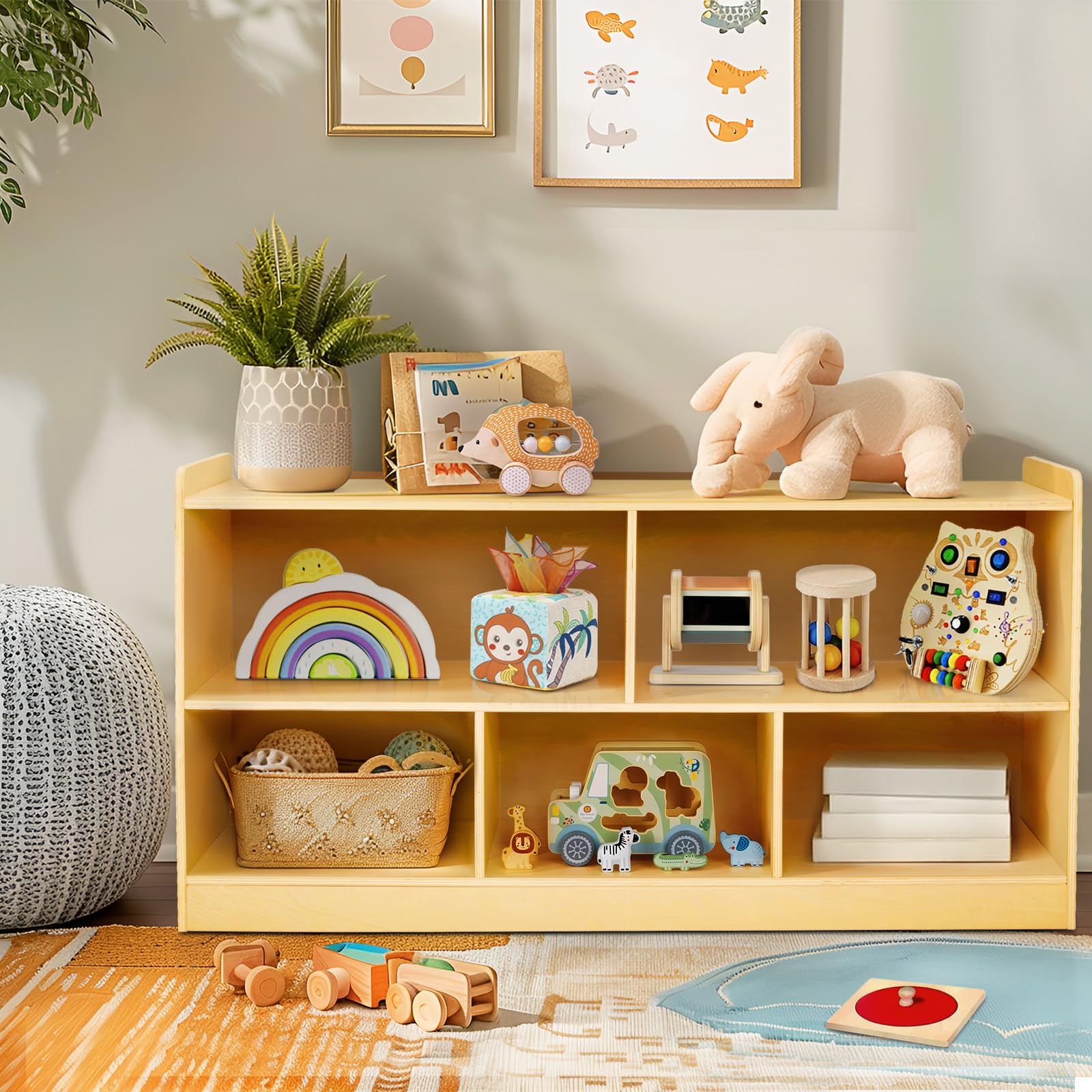
The PTINFLUCE Montessori Shelf is a wooden storage organizer designed for children’s rooms, playrooms, and early learning environments. It features a two-tier design with five distinct sections, intended to hold books, toys, and small items in a way that young children can access independently. This review examines its practical use, construction, and suitability for different households.
In real-world settings, this shelf often serves as a low-profile bookshelf and toy bin combo. Parents place it against a wall in a playroom or beside a reading nook, where toddlers can reach board books and small toys without assistance. The open-front design eliminates doors or lids, which reduces frustration for young children but means items are always visible—a trade-off between accessibility and neat concealment. The five sections typically include a mix of flat shelves and deeper cubbies, allowing for some sorting: books on top, bulkier toys below, for example. Some users might use the top surface as a display area for a few favorite items, though it’s not designed as a seating surface.
Key functional features include its construction from wood (the natural finish suggests an unpainted or lightly sealed surface), which gives it a sturdier feel than particleboard alternatives. The two-tier layout keeps the overall height low—likely under three feet—so it doesn’t dominate a small room. The five sections are divided by vertical panels, creating distinct compartments that help with organization. Assembly is required, and based on similar products, it likely involves basic tools and takes 30–60 minutes. The shelf is intended for indoor use and should be wiped clean with a damp cloth; it is not waterproof.
One limitation is the open storage: without bins or baskets, small items can look cluttered, and there’s no way to hide messes. Also, the natural wood finish may show scratches or stains more readily than painted or laminated surfaces. Additionally, while the low height is a plus for accessibility, it means the shelf holds a limited quantity—roughly 20–30 board books or a similar volume of toys. Families with larger collections may need multiple units or supplemental storage. The shelf also lacks anti-tip hardware in some versions, so anchoring to the wall is advisable for safety, especially if children might climb on it.
Compared to plastic storage bins or fabric cube organizers, this wooden shelf offers a more furniture-like appearance and potentially greater durability. However, it is less flexible than modular cube systems that allow you to add or remove bins. It also costs more than basic plastic options, though it may last longer. Unlike a traditional bookcase, the Montessori-style shelf is designed for child autonomy, but it doesn’t offer the same capacity or adjustable shelving as standard bookcases.
This shelf is well-suited for parents who follow Montessori principles or want to encourage independent access to books and toys. It fits nicely in small apartments, nurseries, and playrooms where a low, open storage solution is preferred. It’s also a good fit for families who value natural materials and are willing to maintain a tidy appearance with occasional organizing. On the other hand, it’s not ideal for those who need to store large quantities of items, prefer concealed storage, or want a piece that requires zero assembly. Households with very destructive toddlers might find the natural finish prone to wear, and those on a tight budget may find it pricier than plastic alternatives.
In summary, the PTINFLUCE Montessori Shelf is a functional, child-friendly storage piece that aligns with Montessori ideals of accessibility and independence. It has clear limitations in capacity and concealment, but for the right setting, it can be a practical and attractive addition.