
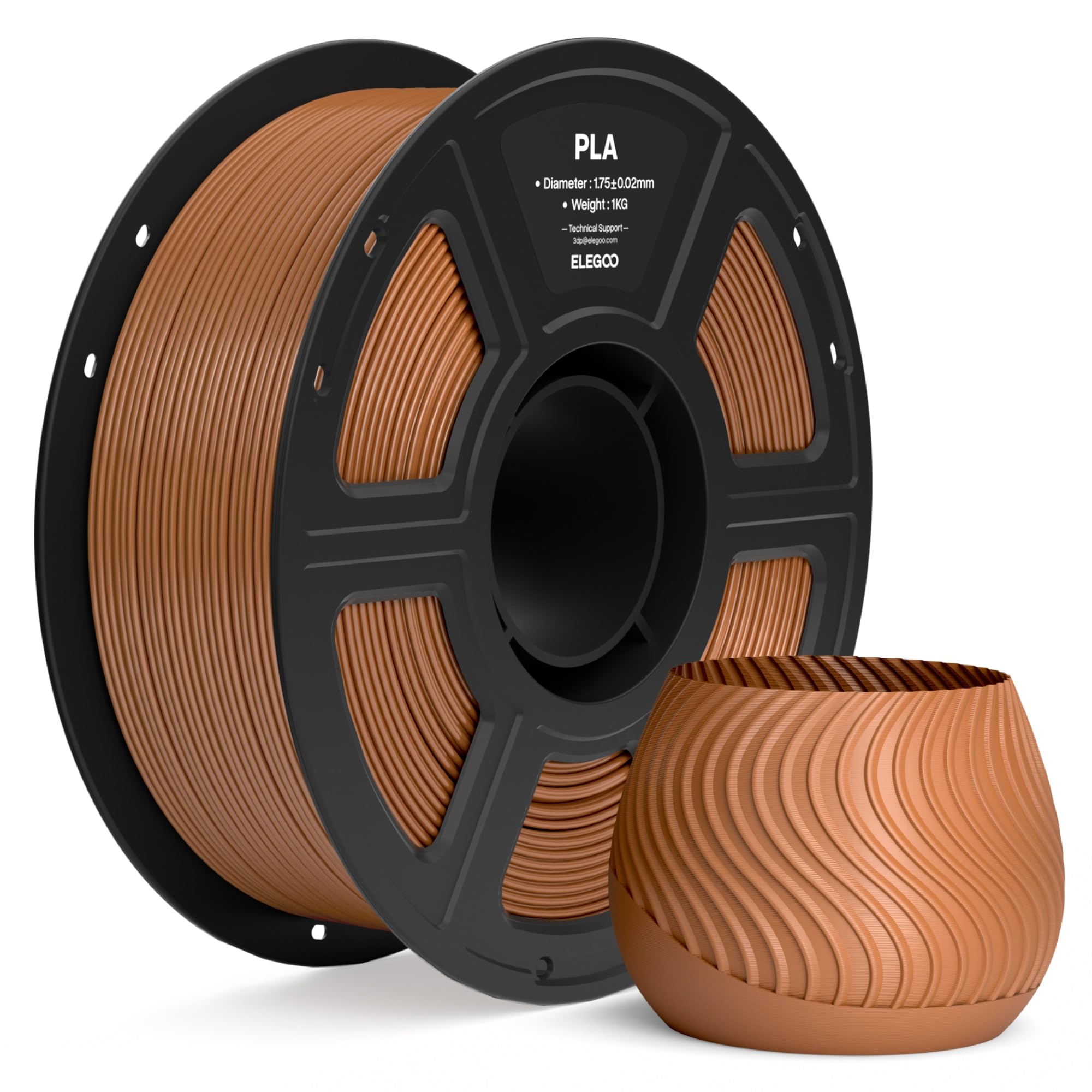
ELEGOO has built a following among hobbyist and semi-professional 3D printer users largely on the back of its resin and filament lines, and this 1.75mm brown PLA in a 1KG spool sits squarely in the company’s comfort zone. It is a general-purpose material aimed at the kind of printing most people actually do: brackets, enclosures, toys, prototypes, and the occasional decorative piece. Brown is an unusual color choice for filament, which makes this spool worth a closer look for anyone tired of the standard black and white.
The practical appeal of PLA is that it is forgiving. It prints at relatively low temperatures, tends to adhere well to a range of bed surfaces, and does not demand an enclosure or heated chamber. ELEGOO lists a recommended nozzle range of roughly 200–220°C and a bed temperature around 50–60°C, which aligns with what most PLA formulations expect. The filament diameter is held to a 1.75mm nominal spec with typical tolerance of about ±0.03mm, which matters for consistent extrusion. A 1KG spool is the standard size and gives a reasonable amount of material for the price bracket.
In real-world use, this is the filament that ends up on the machine for quick jobs. It feeds cleanly through direct-drive and Bowden setups alike, and the brown pigment is opaque enough to read well on printed surfaces without looking washed out. Layer lines are visible under raking light, as with essentially all FDM printing, but the color does a decent job of masking minor surface imperfections. Dimensional accuracy on printed parts tends to be close to the model, provided the printer is calibrated. This is not a filament that will rescue a poorly tuned machine, but it rarely introduces problems of its own.
Where PLA generally falls short is heat resistance. Parts made from this material begin to soften at temperatures that are easy to reach in a parked car or on a sunny windowsill, so it is a poor choice for outdoor fixtures, automotive trim, or anything that will sit near a heat source. It is also more brittle than PETG or ABS, which means thin clips and snap-fit features can crack under repeated stress. Users who need toughness or temperature tolerance should look at PETG as the next step up; it prints at higher temperatures and demands more tuning but handles impact and moderate heat far better. For decorative and low-stress functional parts, though, PLA remains the sensible default.
Moisture is the quieter issue. PLA absorbs water from the air over time, and a spool left out in a humid room will start to pop and string during printing. This is not unique to ELEGOO, but it is worth planning for: a dry box or sealed bag with desiccant extends the usable life of the spool considerably. The cardboard spool is recyclable and generally rolls smoothly, though it can shed a little dust and does not fit every spool holder without an adapter. Some users report the cardboard core being slightly loose on certain holders, which is a minor annoyance rather than a real defect.
Print quality out of the box is consistent with the budget-to-midrange segment. Stringing is manageable with standard retraction settings, and bridging is adequate for typical part geometry. First-layer adhesion is reliable on PEI and textured glass, and the filament does not exhibit excessive warping on small and medium parts. On larger flat prints, a brim is still advisable. The brown color is warm and slightly muted, closer to a milk chocolate than a dark espresso, which suits architectural models and household items but may not match a specific color requirement.
Who is this for? Primarily hobbyists and makers who print functional and decorative parts indoors and want a dependable, no-drama material in a less common color. It suits beginners because PLA is the most forgiving filament type, and it suits experienced users as a cheap workhorse for drafts and jigs. It is not the right pick for anyone printing parts that will see heat, sustained load, or outdoor exposure, and it is not a substitute for engineering-grade materials in mechanical assemblies. Those users should budget for PETG, ASA, or a filled filament instead.
At the end of the day, this spool does what a general-purpose PLA should: it prints predictably, stores reasonably well with basic care, and costs little enough that failed prints are not painful. The brown color is the differentiator, and it is a welcome alternative to the usual palette. It is not a premium filament and does not pretend to be, but for everyday FDM work it earns its place on the shelf.