
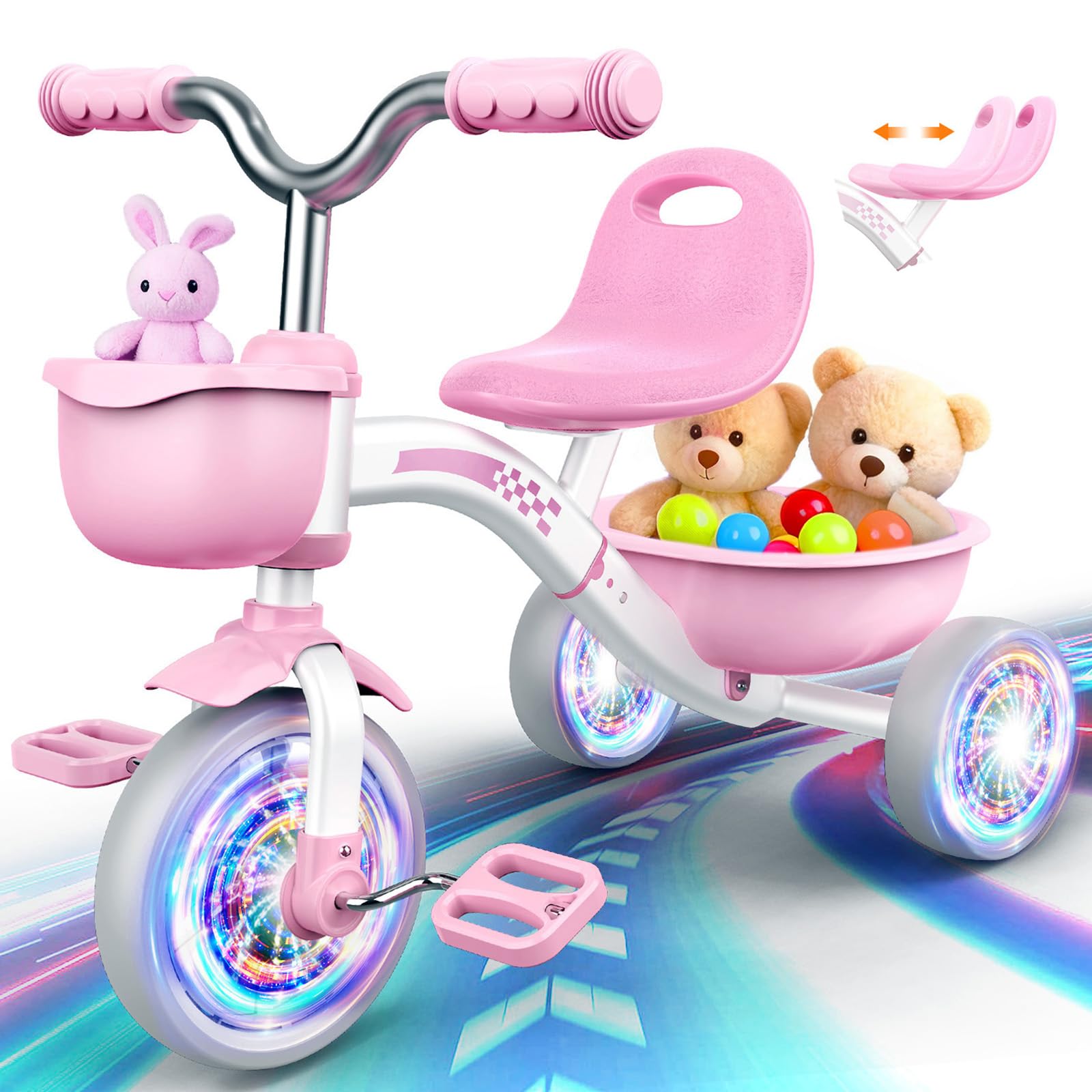
The Kkdi Toddler Tricycle is one of those purchases that looks great in the product photos—bright pink, sturdy-looking, with a little basket on the back and wheels that light up as they spin. But how does it actually hold up on the sidewalk, in the park, or in the living room? After spending a few weeks with it (and a very enthusiastic 3-year-old tester), here’s a grounded look at what this trike offers and where it stumbles.
First, the basics. This is a classic push tricycle, not a pedal-first bike. That means the parent pushes from behind using a long handle, while the kid sits up front with their feet on pedals or resting on the floor. The Kkdi is marketed for ages 1 to 5, and the adjustable seat is the key to that range. The seat slides along a rail and locks into four different positions, so a 12-month-old can sit low enough to reach the pedals (or just dangle their legs) and a 4- or 5-year-old can stretch out a bit more. The handlebar also has a slight tilt adjustment, which helps as the child grows. It’s a simple system, and it works—though the seat adjustment requires a bit of fiddling with a plastic knob, and you’ll need a screwdriver to get it truly snug.
The build quality is decent for the price. The frame is steel, and the plastic parts—the wheels, the baskets, the seat—feel dense and not cheap. The front wheel has a freewheel mechanism, so your child can pedal forward without the pedals spinning wildly when you’re pushing. That’s a thoughtful detail. The rear wheels have a push-button toggle that lets you switch between free-spin and a locked mode for added stability when the kid is learning to push themselves. In practice, the lock is useful for younger riders who haven’t figured out the pedals yet, but it’s a bit stiff to flip—you’ll need to bend down and use a thumb, which is fine for an adult but not something a toddler can manage on their own.
The light-up wheels are the big draw for kids. They’re not battery-powered; they use small dynamos that generate light when the wheels spin. The effect is a soft, colorful glow that flashes as the trike moves. It’s not blinding or distracting, but it does make the trike visible in the evening, which is a nice safety bonus. However, the lights only activate when the trike is moving fast enough—a slow push in the park might not trigger them, which can disappoint a kid who expects a light show every time. It’s a minor quibble, but worth noting.
Storage is another plus. There’s a small basket mounted on the back of the seat and a second, smaller basket on the front of the handlebar. The rear basket is big enough for a few toys or a snack pouch, and the front one is more decorative than practical—it’s shallow and won’t hold much more than a small stuffed animal. For a toddler, that’s probably fine, but don’t expect to carry a diaper bag or a water bottle in either.
Now, the trade-offs. The push handle is adjustable in height, which is good for parents of different statures, but it’s not telescoping—it has a few preset angles and a single height position. If you’re taller than 5’10”, you might find yourself hunching slightly. Also, the handle attaches to the rear of the frame, not the seat, so steering requires a bit of wrist work to turn the front wheel. It’s responsive, but it takes a few minutes to get the hang of it, especially on uneven pavement. The trike also has a relatively narrow wheelbase, so it can tip if your child leans hard to one side while climbing on or off. It’s not unstable, but it’s not a rugged off-road machine either. This is a sidewalk-and-driveway trike, not a trail bike.
Compared to a traditional tricycle with a low step-through frame and no push handle, the Kkdi is more versatile for younger kids. A standard trike from a brand like Radio Flyer requires the child to pedal on their own, which many 1-year-olds can’t do. The Kkdi lets a parent push until the kid is ready to take over, and the adjustable seat means you can keep using it for a few years. That’s a real advantage. But if you’re looking for a trike that your child will grow into for a long time, a sturdier model with a higher weight limit (the Kkdi supports up to 50 lbs) and pneumatic tires might be a better investment. The Kkdi’s solid plastic wheels are fine for smooth surfaces but can be jarring on rough concrete or gravel.
Who is this for? It’s ideal for parents of a 1- to 3-year-old who want a push trike that can transition into a self-pedal ride. It’s also a solid gift for a birthday or holiday—the pink color and light-up wheels are genuinely appealing to many kids. However, if your child is already 4 or 5 and tall for their age, the seat might max out sooner than you’d like, and the plastic wheels might not hold up to heavy outdoor use. Also, if you live in a hilly area, the lack of a handbrake means you’ll rely on the push handle to slow down, which can be awkward on steep descents.
In short, the Kkdi Toddler Tricycle does what it sets out to do: it gives a young child a fun, safe way to experience riding, with a few thoughtful features like the adjustable seat and the freewheel mechanism. It’s not a premium product, and you’ll notice the plastic components and the finicky seat adjustment, but for the price, it’s a reasonable choice. Just keep your expectations in check—this is a starter trike, not a long-term bike, and it excels best on flat, smooth paths with a patient parent pushing.