
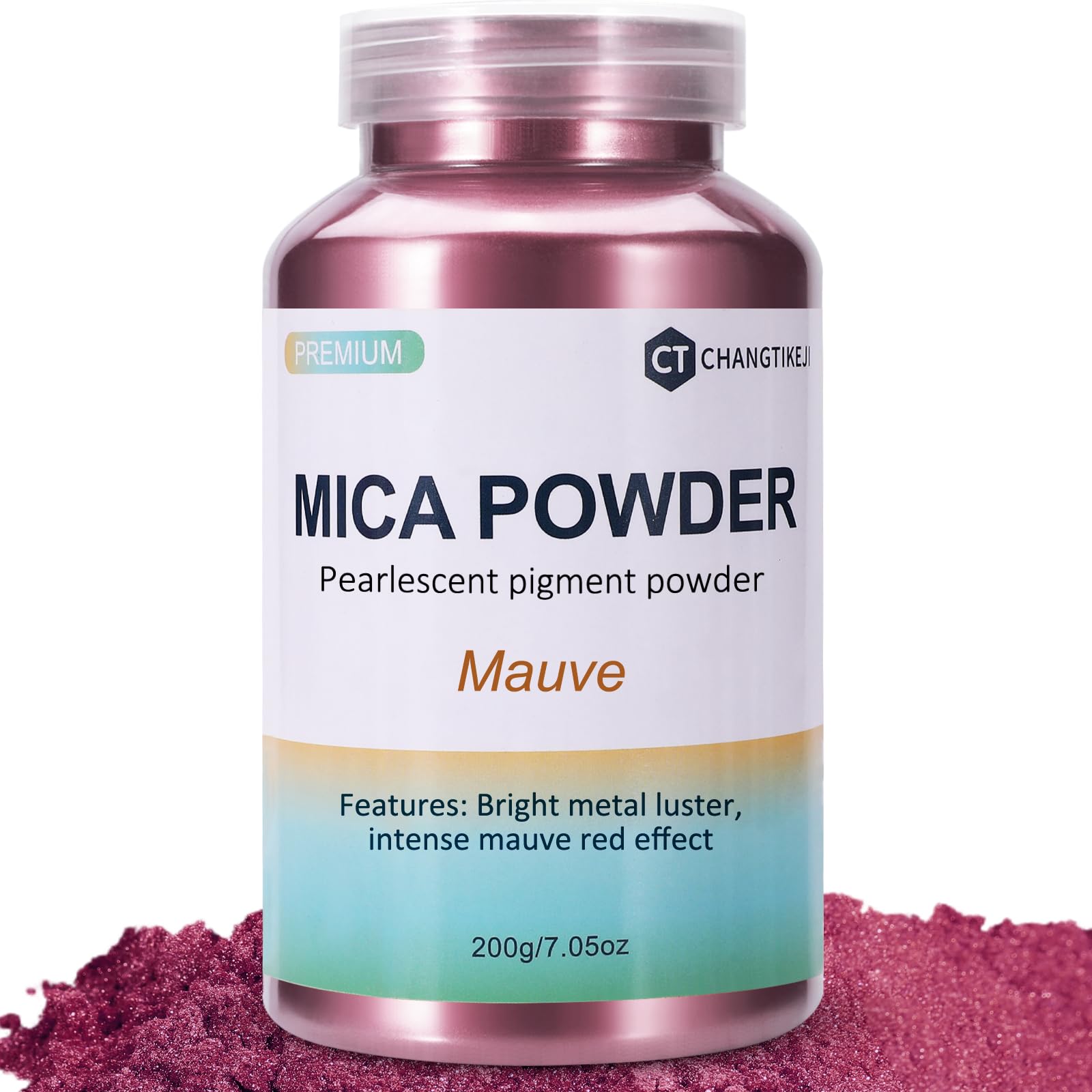
Mica powder has become a staple in craft and cosmetics circles, and the 200g jar format is increasingly common for people who go through pigment quickly. This particular offering is a mauve-toned mica sold in a single large jar rather than a set of small baggies. The size alone makes it worth a closer look, since most craft-store mica comes in 5g or 10g packets that disappear after a few projects. Whether the larger format actually serves you depends heavily on how often you work with colorants.
The product is positioned for a wide range of uses: epoxy resin, lip gloss, paint, dye, soap making, nail polish, candle making, and bath bombs. That list is broad, and not every application is equally well served by a single pigment. In practice, the most common uses are resin casting and cold-process or melt-and-pour soap, where mica provides both color and, in some cases, a pearlescent shimmer. Cosmetics applications like lip gloss and nail polish are possible but come with more caveats, which are worth addressing directly.
In terms of functional characteristics, mica is a mineral-based pigment, and this one is a mauve shade, meaning a muted purple-pink with a soft, dusty quality rather than a vivid magenta. The 200g quantity is substantial. For resin users, that translates to many batches, since typical usage is a small fraction of a percent by weight. For soap makers, the same holds true, though usage rates are higher in opaque soap bases. The jar format is practical for scooping and resealing, and mica powders generally have a long shelf life if kept dry and out of direct sunlight.
One of the more realistic limitations involves color payoff and consistency. Mica pigments are not all created equal, and a mauve tone can look quite different depending on the medium. In clear epoxy, the shimmer tends to read more strongly, while in white or opaque soap bases the color may appear lighter and less saturated than expected. Users often need to use more than they anticipate to achieve a deep mauve, which cuts into the apparent value of the large jar. There is also the matter of clumping; mica powders can be prone to clumping if not sifted or mixed into a small amount of a carrier liquid before being added to a batch. This is not unique to this product, but it is a practical hurdle for beginners.
Another consideration is the cosmetic-grade question. The product listing mentions lip gloss and nail polish, which implies skin contact. Not all mica powders sold for craft use are certified cosmetic grade, and even cosmetic-grade micas should be used with attention to particle size and inhalation risk. Micas are generally considered safe for external cosmetic use, but the fine dust is a respiratory irritant, and a mask is advisable when handling larger quantities. Buyers intending to use this in lip products should verify the supplier’s safety documentation rather than relying on the product title alone. This is a meaningful trade-off: the large jar is economical, but it does not automatically mean the pigment is suited for all the uses listed.
Compared with liquid colorants or oxide pigments, mica offers a distinct shimmer that oxides cannot replicate, but it also provides less opaque, solid color. For soap makers who want a flat, uniform mauve, an oxide or a liquid gel tone may be a better fit. For resin artists who want a pearlescent effect, mica is the appropriate category. The comparison matters because the product’s marketing spans both worlds, and buyers should pick based on the effect they want rather than the label.
Who is this for? It suits frequent crafters, small-batch soap makers, and resin hobbyists who already know they like working with mica and want a larger, cost-effective quantity of a single shade. It also works for someone building a palette who wants a muted mauve as a base or blending color. Who is it not for? Casual users who make one or two projects a year may find 200g excessive, as the powder will likely outlast their interest. Cosmetics makers who need fully documented, batch-tested ingredients should look for suppliers that provide clear safety data. And anyone expecting a vivid, high-opacity purple may be disappointed by the softer, shimmer-driven character of mica.
Overall, this is a practical bulk option for a specific, muted color. The large jar is the main draw, and the mauve tone is versatile for blending. The caveats around cosmetic use, clumping, and color variation across mediums are not dealbreakers, but they are the kind of details that separate a satisfying purchase from a frustrating one. Buyers who understand mica’s behavior will get the most from it; those expecting a one-jar-fits-all pigment may need to adjust expectations.