
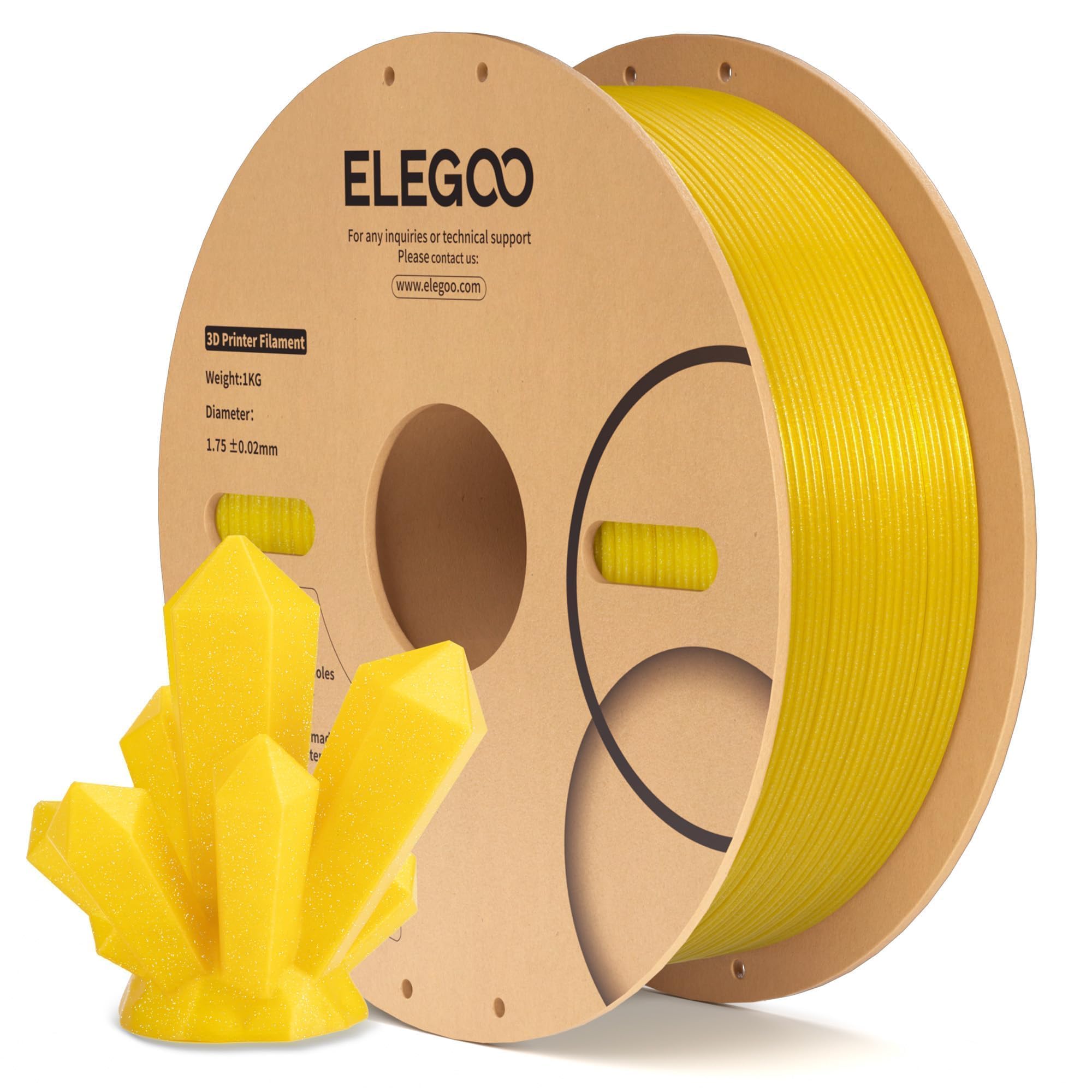
ELEGOO’s Sparkle Gold Yellow PLA is a 1.75mm filament sold in 1kg spools, aimed at hobbyists who want decorative prints with a metallic-looking sheen rather than functional parts. The color sits somewhere between a warm gold and a muted yellow, and the sparkle comes from fine particulate mixed into the plastic. That detail matters because it affects both how the filament prints and what you should expect from the finished surface.
In practice, this filament is most often used for display pieces, cosplay props, seasonal decorations, and small gifts where appearance carries more weight than mechanical strength. A 1kg spool is a reasonable amount for that kind of work; it is enough for several medium-sized models without committing to a bulk purchase. The 1.75mm diameter is the common standard and fits the vast majority of desktop FDM printers, so compatibility is rarely an issue as long as your printer handles standard PLA temperatures.
Functionally, the filament behaves like conventional PLA. ELEGOO lists a print temperature range in the usual 190–220°C band and recommends a heated bed around 50–60°C, though many users will find adhesion fine on bare glass or PEI at the lower end. It does not require an enclosure, and it prints on direct-drive and Bowden setups alike. The sparkle additive is the main variable: because the particles are dispersed through the material, the surface finish tends to hide layer lines better than plain glossy PLA, which is one reason people gravitate toward it for decorative work.
That same additive is where the trade-offs begin. Sparkle and metallic filaments are generally more abrasive than standard PLA, and while this particular product is not marketed as a hardened-nozzle requirement, repeated use will wear a brass nozzle faster than plain filament would. If you print a lot of it, a hardened steel nozzle is a sensible precaution. The particles can also make the filament slightly more brittle on the spool, so aggressive bends or a poorly routed filament path can lead to snapping, particularly toward the end of a spool where the curl is tighter.
Print quality is good but not transformative. Dimensional accuracy is in line with what ELEGOO generally delivers, and most users can expect clean walls and reasonable bridging with normal PLA settings. The sparkle effect is subtle under diffuse indoor light and becomes more pronounced in direct light or sunlight; anyone expecting a bright, glittery finish should temper expectations. Stringing and oozing behave like standard PLA, so retraction tuning still applies. Layer adhesion is adequate for decorative parts but this is not a filament to choose for load-bearing brackets or parts that see heat.
Compared with alternatives, the choice usually comes down to finish versus predictability. Standard PLA in a solid color is cheaper, prints with fewer nozzle concerns, and is easier to color-match across spools. Specialty filaments such as silk PLA offer a shinier, more reflective look but can be fussier about temperature and layer adhesion. Sparkle PLA like this one sits in the middle: more visually interesting than basic PLA, less demanding than silk, but still carrying the abrasion caveat that plain filament does not. PETG is the other common comparison point, and it wins on toughness and heat resistance, though it does not offer this kind of decorative finish and is harder to dial in.
A few practical expectations are worth setting. Spool winding quality varies across the hobby filament market, and while ELEGOO is generally consistent, it is still worth watching the first few meters for tangles. Color consistency between spools is usually close but not guaranteed, which matters if you are printing a multi-part model across two spools. The 1kg weight is nominal including the spool, so actual filament is somewhat less, as with nearly all brands.
This filament suits makers printing decorative objects, props, gifts, and display models who want a finish that reads as more than flat color and who are prepared to accept a little extra nozzle wear. It is a poor fit for anyone printing functional or structural parts, for users running a printer with a delicate or very small nozzle that could clog on particulates, or for buyers who need exact color matching across a large project. Hobbyists on a tight budget may also find standard PLA a better value if the sparkle finish is not essential to the design.