
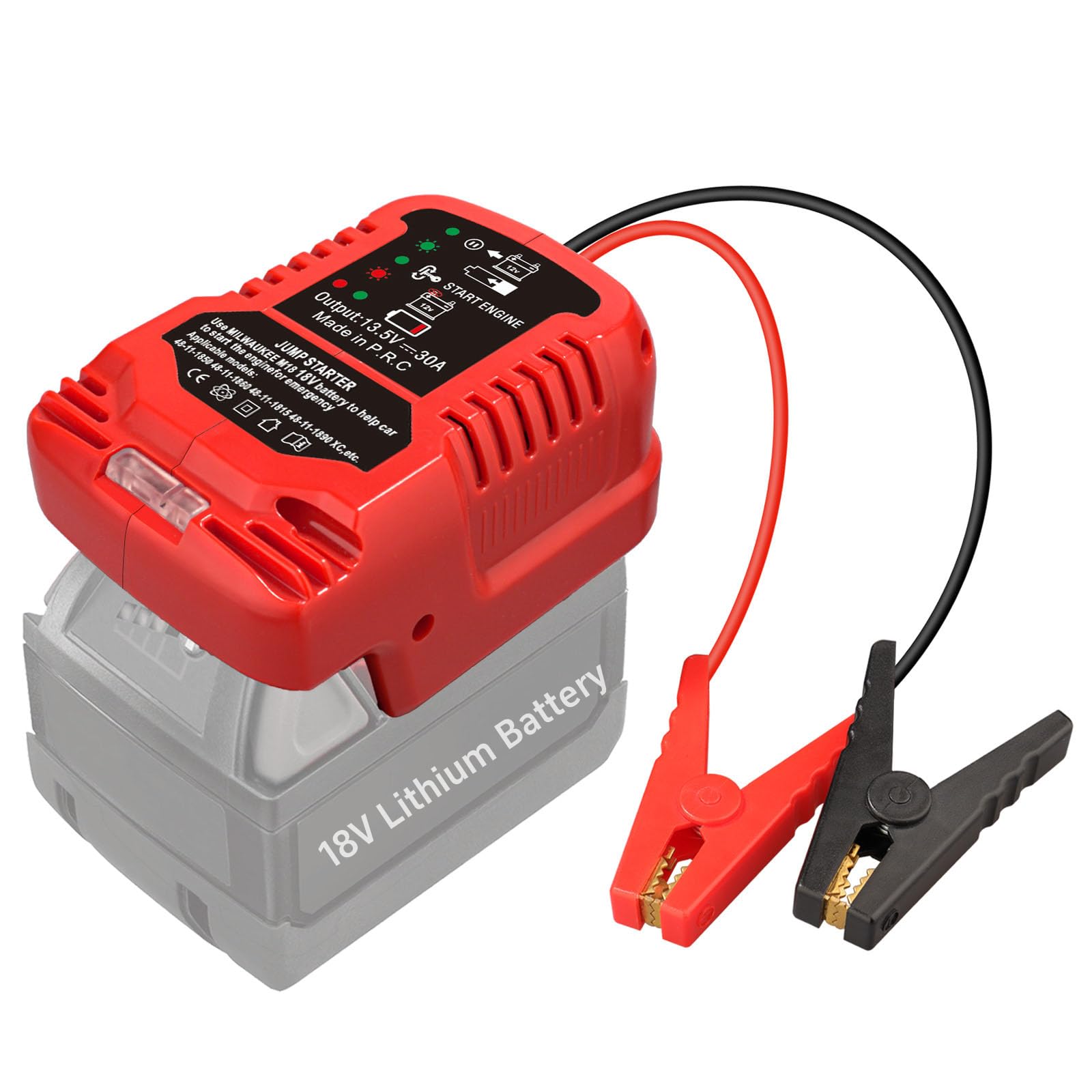
If you already own a Milwaukee M18 power tool battery, a jump starter adapter like this one seems like a smart way to avoid carrying a separate, bulky jump pack. The idea is simple: plug your 18V battery into the adapter, attach the included clamps to your car battery, and use the tool battery’s stored energy to give your vehicle a boost. It’s a niche product that fills a specific gap for people who are already invested in Milwaukee’s ecosystem.
In practice, the adapter works as advertised, but with important caveats. The unit itself is compact and lightweight—it’s essentially a plastic housing with a battery slot, a circuit board, and a pair of heavy-gauge jumper cables with clamps. You slide your M18 battery in until it clicks, connect the red clamp to the positive terminal and the black clamp to a grounded metal part of the engine block (or the negative terminal if you must), and then turn on the ignition. There’s a small button on the adapter that activates the output, and a set of LED lights indicate power status. For a typical 4-cylinder or small V6 engine, the boost is usually sufficient to crank the starter within a few seconds.
One of the key functional features is the built-in protection circuitry. It’s designed to prevent reverse polarity, over-current, and short circuits—critical when you’re dealing with a car battery and a lithium-ion tool battery. The clamps are sturdy and have a good grip, and the cable length is adequate for most engine bays. The adapter also has a USB port, which is a handy addition for charging a phone or tablet in an emergency, though it’s not a fast charger.
However, there are trade-offs you need to consider. The most obvious is that the adapter doesn’t include a battery—you must supply your own M18 battery. That’s fine if you already own one, but it means the total cost is higher if you’re starting from scratch. More importantly, the performance is directly tied to the battery’s charge level and capacity. A fully charged 5.0Ah battery will handle a 3.5L V6 easily, but a 2.0Ah battery with a partial charge might struggle on a cold morning or with a completely dead battery. The adapter is not a substitute for a dedicated jump starter with a high-capacity internal battery, especially for larger engines or multiple jump attempts.
Another limitation is that the adapter relies on the car’s battery being at least somewhat functional. If your car battery is completely dead (e.g., below 2 volts), the adapter may not even power up because it draws a small amount of current from the vehicle battery to detect voltage and enable the output. In that scenario, you’d need to use the bypass mode (if available) or rely on a different solution. Also, the adapter is not weather-sealed, so using it in heavy rain is risky—you’ll want to keep the electronics dry.
Comparing this to a traditional portable jump starter, like a lithium-ion jump pack (e.g., NOCO or Duralast), the differences are clear. A dedicated jump starter is self-contained, has a built-in battery, and often includes features like a flashlight, USB charging, and an air compressor. It’s more expensive upfront but works out of the box without needing to own a specific tool battery brand. The Milwaukee adapter, on the other hand, is cheaper (if you already have batteries) and eliminates the need to keep a separate jump pack charged. But it’s less versatile—you’re tied to Milwaukee batteries, and you can’t use it to jump a car if you forget your battery at home.
Who is this for? It’s ideal for Milwaukee tool users who want a lightweight, space-saving emergency jump starter to keep in the car or workshop. If you’re a contractor or DIYer who already carries M18 batteries for drills and saws, this adapter is a no-brainer addition. It’s also great for occasional use—say, if you left your headlights on and need a quick boost.
Who should avoid it? If you don’t own Milwaukee tools, or if you need a reliable jump starter for a large truck, a diesel engine, or frequent roadside emergencies, you’re better off with a dedicated jump pack. Also, if you prefer a product that works independently of other gear, the adapter’s dependence on a tool battery is a design constraint that might annoy you.
In the end, this adapter is a clever accessory that solves a specific problem for a specific audience. It’s not a miracle device, and it won’t replace a proper jump starter for heavy-duty use. But for the right person, it’s a practical, low-cost addition to their emergency kit. Just remember to keep your M18 battery charged and store the adapter in a dry place.